
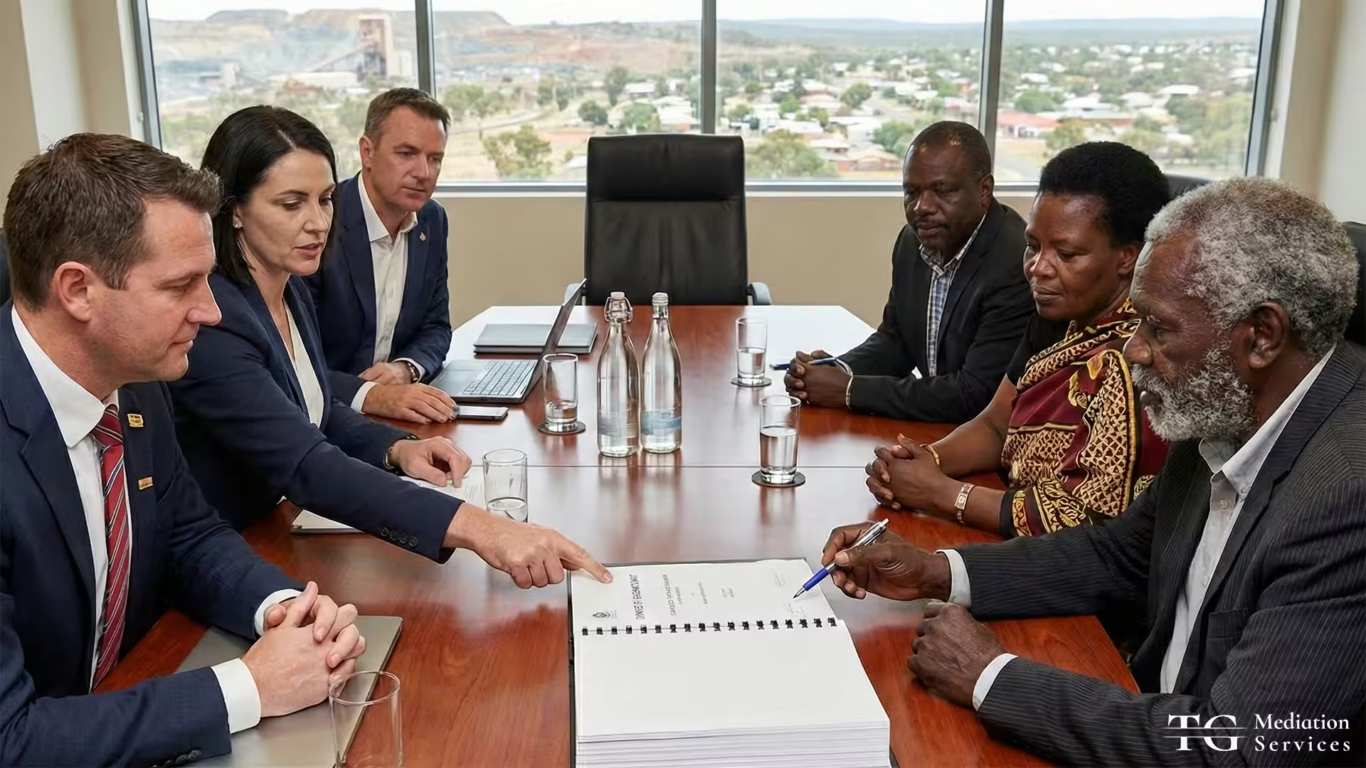
The difference between an IBA and a CBA is less about legal structure and more about context, parties, and the power dynamics that shape negotiation. Impact Benefit Agreements (IBAs) emerged primarily in Canada and Australia as negotiated contracts between extractive companies and Indigenous communities, anchored in Indigenous rights frameworks and the duty to consult. Community Benefit Agreements (CBAs) carry a broader application, used across Africa, Latin America, and increasingly in global mining contexts to formalize benefit-sharing arrangements between companies and any affected community, whether Indigenous or not.
If you are negotiating or advising on a mining project’s community agreement, the terminology you use matters far less than the substance inside the document. Both IBAs and CBAs can be powerful instruments for equitable benefit sharing, or they can be hollow gestures that create the appearance of community protection while delivering little. The distinction lies in understanding which framework fits your specific context, what each instrument does well, and where common pitfalls undermine even well-intentioned agreements.
This guide breaks down the key differences, provides a practical comparison framework, and offers field-tested guidance on selecting, structuring, and negotiating the right agreement type for your project.
Defining the Terms: What IBAs and CBAs Actually Are
Impact Benefit Agreements (IBAs)
An Impact Benefit Agreement is a negotiated contract between an extractive company and an affected Indigenous community. The term originated in Canada, where over 500 such agreements are now in place between mining companies and First Nations, Inuit, and Métis communities, according to the Mining Association of Canada. IBAs are also widely used in Australia and parts of the Arctic. The defining feature of an IBA is its foundation in Indigenous rights, particularly the duty to consult, the principle of Free, Prior and Informed Consent (FPIC), and recognition that benefits should offset or compensate for specific, identified impacts on Indigenous lands, resources, and ways of life.
IBAs typically address employment and training commitments for Indigenous community members, preferential contracting and business development opportunities, direct financial payments (often structured as royalties, per-tonne payments, or equity participation), environmental monitoring with community participation, cultural heritage protection protocols, and governance structures for ongoing relationship management. A critical characteristic of modern IBAs is that they have evolved beyond purely transactional arrangements. Early agreements focused narrowly on compensation payments. Contemporary IBAs increasingly function as comprehensive relationship frameworks that address the full spectrum of impacts and benefits across the project lifecycle.
Community Benefit Agreements (CBAs)
A Community Benefit Agreement is a broader category of formal agreement between a company and affected communities, specifying what the community will receive and what protections will be in place. CBAs are used globally and are not restricted to Indigenous contexts. In several African jurisdictions, they are mandated by law. Sierra Leone’s Mines and Minerals Act of 2009, for example, requires all large-scale mining licence holders to enter into Community Development Agreements (CDAs, a variant of the CBA) with host communities, with mandatory expenditure tied to a percentage of gross revenue. In practice, individual CDAs often commit significantly more than the statutory floor, with some companies voluntarily allocating up to 1% of revenue to community development. Similar legislative mandates exist in Guinea, Mozambique, Nigeria, and South Sudan.
CBAs cover much of the same ground as IBAs: employment, procurement, infrastructure, revenue sharing, environmental protection, and grievance mechanisms. However, they typically arise in contexts where the rights framework is different, involving non-Indigenous communities, communities with contested or unclear land tenure, or situations governed by national mining legislation rather than Indigenous rights instruments.
The terminology varies, but the principle does not change: a well-crafted agreement protects community interests through specific, measurable, enforceable commitments. A poorly crafted one provides the appearance of protection while leaving the community vulnerable.
Side-by-Side Comparison: IBA vs. CBA
The following comparison table highlights the practical distinctions practitioners encounter in the field. These are not rigid categories. Many agreements blend elements of both.
| Dimension | Impact Benefit Agreement (IBA) | Community Benefit Agreement (CBA) |
|---|---|---|
| Primary Context | Canada, Australia, Arctic regions; Indigenous peoples and extractive companies | Africa, Latin America, global; any affected community and extractive companies |
| Legal Foundation | Indigenous rights law, duty to consult, FPIC, constitutional protections, ILO 169 | National mining legislation, regulatory requirements, voluntary negotiation, IFC Performance Standards |
| Parties | Extractive company and Indigenous nation/community (government usually not a direct party) | Extractive company and affected community; government may be party or facilitator |
| Trigger for Negotiation | Indigenous rights and land claims; duty to consult obligations; FPIC requirements | Regulatory mandate (e.g., Sierra Leone, Guinea); licensing conditions; company policy; community demand |
| Scope of Benefits | Compensation for specific impacts on Indigenous lands/resources; revenue sharing; cultural protection; self-determination | Broader community development focus; employment, infrastructure, revenue sharing; social investment; environmental safeguards |
| Revenue Sharing | Common: royalties, per-tonne payments, equity participation, profit sharing | Varies widely: production-based payments preferred; development fund contributions; infrastructure investment |
| Confidentiality | Frequently confidential at Indigenous party’s request; limits public accountability | Varies; African legislated agreements tend toward greater transparency; voluntary agreements often confidential |
| Enforcement Mechanism | Contract law; arbitration clauses; some regulatory linkage to mining approvals | Contract law; regulatory compliance; mining licence conditions; community mobilization |
| Cultural Provisions | Central: sacred site protection, cultural heritage protocols, traditional governance recognition | Less common but increasingly included, particularly where IFC PS7 (Indigenous Peoples) or PS8 (Cultural Heritage) applies |
| Governance Structure | Joint implementation committees; relationship committees; cultural liaison | Joint committees; community development fund boards; multi-stakeholder oversight bodies |
| Duration Alignment | Typically linked to project lifecycle from exploration through closure | Often shorter-term with renegotiation triggers; some legislation mandates periodic review |
What Practitioners Get Wrong: Substance Over Labels
The most common mistake I see in the field is practitioners obsessing over terminology while neglecting substance. A company community relations manager once told me proudly that their project had signed an IBA with the local community. When I reviewed the document, it contained vague commitments to ‘maximize local employment,’ an infrastructure investment clause with no operational budget, and a grievance mechanism that required complaints to be filed in English in a community where fewer than 15% of adults were literate in English. The label said IBA. The content said public relations exercise.
Whether you call your agreement an IBA, CBA, CDA, Social Compact, or Memorandum of Understanding, the label is irrelevant without these non-negotiable elements:
- Specific, measurable commitments with timelines. ‘Priority for local hiring’ means nothing. ‘40% of non-technical positions filled by community members within three years, verified by quarterly reporting’ means something.
- Enforcement mechanisms with real consequences. Every significant provision needs reporting requirements, independent verification rights, and graduated consequences for non-compliance. Commitments without enforcement are aspirations.
- Revenue sharing based on production, not profits. This lesson comes from painful field experience. Profits are easily manipulated through transfer pricing, management fees, and intercompany loans. A percentage of gross revenue or a fixed payment per tonne extracted is transparent and verifiable.
- Successor clauses. Mining projects change hands. An agreement that binds only the original signatory is worthless when the project is sold to a new operator. Every agreement must bind successors.
- Renegotiation triggers. A Zambian community signed a CDA with a copper mining company in 2002 when copper prices were low. When prices surged, the community’s fixed-payment agreement became inadequate relative to the value being extracted. Build in scheduled reviews, price thresholds, and production increase triggers.
When to Use Each Agreement Type: A Decision Framework
Choosing between an IBA, CBA, or hybrid approach depends on context, not preference. Here is the practical decision framework I use when advising mining companies and community representatives:
Use an IBA Framework When:
- The affected community holds recognized Indigenous rights, land title, or treaty rights that create a legal duty to consult and accommodate.
- FPIC requirements apply under national law, IFC Performance Standard 7, ILO Convention 169, or project lender requirements.
- Cultural heritage, sacred sites, or traditional governance systems require specific protection protocols beyond standard environmental safeguards.
- The community’s relationship to the land is inseparable from cultural identity, requiring the agreement to address not just economic impacts but existential ones.
- The jurisdictional context (Canada, Australia, parts of Latin America) has established IBA precedent and legal infrastructure.
Use a CBA Framework When:
- National mining legislation mandates community development agreements (as in Sierra Leone, Guinea, Nigeria, Mozambique, South Sudan, or Kenya).
- Multiple non-Indigenous communities are affected and need a common agreement structure.
- The primary focus is economic benefit sharing, infrastructure development, and livelihood protection rather than Indigenous rights per se.
- The project is in an African mining context where CDA/CBA frameworks are the established norm and regulatory expectation.
- Government is a party to or facilitator of the agreement, as is common in legislated CDA regimes.
Use a Hybrid Approach When:
- The project affects both Indigenous and non-Indigenous communities, requiring differentiated agreements with shared governance elements.
- A legislated CBA requirement exists alongside Indigenous rights obligations (increasingly common in transitional mineral projects).
- The community’s situation does not fit neatly into either category, for example, pastoralist communities in East Africa with land rights that fall outside formal Indigenous recognition but carry comparable significance.
Lessons from the Field: What Actually Determines Agreement Success
Having advised on agreement negotiations across multiple African jurisdictions and reviewed agreements from Canadian, Australian, and Latin American mining contexts, I can tell you that the factor most predictive of agreement success is not the agreement type. It is the quality of the negotiation process that produced it.
The Process Determines the Outcome
The Newmont Ahafo Gold Mine CBA in Ghana is widely cited as a model community benefit agreement. What is less often discussed is that the agreement followed a three-year capacity-building and negotiation process. The community had time to organize, access independent technical and legal advice, identify their priorities, and negotiate from an informed position. Contrast this with template CDAs in parts of West Africa that were presented to rural communities for signature without meaningful consultation or explanation. The documents looked similar. The outcomes were fundamentally different.
Research from Simon Fraser University’s Impact Benefit Agreement database confirms this pattern across Canadian IBAs. Agreements where communities had access to independent legal counsel, adequate time for traditional decision-making processes, and financial support for negotiation consistently produced stronger outcomes than those negotiated under time pressure with significant power imbalances. This finding holds regardless of whether the agreement is called an IBA or a CBA.
Confidentiality: The Double-Edged Sword
One important structural difference between IBAs and CBAs deserves particular attention. In Canada, IBAs are frequently kept confidential at the Indigenous party’s request, often to protect sensitive financial terms from influencing other negotiations. This practice has legitimate protective rationale, but it also limits public accountability and makes it difficult for other communities to learn from existing agreements.
African CDA frameworks increasingly push toward transparency. Sierra Leone’s legislative model, for instance, includes public reporting requirements. This transparency creates accountability but can also expose communities to pressure from neighbouring groups or government actors seeking a share of benefits.
There is no universally correct answer on confidentiality. The right approach depends on the specific power dynamics, the community’s vulnerability, and whether transparency serves or undermines community interests.
The Enforcement Gap
Both IBAs and CBAs suffer from a common failure: weak enforcement. A commitment without a monitoring mechanism and consequences for non-compliance is merely an aspiration. I advise every client, whether company or community, to design accountability mechanisms for what I call the ‘weakest moment’: not the signing ceremony when goodwill is highest, but six months later when a new executive is focused on quarterly earnings and the community’s negotiation advisor has moved on.
Effective enforcement requires regular public reporting against specific benchmarks, independent verification triggers at defined milestones, graduated consequences (formal notice, joint committee review, external audit, suspension of reciprocal obligations, and legal remedies as a last resort), and clear escalation pathways accessible to the community without prohibitive cost.
This enforcement architecture applies equally to IBAs and CBAs.
The Growing Importance of CBAs in African Mining
Africa’s mineral-rich nations are increasingly legislating community benefit sharing requirements, driven by recognition that voluntary corporate social responsibility programs have failed to deliver equitable outcomes. This legislative trend is reshaping how agreements are negotiated, implemented, and enforced across the continent.
A 2017 review published in the Journal of Energy and Natural Resources Law by Nwapi identified six African countries with mining legislation mandating CDAs: Guinea, Kenya, Mozambique, Nigeria, Sierra Leone, and South Sudan. Since that review, Ghana’s Minerals Commission has announced its intent to require community development agreements, and Tanzania and Zimbabwe have introduced benefit-sharing frameworks spanning mining and renewable energy.
For mining executives and ESG leaders operating in these jurisdictions, this means community agreements are no longer optional goodwill gestures. They are regulatory obligations tied to mining licence conditions. Non-compliance can trigger licence suspension, operational disruption, and significant reputational risk.
Yet legislation alone does not guarantee quality. Sierra Leone’s experience illustrates the challenge: despite comprehensive CDA provisions in its 2009 Mining Act, implementation lagged significantly, and as of recent assessments, no CDAs fully satisfying the Act’s requirements had been signed. The gap between legislative intent and practical implementation is where skilled negotiation support makes the critical difference.
Choosing Your Path: Practical Next Steps
Whether your project requires an IBA, CBA, CDA, or a hybrid framework, the principles of effective agreement-making remain constant. Specificity is everything. Vague commitments protect no one. Every key term must be precisely defined: who counts as ‘local,’ what constitutes ‘equivalent’ land, what ‘reasonable’ means in context. Revenue sharing should be based on production volumes, not manipulable profit figures. Enforcement mechanisms must be designed for the moment when commitment is lowest, not highest. And successor clauses must ensure obligations survive ownership changes.
The unique challenge of community agreements in extractive industries is that they must function across decades. A mining project’s lifecycle can span 20 to 50 years. Management teams change. Commodity prices fluctuate. Community leadership evolves. Political contexts shift. The agreement must be robust enough to survive all of these transitions while remaining adaptable enough to respond to changed circumstances through structured renegotiation.
This is where generalist legal advice falls short. Drafting an agreement that works on paper is straightforward. Designing one that works in practice, across power asymmetries, cultural differences, evolving regulatory environments, and the inherent tensions of extractive development, requires deep understanding of both mediation process and mining industry realities.
Need Expert Support for Your Agreement Negotiation?
Whether you are a mining company seeking to negotiate a robust IBA or CBA, a community preparing for benefit-sharing discussions, or an ESG team ensuring your agreements meet international standards, I bring the intersection of mediation expertise, stakeholder engagement experience, and deep extractive industry knowledge that this work demands. Schedule a consultation to discuss your project’s specific agreement needs and develop a negotiation strategy grounded in field-tested best practice.
Frequently Asked Questions
Q: What is the main difference between an IBA and a CBA?
An IBA is specifically negotiated between an extractive company and an Indigenous community, grounded in Indigenous rights, the duty to consult, and FPIC. A CBA is a broader instrument used between companies and any affected community, often mandated by national mining legislation. Both can contain similar provisions; the difference lies in the legal foundation, the parties involved, and the rights framework.
Q: Are IBAs legally enforceable?
Yes. IBAs are private contracts enforceable under contract law. However, enforcement depends on the specificity of provisions and the accessibility of dispute resolution mechanisms. Vague commitments are difficult to enforce regardless of the agreement label.
Q: Which African countries require community benefit agreements by law?
As of 2026, Sierra Leone, Guinea, Mozambique, Nigeria, South Sudan, and Kenya have mining legislation mandating community development agreements. Ghana and Tanzania are implementing similar frameworks, and Zimbabwe has introduced benefit-sharing provisions spanning mining and renewable energy.
Q: Can a mining project have both an IBA and a CBA?
Yes. Projects affecting both Indigenous and non-Indigenous communities may negotiate differentiated agreements. This is increasingly common in transitional mineral projects where Indigenous rights and broader community development obligations overlap.
Sources
1. Mining Association of Canada. (2023). “Mining-Indigenous Relationship Agreements.“
2. Gunton, T., Gunton, C., et al. (2021). “The role of community benefit agreements in natural resource governance and community development: Issues and prospects.” Resources Policy, 72.
3. Nwapi, C. (2017). “Legal and institutional frameworks for community development agreements in the mining sector in Africa.” Journal of Energy & Natural Resources Law, 35(4).
4. Adebayo, B. & Werker, E. (2021). “How much are benefit-sharing agreements worth to communities affected by mining?” Resources Policy, 71.
5. World Bank. (2016). “Development from the ground up? Mining community development agreements in Sierra Leone.” World Bank Governance Blog.


 EN
EN  FR
FR  PT
PT