
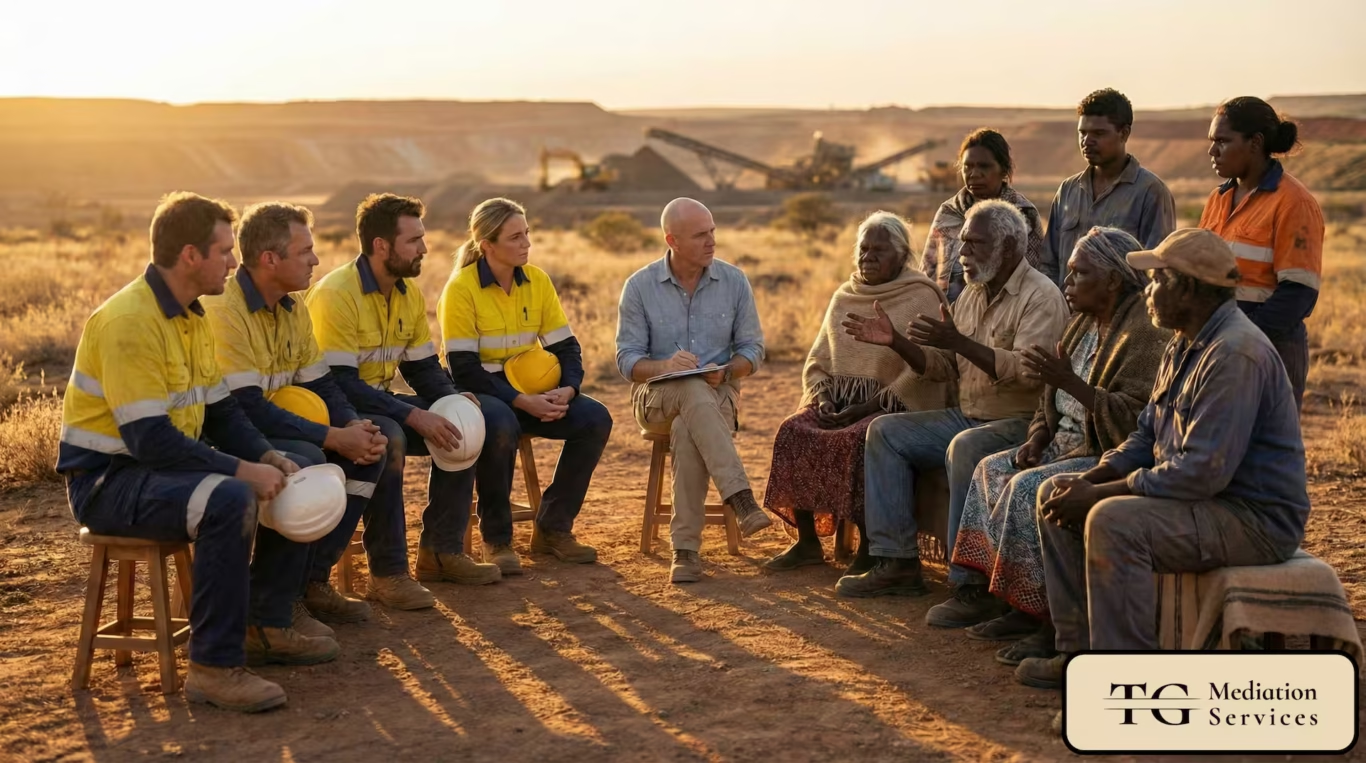
After fifteen years of working as a mediator, and many years on the ground in extractive industries, from gem mines in Zambia and Mozambique to lithium projects in Portugal, I have witnessed a recurring pattern. Companies arrive with legal permits, environmental impact assessments, and technical expertise. They run the risk of having to leave, years later, without having broken ground. The missing element is rarely geological or financial. It is relational. This is what happened recently with Rio Tinto when they decided to put their Serbian Jadar underground Lithium mine into care and maintenance rather than push forward with the next phases of the project.
Social license to operate (SLO) has become one of the most consequential concepts in the mining sector, yet it remains widely misunderstood. It is not a permit you can apply for or a box you tick in a stakeholder engagement plan. Social license is the ongoing, dynamic acceptance that a community grants, and can revoke, based on how a company behaves over time. It exists on a spectrum from grudging tolerance to active partnership, and it can shift in either direction with remarkable speed.
This article offers practical guidance on how mediation, properly understood and strategically deployed, can help companies earn and maintain social license. The principles apply across extractive industries and infrastructure projects, though I will draw primarily from mining contexts where the stakes, both for companies and communities, are often highest.
Understanding What Social License Actually Requires
The first mistake companies make is treating social license as something to be obtained rather than earned. This framing leads to transactional approaches: compensation packages calculated by hectare, community investment funds administered at arm’s length, public relations campaigns designed to manufacture consent. These tactics occasionally produce short-term compliance. They rarely produce genuine acceptance.
Communities grant social license when they believe three things to be true. First, that they have been genuinely heard and their concerns taken seriously. Second, that the benefits and burdens of a project are being distributed fairly. Third, that they have meaningful influence over decisions that affect their lives. Notice that none of these conditions can be satisfied through unilateral action by the company. Each requires dialogue, and dialogue requires structure.
This is where mediation becomes essential, not as a mechanism for resolving disputes after they have escalated, but as a framework for building the relationships that prevent escalation in the first place.
Why Traditional Engagement Falls Short
Standard community engagement practice in the mining industry typically follows a predictable pattern. Companies conduct stakeholder mapping exercises, hold public information sessions, establish grievance mechanisms, and negotiate directly with community representatives on issues like land access and compensation. Each of these activities has value, but none of them, individually or collectively, creates the conditions for genuine acceptance.
The fundamental problem is structural. When a company negotiates directly with a community, even with the best intentions, the power imbalance is enormous. The company has lawyers, technical experts, financial resources, and time. The community typically has none of these advantages, and its representatives may face pressure from multiple directions: from company negotiators, from their own constituents, from local politicians with their own agendas, and from broader civil society groups with ideological commitments that may not align with local interests.
I have seen negotiations where community leaders agreed to terms they did not fully understand, only to face accusations of betrayal from their own members months later. I have seen companies celebrate signed agreements that collapsed the moment ground was broken, because the process that produced those agreements had excluded or alienated key stakeholder groups. The paper victory became an operational disaster.
Mediation addresses these structural problems by introducing a neutral third party whose role is to ensure that all voices are heard, that power imbalances are acknowledged and mitigated, and that agreements reflect genuine understanding rather than coerced consent.
The Five Functions of Mediation in Social License
In my practice, I have come to understand mediation as serving five distinct functions in the social license context, each corresponding to a different type of challenge that companies face.
Processing Legacy Grievances
Every community where mining has occurred, or where communities have experience of extractive industries elsewhere, carries collective memories. Some of these memories are of specific harms: displacement, pollution, broken promises, deaths. Others are more diffuse: a general sense that mining companies cannot be trusted, that they take more than they give, that they leave destruction in their wake.
These legacy grievances are often not about the current company at all. But they shape community perceptions and they must be addressed before productive engagement can occur. In Mozambique, I spent months facilitating conversations about events that had occurred decades earlier, at a very different phase of the project, with a different kind of management approach. The company assumed ownership and responsibility for these historical harms, which is a great step in the right direction, but they also inherited them as part of the social landscape.
Mediation creates a structured space for these grievances to be expressed, acknowledged, and processed. The company does not necessarily need to accept blame for what others did. It does need to demonstrate that it understands the community’s history and that it is committed to operating differently.
Surfacing Hidden Concerns
Communities rarely articulate their full range of concerns in public meetings or formal negotiations. Some concerns feel too small to mention. Others feel too large, too fundamental, too likely to provoke dismissal. Still others involve internal community dynamics that leaders prefer not to expose to outsiders.
Skilled mediators know how to create the conditions for these hidden concerns to emerge. Private conversations, conducted with appropriate confidentiality, often reveal the real obstacles to agreement. A community that officially opposes a project on environmental grounds may actually be most concerned about which families will receive employment opportunities. A farmer who refuses to negotiate land access may be primarily worried about how the compensation payment will affect his standing within his extended family.
These concerns cannot be addressed if they are not surfaced. And they are unlikely to be surfaced in direct negotiations where the community feels it must present a unified front to a more powerful counterpart.
Aligning Expectations with Reality
One of the most reliable predictors of future conflict is the gap between what a community expects from a mining project and what the project can realistically deliver. Communities often arrive at the negotiating table with inflated expectations, shaped by company marketing materials, by promises made during exploration phases, by politicians seeking credit, or simply by hope for transformative change after years of economic marginalization.
Companies, meanwhile, often underestimate what communities need in order to feel that they have received fair value. The technical calculation of land value based on agricultural productivity misses everything that land means to people: identity, heritage, security, social standing.
Mediation provides a forum for these different frameworks of value to be made explicit and examined. A good mediator helps both parties understand what the other actually wants, not what they assume the other wants, and guides them toward agreements that account for different definitions of fairness.
Managing Internal Community Conflicts
This is perhaps the least understood function of mediation in the social license context. Communities are not monolithic. They contain competing interests, historical rivalries, generational tensions, and distributional conflicts. When a mining project arrives, these internal divisions often intensify as different factions compete for access to anticipated benefits.
Companies frequently make the mistake of negotiating with whoever presents themselves as community leaders, without understanding the internal dynamics well enough to know whether those leaders actually speak for the community. The result can be agreements that a significant portion of the community never accepted, followed by protests from the excluded groups, followed by accusations that the company engaged in bad faith.
Mediators can help by facilitating intra-community dialogue before or alongside company-community negotiations. This takes time and requires cultural competence, but it produces more durable outcomes than agreements negotiated with unrepresentative leaders.
Creating Durable Governance Structures
The final function of mediation is helping parties design governance structures that can manage their relationship over the life of the project. Mining projects often operate for decades. The individuals who negotiated initial agreements will leave, retire, or die. Community leadership will change. Company management will turn over. If the relationship depends entirely on personal relationships between specific individuals, it will not survive these transitions.
Mediated processes can help parties create joint committees, monitoring mechanisms, regular review processes, and escalation pathways that institutionalize the relationship. These structures need to be designed carefully, with attention to questions like: Who has authority to make decisions? How are disputes resolved? What information will be shared, and how often? What happens when one party believes the other has violated the agreement?
Getting these details right at the outset is far easier than trying to retrofit governance structures after conflict has already erupted.
Practical Guidance for Implementation
If you are a community relations professional, a project manager, or an executive responsible for social performance, here are concrete steps you can take to integrate mediation into your approach to social license.
Begin before you need it. The best time to engage a mediator is when you do not have an active dispute. Bring in a skilled facilitator during the project planning phase to conduct stakeholder mapping, identify potential conflict triggers, and design engagement processes. This investment is trivial compared to the cost of a six-month project delay caused by community opposition.
Choose mediators with relevant expertise. Mediation in the extractive industries context requires a specialized skill set. Look for practitioners who understand both the technical aspects of mining and the social dynamics of affected communities. Language capability is essential, but cultural competence goes deeper than language. The mediator needs to understand the community’s decision-making processes, its internal hierarchies, and the ways that power operates in that specific context.
Give the process adequate time. Communities operate on different timelines than corporations. Decisions that affect generations cannot be rushed to fit a project schedule. Pressure tactics that might work in commercial negotiations are counterproductive in community relations contexts. They may produce signed agreements, but those agreements will not hold.
Build mediation into your formal agreements. Include mediation clauses in community benefit agreements, land access agreements, and memoranda of understanding. Specify that disputes will be submitted to mediation before litigation. Create standing mediation panels with pre-agreed processes and trusted neutrals.
Train your team. Community relations staff should have basic mediation skills, not to serve as neutral mediators themselves, but to recognize when mediation is needed, to prepare effectively for mediated processes, and to support rather than undermine the work of professional mediators when they are engaged.
Document outcomes and follow through. Mediated agreements are only as valuable as the implementation that follows. Create clear records of what was agreed, assign responsibility for each commitment, establish timelines, and build in verification mechanisms. Nothing destroys trust faster than broken promises.
A Word About Authenticity
I want to close with a point that cannot be reduced to process or technique. Mediation is a tool, but it is not magic. It cannot manufacture trust where the underlying relationship is exploitative. It cannot compensate for projects that genuinely harm communities more than they benefit them. It cannot make an unjust arrangement just.
Communities are remarkably perceptive about corporate intentions. They have had decades of experience with companies that spoke the language of partnership while practicing extraction. They can tell the difference between genuine engagement and sophisticated manipulation. If a company views mediation primarily as a risk management tool, as a way to neutralize opposition rather than build genuine relationships, communities will eventually figure this out. And when they do, the backlash will be severe.
The companies that have earned durable social license, the ones that operate with community support through economic downturns and management transitions and political changes, are the ones that approached the relationship with genuine respect. They listened not because it was strategic but because they cared about what communities had to say. They shared benefits not because it was required but because they believed it was right. They were honest about what they could and could not deliver, even when honesty was uncomfortable.
Mediation can help structure these conversations. It can create space for difficult truths to be spoken and heard. It can guide parties toward agreements that reflect their actual interests. But it works best when deployed by people who genuinely want it to work, who see the community not as an obstacle to be managed but as a partner whose wellbeing matters.
That orientation cannot be taught. But for those who possess it, mediation offers a powerful set of tools for translating good intentions into sustainable outcomes. In an industry where social license has become the difference between success and failure, those tools are no longer optional.
I am a bridge-builder across borders, a multilingual mediator and international legal consultant who transforms complex disputes into sustainable solutions. With authenticity and precision, I guide stakeholders through conflict in the extractive industries, energy sector, and cross-border commerce, bringing 15+ years of deep expertise to every challenge. Whether teaching the next generation of dispute resolution professionals, advising on high-stakes agreement, or mediating between communities and corporations, I operate with one principle: genuine partnership yields lasting resolution.


 EN
EN  FR
FR  PT
PT