

Shuttle diplomacy in mining conflicts is the process of a mediator moving physically or virtually between separated parties, carrying proposals, testing reactions, and building incremental agreement when face-to-face dialogue has broken down or never been viable. It is not a fallback. In many mine-community disputes, particularly those that have escalated beyond the mid-stages of conflict intensity, shuttle diplomacy is the only mediation technique that preserves enough psychological safety for both sides to engage at all.
If you are a community relations manager watching protests intensify, a mediator called into a dispute where the company and community refuse to sit in the same room, or an ESG leader trying to understand why your grievance mechanism has gone silent, this post provides a field-tested methodology for deciding when shuttle diplomacy is appropriate and how to execute it effectively. The techniques described here are drawn from extractive industry practice across African mining contexts and global operations where standard joint-session mediation has reached its limits.
Why Standard Joint Sessions Fail in Mining Disputes
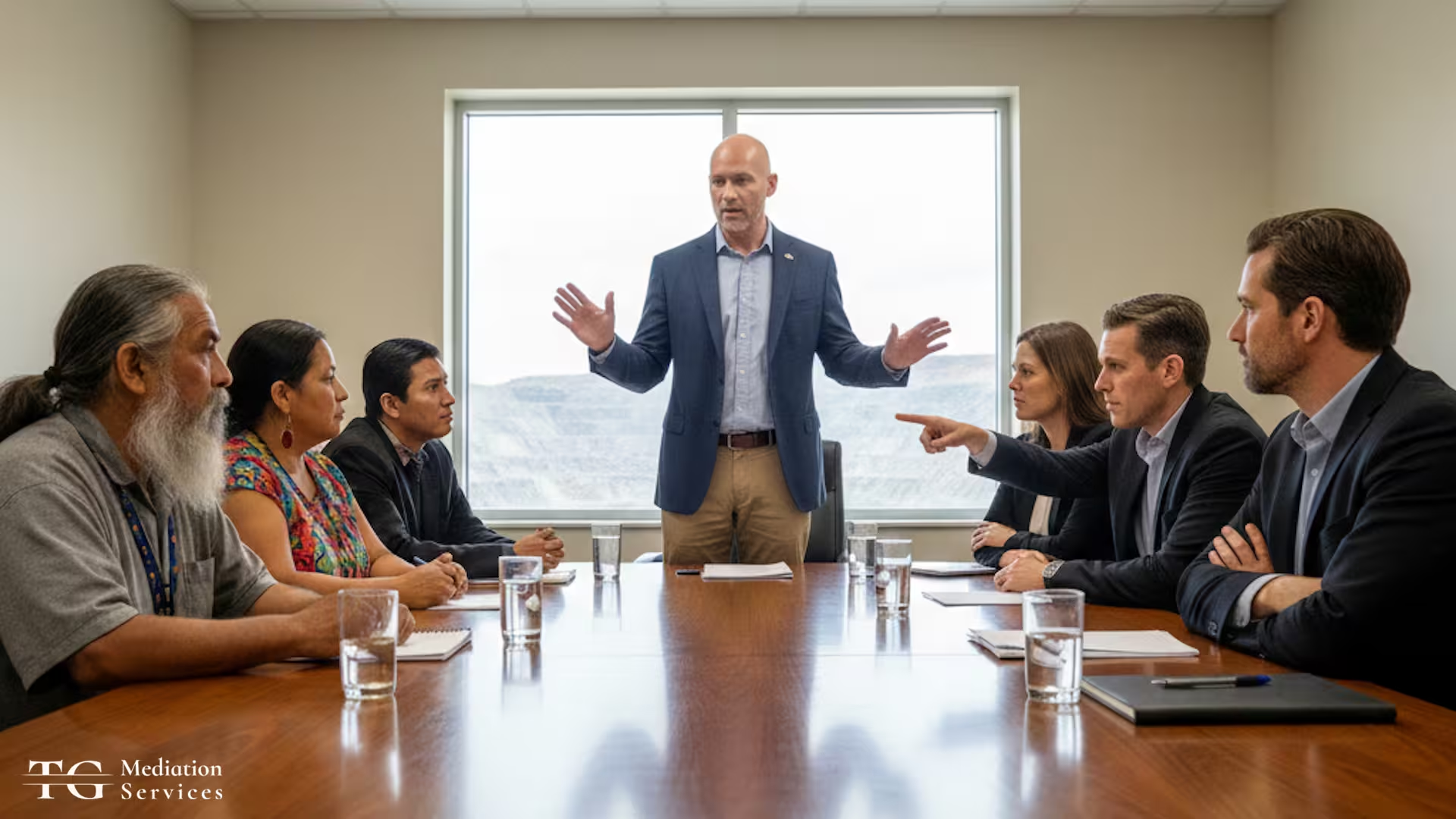
Most mediation training emphasizes joint sessions as the default. Bring parties together, establish ground rules, facilitate dialogue, and work toward resolution. In commercial disputes between parties of roughly equal sophistication, this works. In mine-community conflicts, it often does not, and the reasons go deeper than personality clashes.
The Power Asymmetry Problem
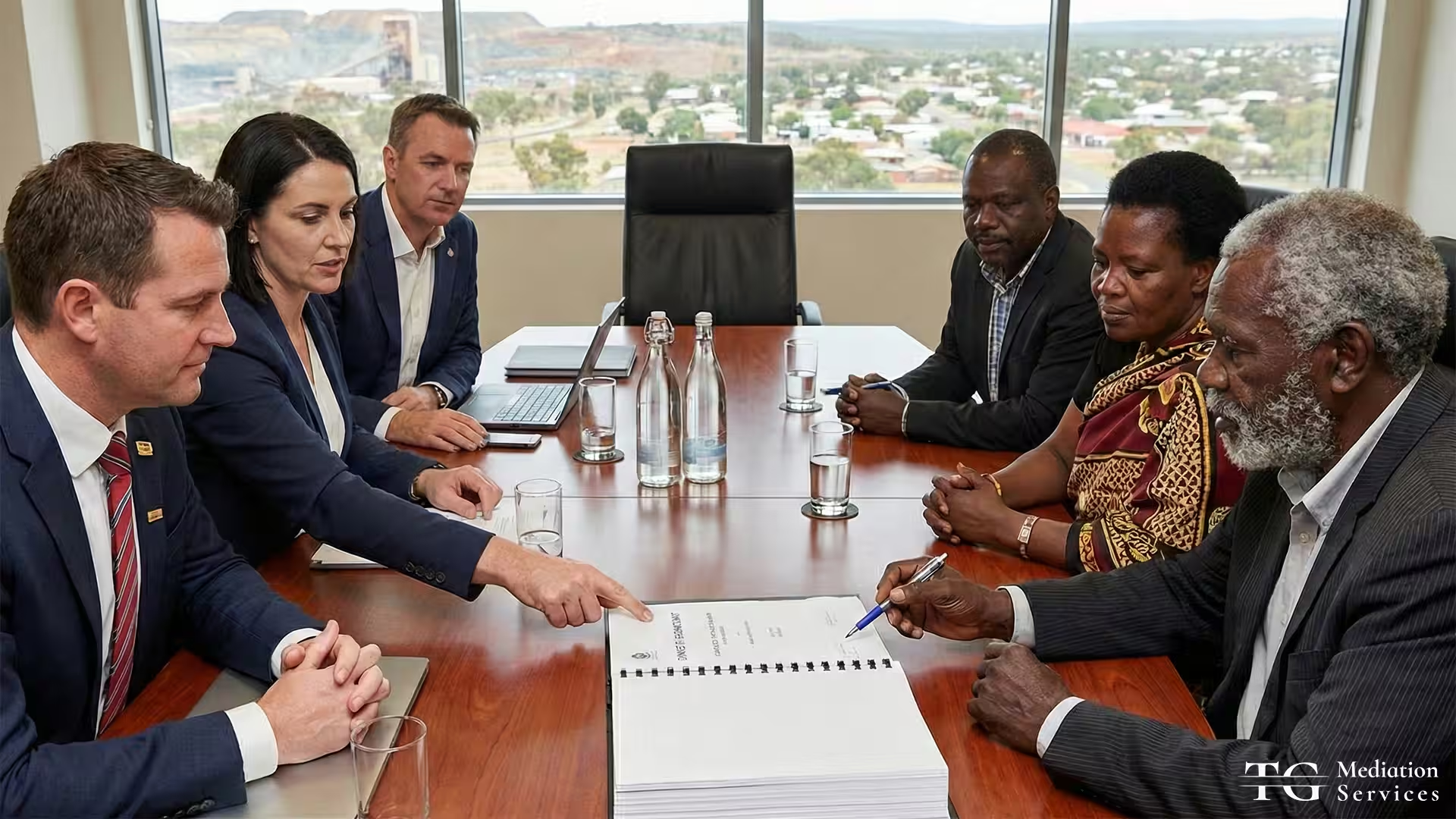
Mining companies arrive at mediation with legal counsel, technical experts, negotiation specialists, and institutional memory stretching back decades. Community representatives often volunteer their time, have limited access to independent advice, and may have never participated in a formal negotiation process. Place these parties across a table from each other and the imbalance becomes a physical force in the room.
The company’s representatives speak in polished corporate language. Community members, particularly in African mining contexts where English or French may be a second or third language, can feel outmatched before the first agenda item is addressed. The experience of sitting opposite someone with more resources, more expertise, and more confidence is not merely uncomfortable. It is silencing.
Shuttle diplomacy addresses this directly. When the mediator meets each party separately, the community can speak in their own language, at their own pace, without performing for an audience they distrust. The company can be candid about constraints they would never reveal in joint session for fear of appearing weak.
When Trust Has Collapsed Entirely
A joint session requires a minimum baseline of trust, not trust in the other party, but trust in the process. When community members have experienced years of broken promises (the half-built school, the water project that was never completed, the employment targets that quietly disappeared), the mere presence of company representatives can trigger what trauma-informed practitioners recognize as a stress response. Rational dialogue becomes biologically impossible.
Consider the well-documented pattern in West African gold mining disputes, where conflicts have sometimes required years of iterative engagement and numerous interim agreements before reaching comprehensive resolution. The early phases of such processes rely heavily on shuttle diplomacy precisely because trust has deteriorated to the point where community members view any company-organized meeting as a tactic for delay or manipulation.
Face-Saving and Public Commitment Traps
This is the dynamic that generalist mediators consistently underestimate. In many African mining communities, traditional leaders have made public declarations about what they will and will not accept. Company executives have reported positions to their boards. Both sides are now trapped by their own rhetoric.
Joint sessions make this worse. Every concession made publicly feels like a defeat. Shuttle diplomacy provides face-saving opportunities that joint sessions cannot. The mediator can present proposals without revealing their source (“I have been thinking about a possible approach”), test reactions before formal offers are made, and allow parties to move toward each other in small steps without the audience that makes flexibility feel like capitulation.
Practitioner Insight: The Power of Unattributed Proposals
Many impasses persist because parties cannot find a way to change position without appearing weak or inconsistent.
Your job as a mediator is to provide face-saving narratives: “New information has emerged,” “Circumstances have changed,” “A creative new option addresses concerns.” Help parties move without losing dignity. Shuttle diplomacy is the format that makes this possible.
Shuttle Diplomacy as a Format for Structured Methodology
Before exploring the protocol, it is important to clarify a fundamental concept: shuttle diplomacy is not an alternative to structured mediation methodology. Rather, it is a delivery format, a way of applying systematic process when parties are too far apart to sit in the same room.
Many practitioners mistakenly treat shuttle diplomacy as an ad hoc process, moving back and forth between parties carrying messages. This approach often produces minimal results. The superior approach is to combine shuttle diplomacy with a structured methodology such as the GROUNDS framework, a seven-phase mediation model that provides the systematic foundation needed for lasting resolution.
The GROUNDS framework comprises seven phases: Groundwork (Phase 0) for preparation and readiness assessment, Rapport (Phase 1) for establishing trust, Organize (Phase 2) for structuring the agenda, Understand (Phase 3) for accessing underlying interests, Navigate (Phase 4) for exploring options creatively, Deliberate (Phase 5) for reality testing and evaluation, and Secure (Phase 6) for formalizing agreement. When applied through shuttle diplomacy, each phase unfolds across separate sessions, allowing the mediator to move between parties while maintaining the logical structure and progression that produces sustainable outcomes.
The protocol described below maps directly to these phases. Shuttle diplomacy becomes the format, while GROUNDS provides the methodology. This combination is what distinguishes a rigorous mediation process from a series of unstructured carrier conversations.
The Decision Framework: When to Deploy Shuttle Diplomacy
Not every difficult conversation requires shuttle diplomacy. It is resource-intensive for the mediator, slower than joint sessions, and carries its own risks. Use this five-factor assessment to determine when it is the right tool.
Factor 1: Conflict Escalation Stage
Using established conflict escalation models adapted for mining contexts, shuttle diplomacy becomes increasingly necessary as intensity rises:
- Low escalation (position hardening through crystallization): Joint sessions with skilled facilitation are typically sufficient. Parties are still communicating, even if the tone has shifted.
- Mid-range escalation (coalition-building through strategic threats): Shuttle diplomacy should be a primary tool. Parties are actively seeking allies, framing the dispute publicly, and issuing threats. Direct interaction produces escalation, not resolution.
- High escalation (systematic destruction and beyond): Shuttle diplomacy is the only viable starting point. Extensive preparatory work is required before any form of joint engagement is possible.
Most mine-community conflicts oscillate between mid-range escalation stages. The mediator’s first diagnostic task is to assess accurately where the conflict sits and choose the intervention format accordingly. Techniques suitable for early stages may be dangerously inadequate for advanced escalation.
Factor 2: Communication Status
Ask yourself three questions. Have the parties stopped communicating directly? Is communication now happening through lawyers, media, or government officials rather than between the principals? Are public statements replacing private dialogue? If the answer to any of these is yes, shuttle diplomacy is indicated.
Factor 3: Power Differential Severity
When the power gap is so wide that community representatives cannot articulate their interests effectively in the presence of company professionals, separate sessions allow the mediator to provide coaching, help reframe concerns, and build capacity before any joint engagement. This is not bias. It is creating the conditions under which meaningful negotiation can occur.
Factor 4: Cultural and Linguistic Barriers
In many West African mining contexts, community decision-making is collective and consultative. Elders may need to deliberate among themselves before responding to any proposal. A joint session that expects immediate reactions to complex proposals violates the community’s decision-making culture and produces either premature agreement or entrenched refusal, neither of which is durable. Shuttle diplomacy respects the tempo of community consultation.
Factor 5: Safety Concerns
If community members fear retaliation for what they say, or if company representatives feel physically threatened, joint sessions are contraindicated regardless of any other factor. Field experience documents cases where company security personnel have photographed community members arriving at mediation sessions, creating an intimidation dynamic that had to be addressed through separate engagement before any joint process was possible.
The Shuttle Diplomacy Protocol: Applying the GROUNDS Framework in Separate Sessions
Once the decision to use shuttle diplomacy is made, execution determines success or failure. This protocol, refined through extractive industry field practice, maps each step to the relevant GROUNDS phases and provides the operational framework.
Step 1: Establish Separate Venues and Ground Rules (GROUNDS Phase 0: Groundwork)
Physical setup matters more than most mediators realize. Each party needs a private space where they feel comfortable speaking candidly. In remote mining contexts, this might mean a room in the community’s preferred meeting place and a separate location at the company’s regional office. Never use the company’s conference room for community sessions. The psychological disadvantage is immediate and often invisible to the company.
Establish confidentiality rules explicitly. Explain to all parties at the outset that you will meet privately with each side, and that anything shared in caucus remains confidential unless they give explicit permission to convey it. This single rule, stated clearly and honoured absolutely, is the foundation of everything that follows. This foundational work corresponds directly to GROUNDS Phase 0 (Groundwork), where preparation and readiness assessment occur before formal sessions begin.
Step 2: Conduct Initial Listening Sessions (GROUNDS Phases 1-2: Rapport and Organize)
The first round of shuttle visits is not about proposals. It is about listening. Each party needs to tell their story without interruption, without judgment, and without the pressure of the other side watching. For communities with histories of broken promises, this may be the first time anyone with authority to influence the process has genuinely listened. This is Rapport building, GROUNDS Phase 1.
During these sessions, map the underlying interests beneath the stated positions. The community that demands “$2 million in compensation” may actually need assurance that their children’s education will not be disrupted. The company that insists it “cannot renegotiate the agreement” may actually need a face-saving mechanism to modify terms without appearing to have capitulated to protest. As you listen, begin organizing themes and grouping related concerns into a balanced agenda structure. This transitions into GROUNDS Phase 2 (Organize), where raw grievances are transformed into structured, neutral language.
Step 3: Identify the Zone of Possible Agreement (GROUNDS Phase 3: Understand)
Through iterative conversations, test where flexibility exists without attributing positions to either side. The mediator’s language is critical here. Instead of saying “The company is willing to consider…”, use framing such as “I have been exploring whether there might be an approach that addresses your concern about water quality while also being technically and financially feasible.”
This unattributed exploration is what distinguishes skilled shuttle diplomacy from simply carrying messages back and forth. The mediator is not a courier. The mediator is actively constructing possibilities that neither party has imagined, using information that each party has shared in confidence. At this stage, you are in GROUNDS Phase 3 (Understand), where the pivotal shift from surface positions to underlying interests occurs through questioning, active listening, and reframing.
Step 4: Build Incrementally Through Small Agreements (GROUNDS Phases 4-5: Navigate and Deliberate)
Do not attempt to resolve the entire dispute through shuttle diplomacy. Instead, seek early, small agreements that build confidence in the process. A commitment to share water testing data. An agreement on the composition of a joint monitoring committee. A timeline for the next round of engagement. In GROUNDS Phase 4 (Navigate), the focus is on generating creative options without commitment. In Phase 5 (Deliberate), you move to focused evaluation and reality testing of which options are feasible.
Each small agreement kept is a deposit in the trust account. Each broken commitment is a catastrophic withdrawal. Research on social risk in the extractive sector consistently demonstrates that companies investing a modest percentage of a project’s net present value in proactive social performance can avoid financial risks many times that cost. The math of early, small commitments is compelling: they cost little and prevent losses that research shows can reach 24% to 37% of a project’s NPV when social conflict escalates.
Step 5: Transition Toward Joint Sessions (GROUNDS Phase 6: Secure)
Shuttle diplomacy is not the destination. It is the bridge to direct engagement. As trust builds and positions converge, the mediator should gradually test readiness for face-to-face interaction. This might begin with a joint session limited to a single, low-stakes agenda item. Or it might involve bringing technical representatives together before principals meet. This transition into direct engagement corresponds to GROUNDS Phase 6 (Secure), where agreement is formalized, implementation mechanisms are established, and monitoring provisions are set in place.
The mediator should actively work to build direct communication channels between parties and test whether they can sustain dialogue independently. If the mediator remains central indefinitely, something has gone wrong. The goal is relationship repair, not permanent mediation.
Case Scenario: Shuttle Diplomacy in a West African Mining Dispute
Consider a realistic scenario drawn from field patterns across West African mining operations. A community of approximately 3,000 people adjacent to an operating mine has experienced two years of escalating conflict. The triggering events include alleged water contamination from tailings runoff, unfulfilled local employment commitments, and the company’s decision to expand operations into land used for subsistence farming.
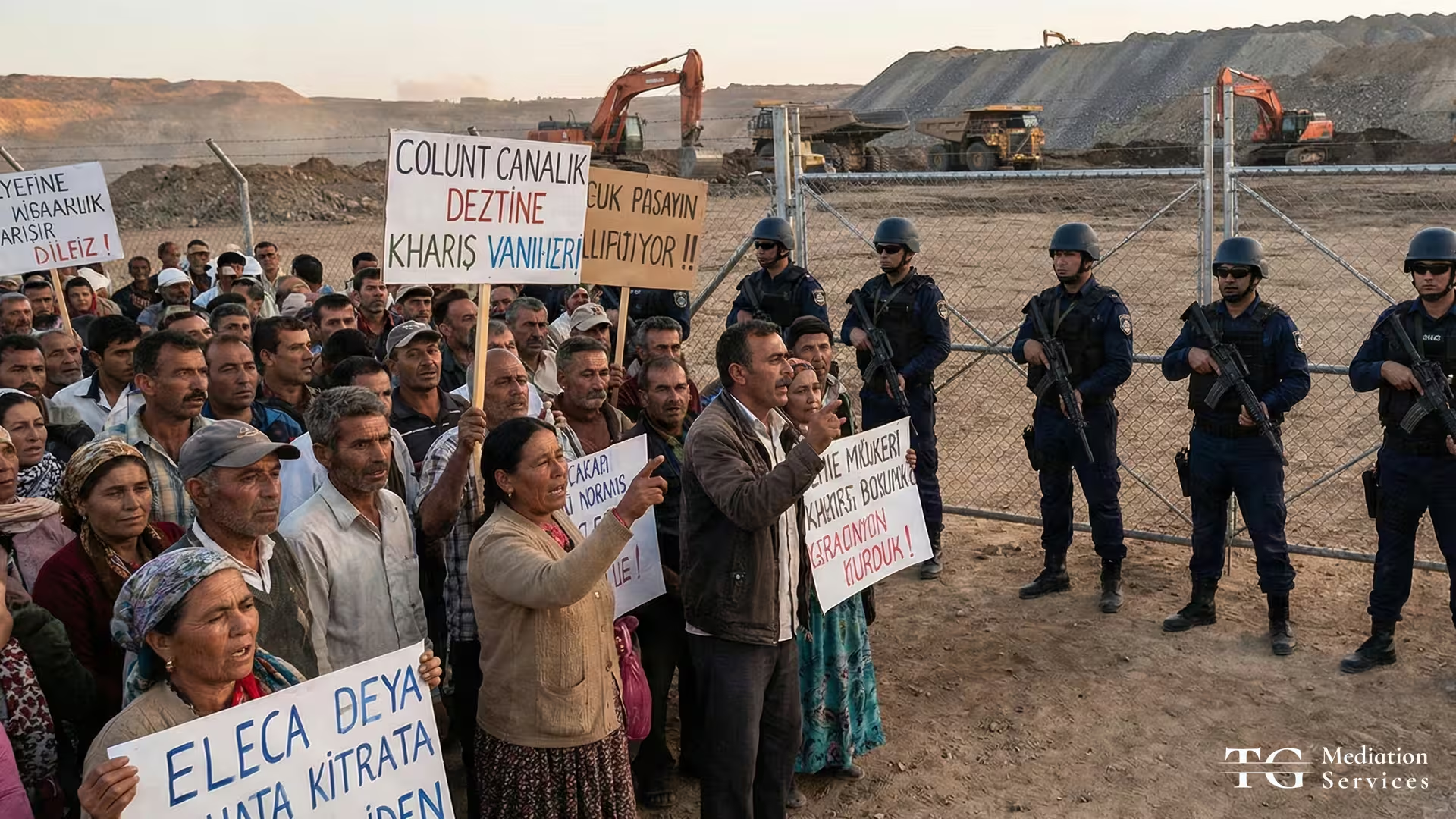
Direct dialogue collapsed after community protests were met with a heavy security response. Three community leaders were briefly detained. The community filed a complaint with the project’s lender accountability mechanism. The company views the complaints as politically motivated; the community views the company as indifferent to their survival.
A mediator is engaged. Joint sessions are clearly impossible. Community members refuse to enter company property. The company refuses to meet in the community without security guarantees it considers adequate.
The shuttle diplomacy approach begins. Groundwork (Phase 0): The mediator spends the first week meeting each party separately, in locations each party controls. With the community, conversations happen under a tree at the edge of the village, with elders, women’s group leaders, and youth representatives participating across three separate sessions. With the company, meetings occur at a regional office, or at the mine site. During this phase, the mediator establishes confidentiality, clarifies the mediation role, and assesses readiness to proceed.
Rapport and Organize (Phases 1-2): During the listening phase, the mediator discovers that the community’s primary concern is not compensation. It is the fear that the expansion will destroy their remaining farmland without providing viable alternative livelihoods. The company, meanwhile, is under pressure from its parent board to resolve the dispute because a major institutional investor has flagged the conflict as a social risk factor affecting the next round of project financing. As the community tells its story, the mediator acknowledges emotions, validates concerns, and begins organizing the key issues into a coherent agenda. The company does the same, and the mediator listens without judgment.
Understand (Phase 3): The mediator digs beneath positions. When the company emphasizes “contractual obligations,” the mediator asks what flexibility might exist on implementation timing. When the community demands “halt the expansion,” the mediator explores what would address the underlying livelihood concern. The mediator constructs a proposal framework that neither party could have articulated: a phased expansion plan tied to measurable livelihood transition milestones, monitored by an independent third party acceptable to both sides. The proposal is presented as the mediator’s own idea, allowing both parties to evaluate it without the stigma of accepting the other side’s terms.
Navigate and Deliberate (Phases 4-5): After three weeks of shuttle diplomacy and four iterative rounds of proposal refinement, the parties are testing the phased expansion approach against their own criteria. Which benchmarks matter most? What timeline is realistic? Who should constitute the independent monitoring committee? The mediator helps each side reality-test the emerging agreement, raises questions about feasibility, and ensures each side can explain the logic to their constituents.
Secure (Phase 6): The parties agree to a joint meeting limited to discussing the terms of the independent monitoring arrangement. This single, concrete agenda item provides a low-risk entry point for face-to-face engagement. The first joint session lasts 90 minutes. It is tense but productive. It is also the beginning of a process that will take months, not weeks, to reach comprehensive agreement. As the parties sit together for the first time since the crisis escalated, they formalize the monitoring structure, establish protocols for sharing data, and agree on a dispute resolution mechanism for future disagreements about expansion timeline modifications.
Common Mistakes That Derail Shuttle Diplomacy
Carrying Information Without Permission
The moment either party suspects the mediator is sharing confidential information, trust in the entire process collapses. Never convey anything between parties without explicit authorization.
Becoming a Permanent Intermediary
If parties become dependent on the mediator for all communication and cannot interact directly, the shuttle process has become a crutch rather than a bridge. Actively build toward independence.
Moving Too Quickly to Joint Sessions
The pressure to demonstrate progress, particularly from corporate timelines, can push mediators into joint sessions before parties are ready. A premature joint session that ends badly can set the process back months.
Neglecting Internal Dynamics
Each “side” is not monolithic. The community has factions, generational divides, and competing interests. The company has tension between its community relations team and its operations managers. Shuttle diplomacy must account for these internal dynamics, sometimes requiring separate sessions within a single side.
When Shuttle Diplomacy Is Not Enough
Intellectual honesty requires acknowledging the limits of any technique. Shuttle diplomacy cannot substitute for genuine accountability when a company has caused serious harm. It cannot resolve disputes where one party is acting in bad faith. And it cannot compress timelines that the conflict’s complexity demands. Data from the IFC’s Compliance Advisor Ombudsman shows that dispute resolution in extractive industry contexts achieves full or partial agreements in approximately 76% of cases where parties commit to the process. That is a strong track record, but it also means roughly one in four cases requires escalation to other mechanisms.
Ready to Take the Next Step?
If your organisation is navigating a mine-community conflict where direct dialogue has broken down, or if you are a mediator preparing to enter a high-tension extractive industry dispute, shuttle diplomacy may be the critical first step.
Schedule a consultation to design a shuttle diplomacy strategy tailored to your specific conflict context.
Downloadable Resource
The Shuttle Diplomacy Decision Checklist and Session Planning Template. A field-ready tool covering the five-factor assessment framework, session logistics planning, confidentiality protocols, and transition-to-joint-session readiness indicators. This template integrates the GROUNDS framework phases, helping mediators track progression through each phase and identify readiness gates before advancing to the next stage.
Sources
- Hoffman, D. A. (2011). “Mediation and the Art of Shuttle Diplomacy.” Negotiation Journal, 27(3), 263-309. MIT Press. Comprehensive analysis of caucusing and shuttle diplomacy, including the role of face-saving and relationship-building in high-conflict mediation.
- IFC Compliance Advisor Ombudsman (CAO). (2018). Annual Report: Dispute Resolution and Compliance. World Bank Group. Documents dispute resolution outcomes including the finding that Sub-Saharan Africa accounted for the largest share of the CAO’s caseload, with 76% of dispute resolution cases achieving full or partial agreements.
- Oh, C. H., et al. (2023). “Conflicts between Mining Companies and Communities: Institutional Environments and Conflict Resolution Approaches.” Business Ethics, the Environment & Responsibility, Wiley. Empirical analysis of how mediated dialogue and informal resolution approaches affect conflict outcomes in extractive industry contexts across multiple jurisdictions.

 EN
EN  FR
FR  PT
PT