
Why the extractive industry needs a systems-level methodology for building durable agreements, and what it changes for everyone involved.
Social Accord Architecture is a new professional discipline for designing, building, and maintaining the structured processes through which industrial projects and communities reach agreement. It is not traditional mediation with a new label. It is an engineered, systems-level methodology that treats community engagement and dispute resolution as infrastructure, as essential to project success as environmental impact assessments, geological surveys, or financial modelling.
The discipline emerges from a simple observation validated over fifteen years of field practice and the resolution of more than 2,000 claims across Sub-Saharan Africa, Europe, and Asia: the extractive industry has no shortage of frameworks telling companies what to do with communities. What it lacks is a coherent system for how to do it. Social Accord Architecture provides that system.
This post introduces the core concepts, explains why existing approaches have created a dangerous gap, and outlines what this new discipline means for mining executives, community leaders, mediators, and social performance practitioners. The full methodology is available in the Social Accord Architecture: A Foundational Definition and Manifesto, which you can download at the end of this article.
Why the Extractive Industry Needs a New Discipline
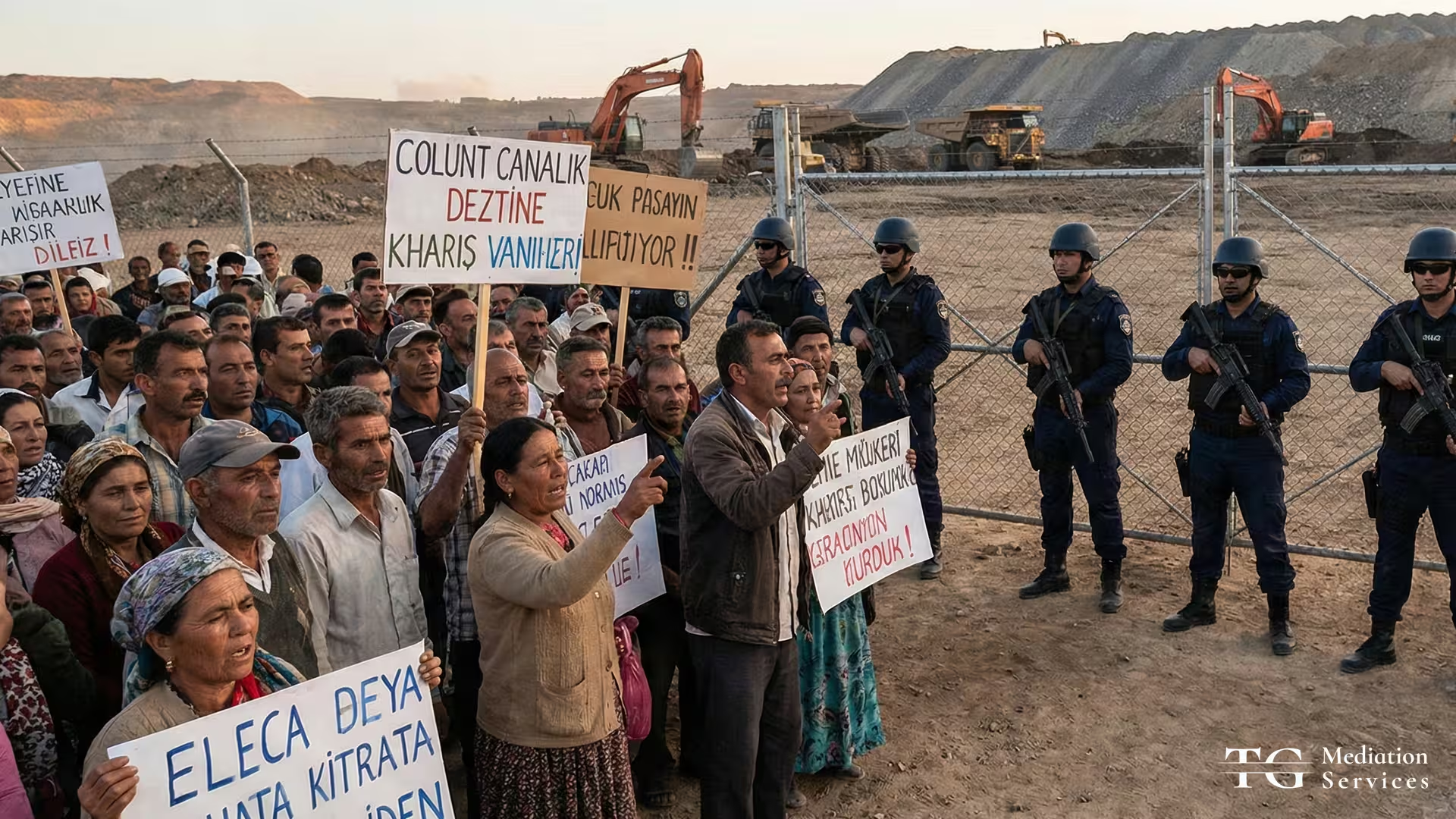
Community opposition is now the single most common cause of project delay and cancellation in the global mining sector. Research by Davis and Franks at the University of Queensland’s Centre for Social Responsibility in Mining found that company-community conflicts can cost mining operations up to $20 million per week in delayed production for projects valued between $3 billion and $5 billion. Separately, decision-tree modelling of the Pebble Mine in Alaska demonstrated that stakeholder opposition can reduce a project’s net present value by as much as 80%, with the NPV dropping from approximately $6 billion to $1.1 billion once social conflict risk was properly quantified.
These are not outlier statistics. They describe the operating reality facing every project that breaks ground in a community that feels unheard, excluded, or betrayed. Social license to operate is no longer a soft concept invoked at stakeholder meetings. It is a material risk factor that determines whether projects proceed, stall, or collapse entirely.
Yet the tools available to manage this risk remain fragmented and inadequate. They fall into three categories, each with structural limitations that no amount of good intention can overcome.
The Three Approaches That Are Not Enough
Corporate Community Relations. Most companies manage community engagement through internal teams operating under the corporate hierarchy. These teams report to executives whose incentives prioritize project timelines over relationship quality. They lack the independence required for communities to trust the process. Even the most skilled community relations managers find themselves functioning as what I call “human shock absorbers,” absorbing anger from both sides while lacking the authority to change outcomes. The result is a transactional dynamic where minor frictions easily escalate into major disputes.
Traditional Mediation. When disputes escalate, companies and communities sometimes turn to professional mediators. But conventional mediation is mainly designed for two-party disputes. It was not purposefully built for the asymmetric power dynamics, cultural complexity, multi-stakeholder networks, and decade-long time horizons that characterize industrial-community conflicts. A mediator trained in facilitative techniques for contract disputes is not necessarily equipped to navigate a conflict involving a multinational corporation, three levels of government, six community associations, an artisanal mining cooperative, and an international development bank, each with different interests, languages, and conceptions of justice.
ESG Compliance Frameworks. The rise of IFC Performance Standards, the Equator Principles, the EU Corporate Sustainability Due Diligence Directive (CSDDD), and the UN Guiding Principles on Business and Human Rights has created a compliance architecture that requires grievance mechanisms, stakeholder consultation, and social impact assessment. But compliance is not competence. Most grievance mechanisms are poorly designed, distrusted by communities, and operated by personnel with no or limited training in mediation or dialogue facilitation. The gap between what standards require and what practitioners can deliver is where projects fail.
The Missing Layer What all three approaches lack is a design discipline: a structured, teachable methodology that integrates dialogue, engagement, mediation, and dispute resolution into a coherent system across the full lifecycle of an industrial project. Social Accord Architecture fills this gap.
What Social Accord Architecture Actually Is
Social Accord Architecture rests on a central thesis: protecting community wellbeing and protecting project viability are not competing objectives. They are the same objective, pursued through different lenses. The discipline provides the methodology for bringing those lenses into alignment.
If physical infrastructure is the hardware of a mining project, and social impact assessment is the software, then Relational Infrastructure, the trust, protocols, and governance structures that connect them, is the operating system. Social Accord Architecture builds that operating system.
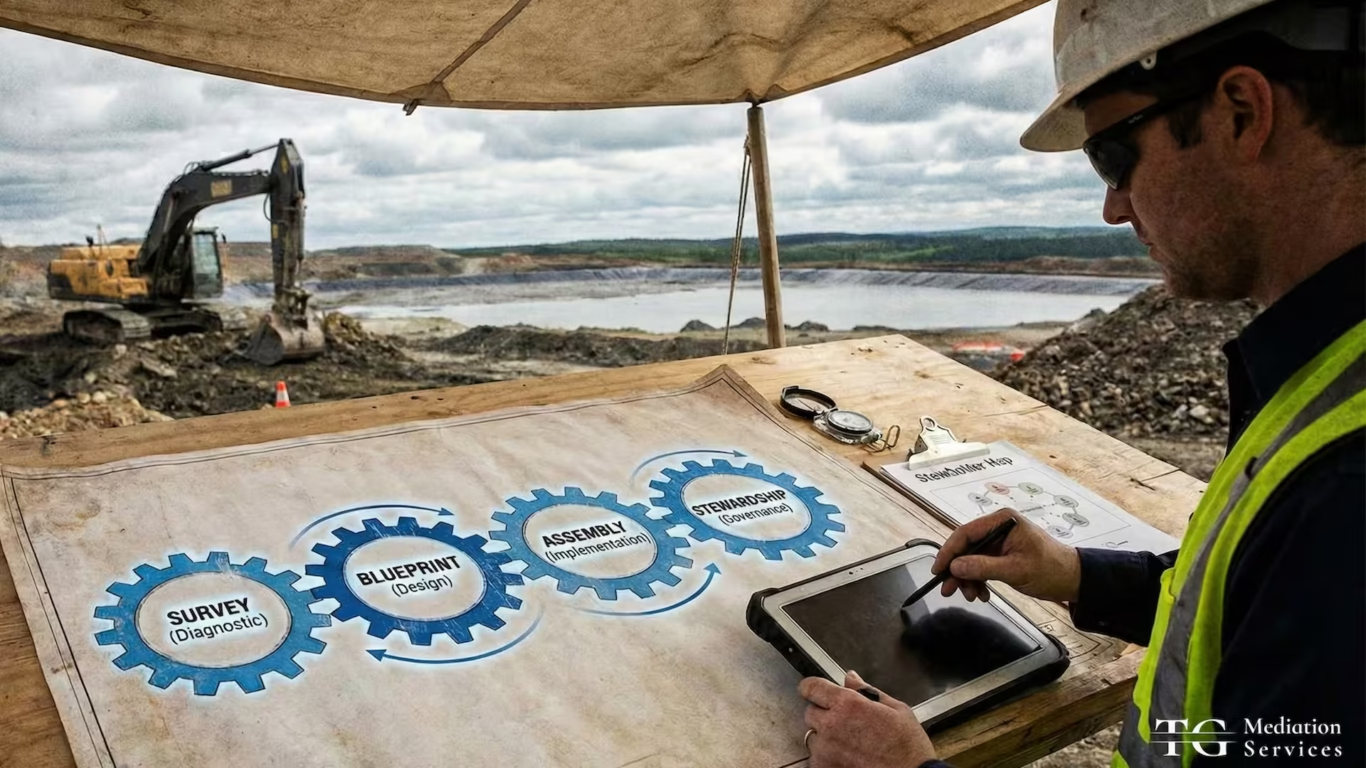
This is a deliberately engineered approach. The discipline borrows from the language of construction because the analogy is precise. Just as a building requires a site survey, architectural blueprints, physical assembly, and ongoing maintenance, a durable community agreement requires the same disciplined progression. The difference between a handshake and a skyscraper is engineering. The same is true for social agreements.
The Five Founding Principles
Social Accord Architecture is built on five foundational principles that distinguish it from both traditional mediation and corporate community engagement:
- Architecture Over Improvisation. Agreements are designed through structured methodologies, not assembled through ad hoc conversations. Every engagement follows a deliberate process with defined phases, decision points, and quality standards.
- Dual Accountability. The methodology serves both community wellbeing and project viability simultaneously. The moment it appears to favor one side, it loses credibility with the other. This dual accountability is not a compromise. It is the source of the methodology’s power.
- Lifecycle Integration. Social Accord Architecture spans the entire project lifecycle, from early exploration through operations, expansion, transition, and closure. It is not a crisis response tool deployed when things go wrong. It is the system that prevents things from going wrong or from spiraling out of control.
- Cultural and Contextual Adaptation. The framework is structurally consistent but contextually flexible. It has already been deployed across Sub-Saharan Africa and Europe, because it adapts to local governance structures, cultural norms, and power dynamics without losing its methodological rigor.
- Measurable Outcomes. Every phase of the framework produces defined deliverables, from diagnostic assessments to signed agreements to compliance monitoring reports. Progress is tracked against concrete milestones, not subjective impressions of “relationship quality.”
The Accord Architecture Framework: Four Phases of Building Relational Infrastructure
The operational core of Social Accord Architecture is the Accord Architecture Framework (A²F): a four-phase system for constructing the Relational Infrastructure required for long-term, durable agreements between mining operations and affected communities. The framework is structural, repeatable, and scalable. It applies whether the context is a lithium mine in Portugal, an expanding mining operation in Mozambique, or a renewable energy installation in Southeast Asia.
Phase 1: Survey (Diagnostic Assessment)
No responsible architect begins construction without a site survey. Phase 1 maps the relational landscape: stakeholder networks, power dynamics, historical grievances, cultural protocols, governance structures, and existing trust levels. This is not a standard stakeholder mapping exercise that produces a color-coded matrix for a board presentation. It is a diagnostic assessment that reveals the actual terrain on which any agreement must be built.
In practice, this means understanding dynamics that standard ESG assessments routinely miss. In a West African mining context, for example, the formal chief recognized by the company may not hold the decision-making authority that a council of elders exercises. A Phase 1 Survey identifies these hidden governance structures before they derail a consultation process that assumed the wrong interlocutors.
Phase 2: Blueprint (Process Design)
Using the diagnostic intelligence from Phase 1, the practitioner designs the engagement architecture: the specific processes, protocols, timelines, and decision-making structures through which dialogue, negotiation, and agreement will occur. This is where Social Accord Architecture diverges most sharply from conventional approaches.
A standard community engagement plan might specify “conduct three public consultations.” A Phase 2 Blueprint specifies who participates in each consultation, how participants were selected, what information is shared and in what format, how community input is documented and fed back, what decisions are on the table and what is non-negotiable, and how disagreements at each stage are escalated to structured mediation. The level of process specificity is what transforms a consultation exercise into a genuine dialogue architecture.
The Blueprint phase also determines which mediation pathway will be deployed within the framework, drawing on the GROUNDS methodology for standard disputes and the REBUILD methodology for trauma-informed contexts. (More on these below.)
Phase 3: Assembly (Implementation and Mediation)
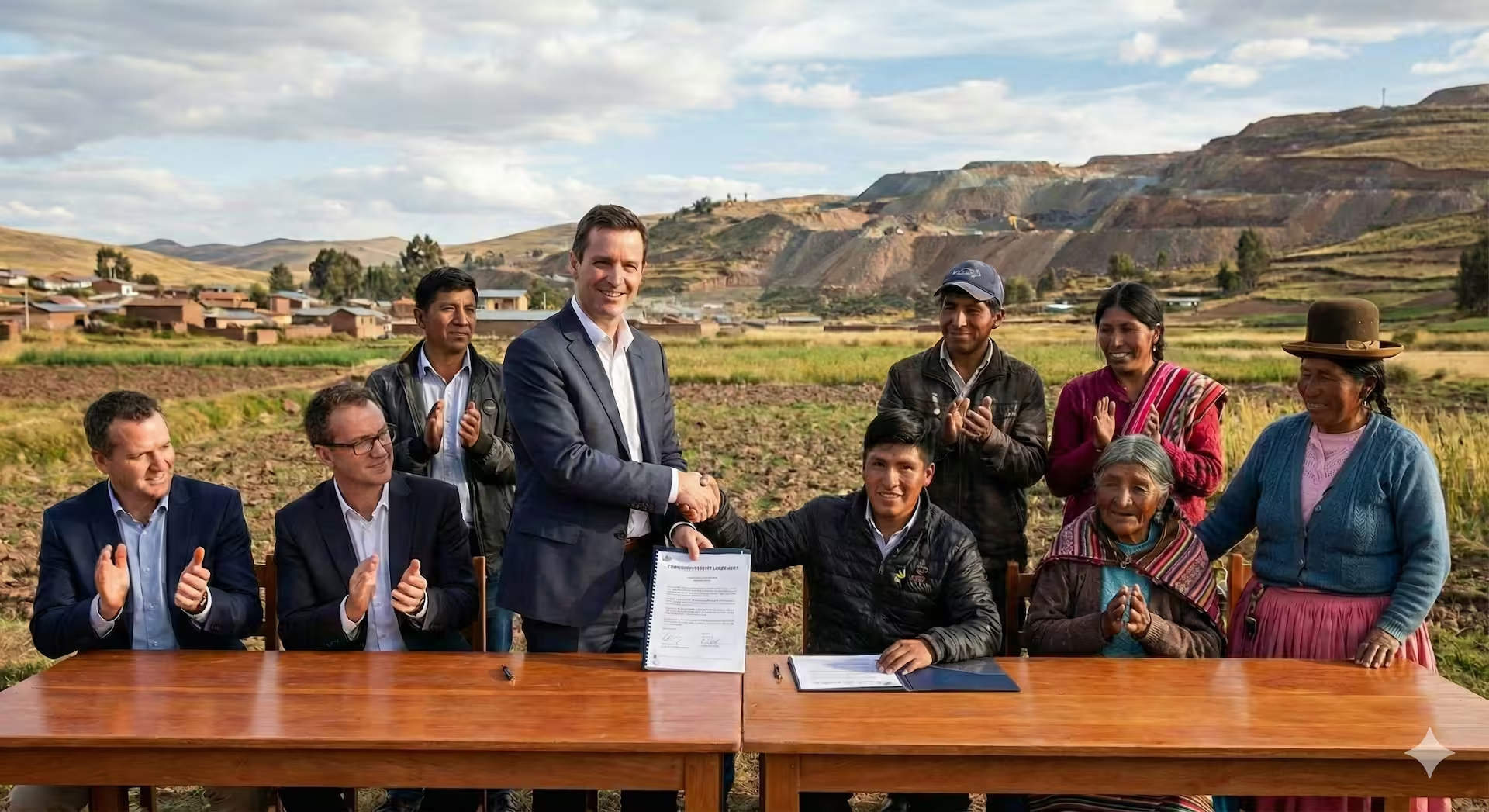
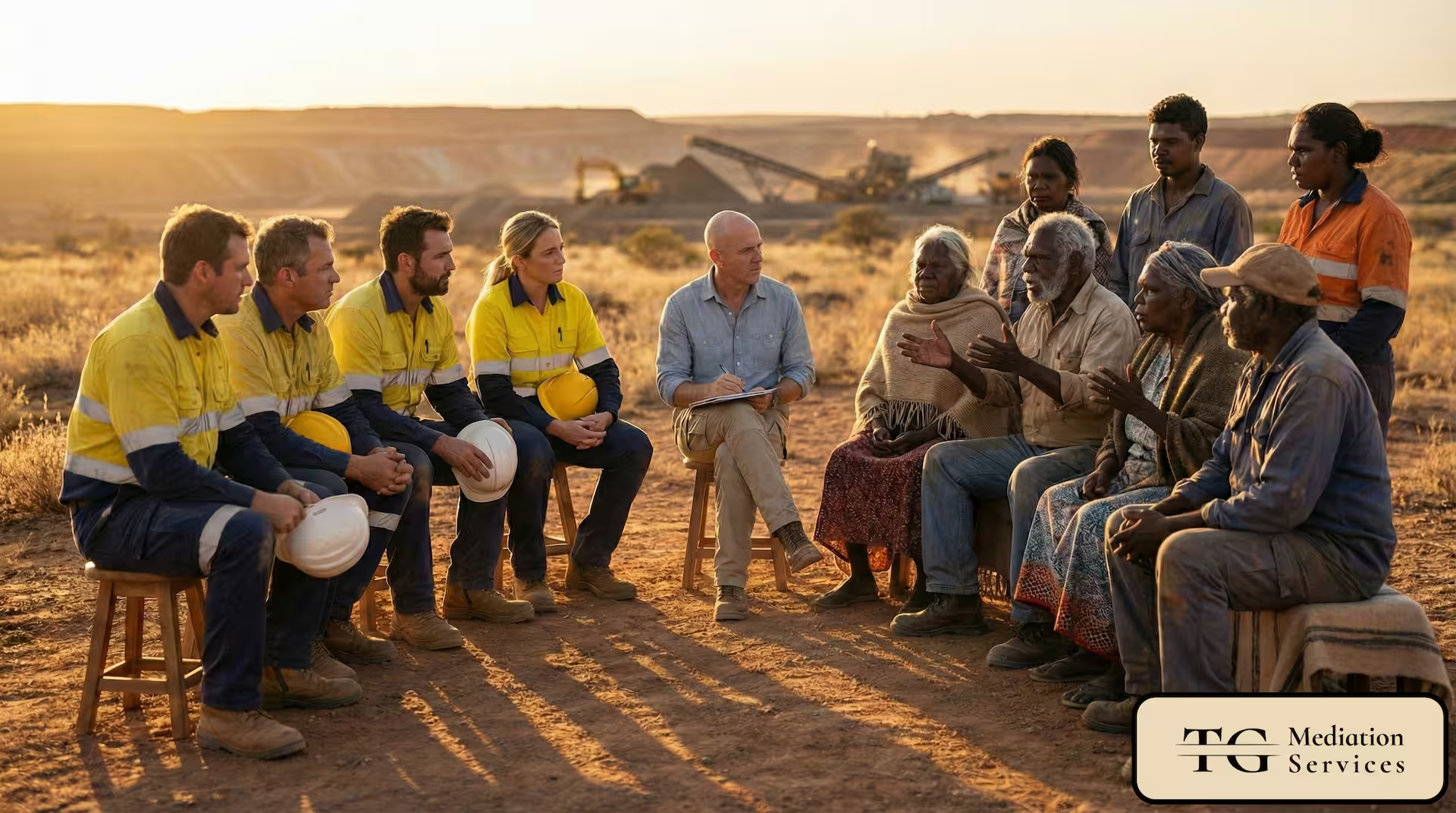
Phase 3 executes the Blueprint. This is where dialogue sessions are facilitated, grievances are processed, negotiations are conducted, and agreements are drafted and signed. The Assembly phase is where most conventional approaches begin, and therein lies the problem. Without the diagnostic intelligence of Phase 1 and the structural design of Phase 2, implementation becomes reactive improvisation.
Within this phase, the practitioner deploys the GROUNDS or REBUILD mediation pathways depending on the nature of the disputes being addressed. Both follow the same seven-phase structure, from Phase 0 (Preparation) through Phase 6 (Agreement), creating a parallel architecture that allows practitioners to use a common structural logic while adapting to specific conditions. This dual-pathway design addresses a gap that every field mediator has encountered: the standard mediation toolkit is insufficient when a community has experienced genuine trauma, whether forced displacement, environmental contamination, destruction of sacred sites, or security force violence.
The GROUNDS pathway handles disputes where conflict exists but acute trauma is not the dominant factor. Disagreements over employment, procurement, environmental mitigation, benefit-sharing, and land access follow this pathway. The REBUILD pathway is deployed for situations involving genuine trauma. Its name acknowledges that something has been broken and speaks to communities who have experienced harm.
Phase 4: Stewardship (Monitoring and Adaptation)
Agreements do not maintain themselves. Phase 4 provides the governance structure for monitoring compliance, managing adaptation as circumstances change, resolving implementation disputes, and sustaining the relational capital built during Phases 1 through 3. This is where most agreements fail, not because the terms were bad, but because no one designed the system that keeps them alive.
In an extractive sector context, one could very well have observed a well-negotiated community benefit agreement unravel within eighteen months because the agreement contained no mechanism for addressing grievances that arose during implementation. The terms were sound. The Stewardship infrastructure did not exist. Phase 4 builds the ongoing governance that prevents this decay.
For a deeper treatment of agreement sustainability, see Community Benefit Agreements: The Complete Negotiation Guide, which covers enforcement mechanisms and long-term governance structures.
What Social Accord Architecture Means for You
The implications of this discipline differ depending on your role. Here is what it changes for each audience.
For Mining Executives and Project Directors
Social Accord Architecture translates your most expensive unmanaged risk into an engineered system with defined inputs, phases, and measurable outputs. It replaces the current approach, which typically involves hoping your community relations team can manage escalating tensions through personal relationships and goodwill, with a structured methodology that integrates into your project management infrastructure alongside every other engineering discipline.
The business case is straightforward. Research by Henisz, Dorobantu, and Nartey, analysing 26 gold mines over fifteen years, found that variation in stakeholder cooperation explained more variance in market valuation than the net present value of the gold reserves themselves, with financial markets discounting asset values by up to 72% in high-conflict environments. The Pebble Mine case demonstrated an 80% NPV reduction when social opposition risk was modelled. Projects that invest in Relational Infrastructure at the design stage avoid the costly reactive interventions that consume management attention, delay permitting, trigger force majeure clauses, and destroy shareholder confidence. The methodology does not eliminate community opposition. It designs the structured channels through which opposition is heard, addressed, and resolved before it becomes a project-stopping crisis.
For Community Relations Practitioners and Social Performance Teams
This discipline provides the professional framework that many of you have been building informally through years of field experience. If you have ever felt that your work was treated as secondary to the “real” engineering, or that your relationship-building efforts lacked the structural vocabulary to be taken seriously in a project review meeting, Social Accord Architecture gives your expertise the language, the methodology, and the credential it deserves.
The framework does not replace your field knowledge. It systematizes it. It provides the diagnostic tools, the process design templates, and the monitoring infrastructure that transform community engagement from an art practiced by talented individuals into a discipline that organizations can implement, measure, and scale.
For Mediators and Dispute Resolution Professionals
If you are a trained mediator considering work in the extractive sector, Social Accord Architecture marks the boundary between generalist mediation and the specialized competence this field requires. The GROUNDS and REBUILD mediation pathways provide the sector-specific methodology that conventional mediator training programs do not cover. They address the multi-party dynamics, the severe power asymmetries, the cultural complexity, and the long-term operational timelines that make mining-community mediation a distinct professional specialization.
For Community Leaders
Social Accord Architecture treats your voice, your concerns, and your right to shape decisions affecting your lives as structural requirements of any project, not optional consultations that check a compliance box. The discipline insists that engagement processes be designed with your participation, that power imbalances be addressed through process design rather than ignored, and that agreements include the governance structures needed to hold all parties accountable over the long term.
What Social Accord Architecture Is Not
Precision matters. This discipline is distinguished from several things it might be confused with.
It is not a corporate communications strategy. It does not manage perceptions. It structures the processes through which genuine agreements are reached. If a company is looking for a sophisticated way to present the appearance of consultation without the substance, this methodology will actively work against that objective.
It is not community advocacy. The discipline serves the process, not a party. Its dual accountability means it loses its integrity the moment it is captured by either side.
It is not a replacement for legal compliance. Environmental impact assessments, FPIC processes, and regulatory approvals remain necessary. Social Accord Architecture provides the engagement infrastructure that makes those processes function as intended rather than as hollow procedural exercises.
And it is not traditional mediation rebranded. It is a systems-level methodology that includes mediation as one of its tools, alongside diagnostic assessment, process design, agreement architecture, and long-term governance stewardship. Mediation is an instrument within the system, not the system itself.
Download the Full Manifesto The Social Accord Architecture: A Foundational Definition and Manifesto provides the complete methodology, including the five founding principles, the four-phase Accord Architecture Framework, the GROUNDS and REBUILD mediation pathways, and the full professional vocabulary of the discipline.
Download the Manifesto HERE
If your project is facing community opposition, grievance management challenges, or upcoming CBA negotiations and you want to explore how Social Accord Architecture applies to your specific context, schedule a consultation.
The Evidence Base: Field-Tested, Not Theoretical
Social Accord Architecture is not a concept developed in a lecture hall. Its principles, frameworks, and methodologies have been developed, tested, and refined through over fifteen years of field practice across multiple continents, sectors, and conflict types. This includes the resolution of more than 2,000 formal claims in various African extractive sector projects, including historic human rights grievances requiring trauma-informed mediation processes. It encompasses active operational practice as Community Relations Manager for a lithium mining operation in Portugal during Europe’s critical minerals transition. And it reflects cross-continental deployment across Sub-Saharan Africa and Europe, demonstrating that the methodology is culturally adaptable rather than context-specific.
This breadth of application is what distinguishes Social Accord Architecture from approaches developed in isolation. The methodology has been tested against the full spectrum of industrial-community conflict, from routine operational grievances about dust and noise to deeply sensitive cases involving forced displacement, and historical human rights violations.
An Invitation to Build Differently
The extractive industry has spent decades treating community engagement as either a compliance requirement, a communications exercise, or a crisis response. The result is predictable: projects that are technically sound and financially viable collapse under the weight of community opposition that no one designed a system to address.
Social Accord Architecture offers an alternative. Not a better version of community relations. Not a more sophisticated form of mediation. A new professional discipline that treats the relationship between industrial projects and affected communities as infrastructure that can be surveyed, designed, built, and maintained with the same rigor applied to every other dimension of a complex project.
We do not stumble into agreements. We design them.
The frameworks exist. The evidence base is established. The manifesto is published. What remains is the invitation to those who share this founding conviction: that industrial development and community wellbeing can be designed to succeed together.
Your Next Step Whether you are a mining executive assessing social risk exposure, a community relations practitioner looking for the professional framework your work deserves, or a mediator seeking to specialize in the extractive sector, Social Accord Architecture provides a structured pathway forward. Download the Manifesto: HERE or Schedule a Consultation.
Frequently Asked Questions
How does Social Accord Architecture differ from standard stakeholder engagement?
Standard stakeholder engagement provides a set of activities, such as consultation, information disclosure, and grievance handling. Social Accord Architecture provides the design methodology that determines how those activities are structured, sequenced, connected, and governed across the full lifecycle of a project. It is the difference between having building materials and having architectural blueprints.
Can Social Accord Architecture be applied to projects already in operation?
Yes. While the methodology is most powerful when deployed at the design stage, the four-phase framework can be entered at any point in a project’s lifecycle. An operating mine with deteriorating community relations would begin with a Phase 1 Survey to diagnose the current relational landscape, then design a Phase 2 Blueprint to restructure engagement processes. The framework is adaptive by design.
Is this only for the mining sector?
The methodology was developed in the extractive industry context, which presents the most complex combination of power asymmetry, cultural diversity, long time horizons, and environmental impact. It has also been applied to energy and infrastructure projects. The principles are sector-transferable; the tools are calibrated for extractive industry conditions.
What qualifications does a Social Accord Architecture practitioner need?
The discipline integrates mediation, stakeholder engagement, process design, and governance. Practitioners typically come from backgrounds in dispute resolution, social performance, community development, or law, combined with substantial field experience in the extractive or energy sectors. Formal training and certification pathways are under development.
Sources
- Davis, R. and Franks, D. M. (2014). Costs of Company-Community Conflict in the Extractive Industry. Corporate Social Responsibility Initiative, Harvard Kennedy School. Cambridge, MA.
- Henisz, W. J., Dorobantu, S. and Nartey, L. J. (2014). “Spinning Gold: The Financial Returns to Stakeholder Engagement.” Strategic Management Journal, 35(12), pp. 1727–1748.
- ICMM (2022). Mining Principles: Performance Expectations. Principle 9: Social Performance. International Council on Mining and Metals. London.
- Franks, D. M., Davis, R., Bebbington, A. J., Ali, S. H., Kemp, D. and Scurrah, M. (2014). “Conflict Translates Environmental and Social Risk into Business Costs.” Proceedings of the National Academy of Sciences, 111(21), pp. 7576–7581.
- Prno, J. and Slocombe, D. S. (2012). “Exploring the Origins of ‘Social License to Operate’ in the Mining Sector.” Resources Policy, 37(3), pp. 346–357.


 EN
EN  FR
FR  PT
PT