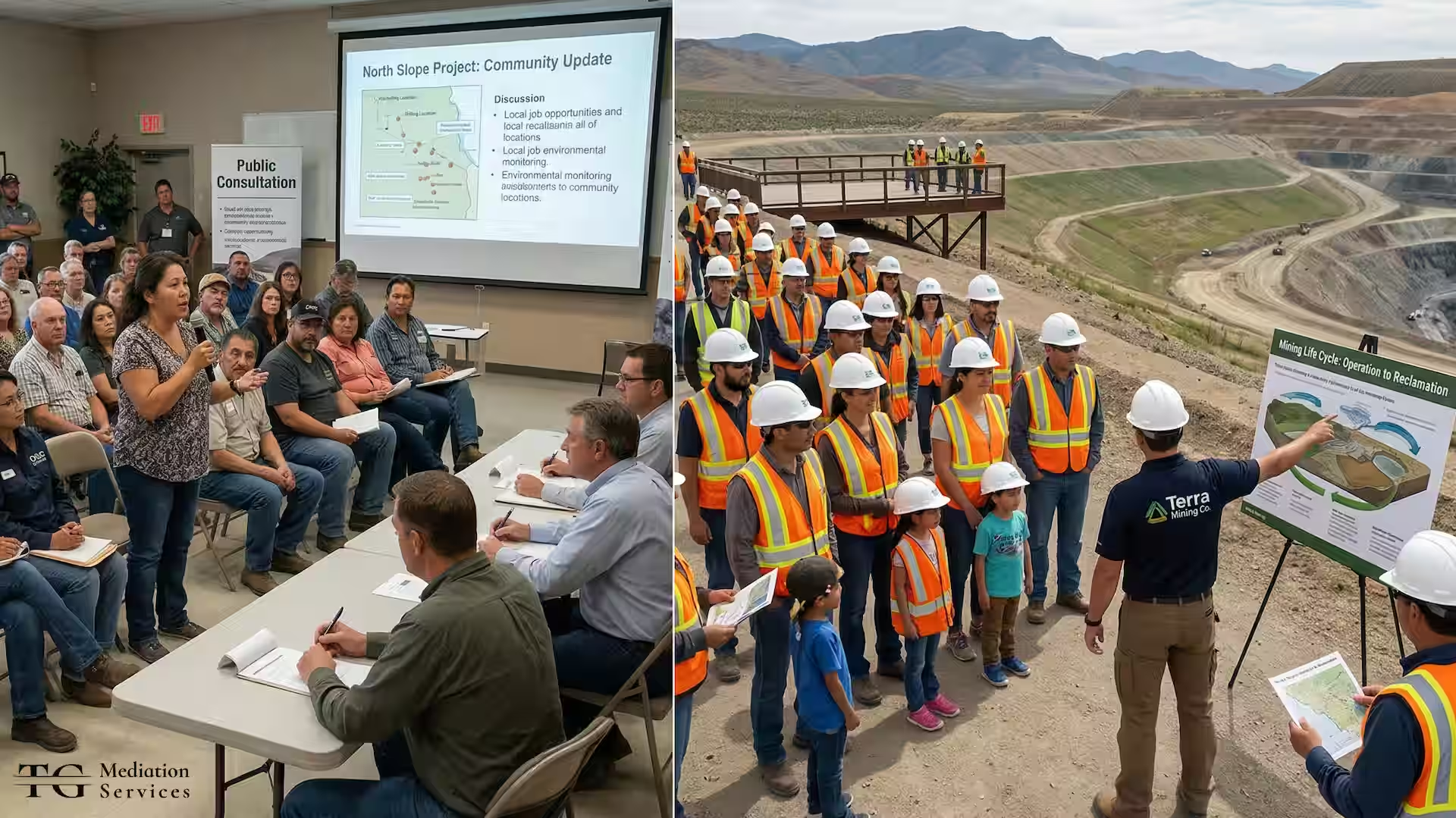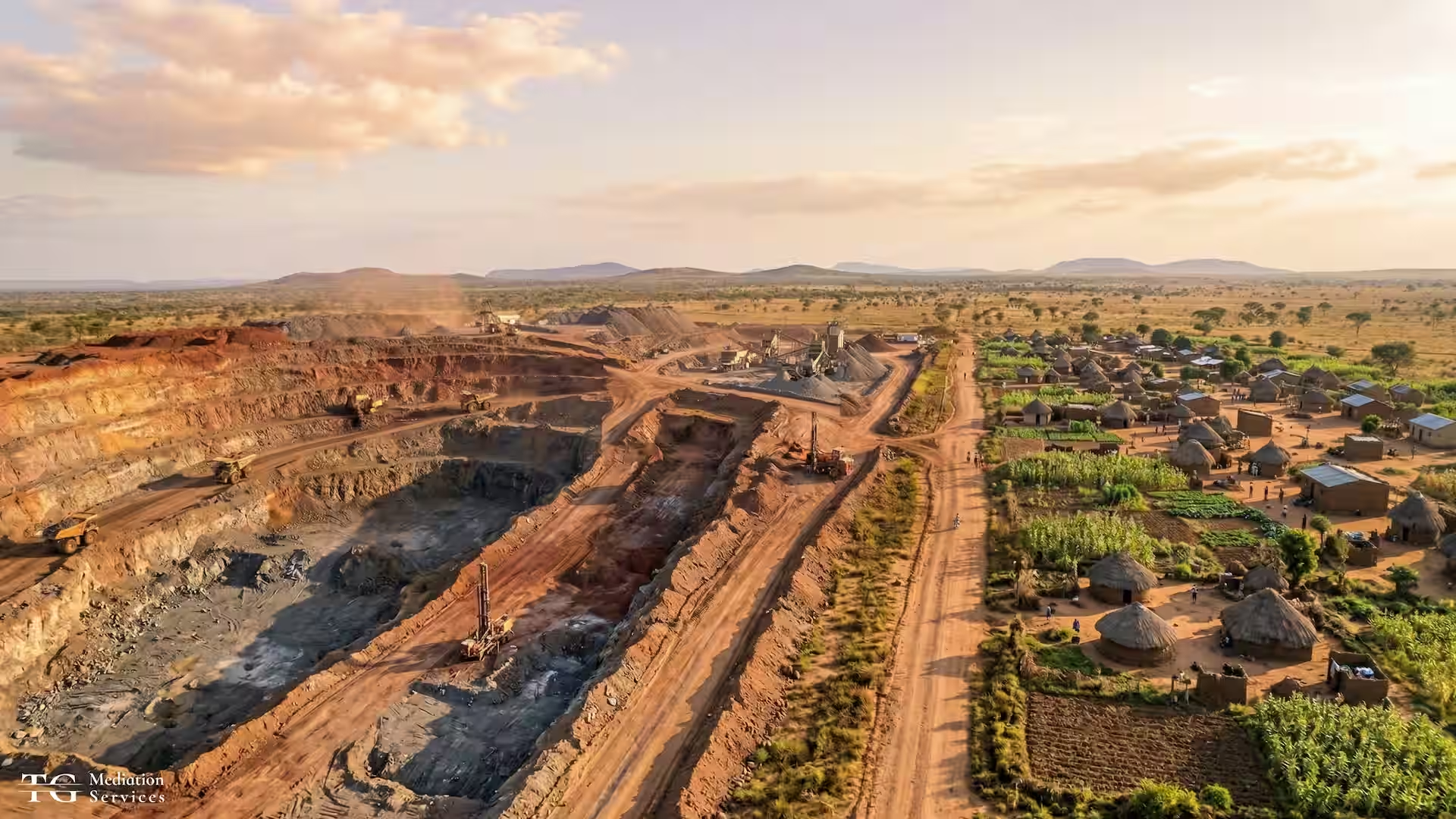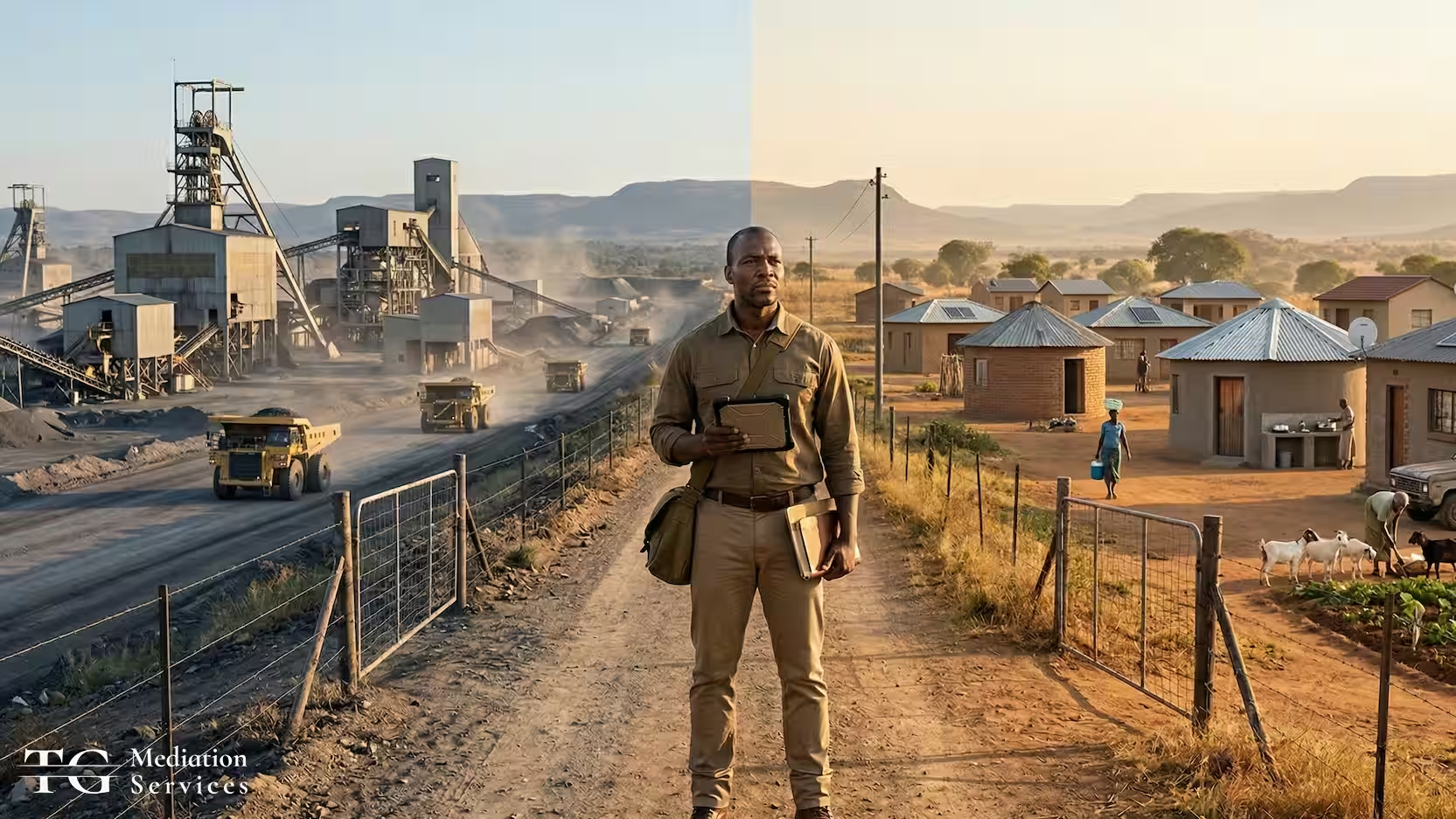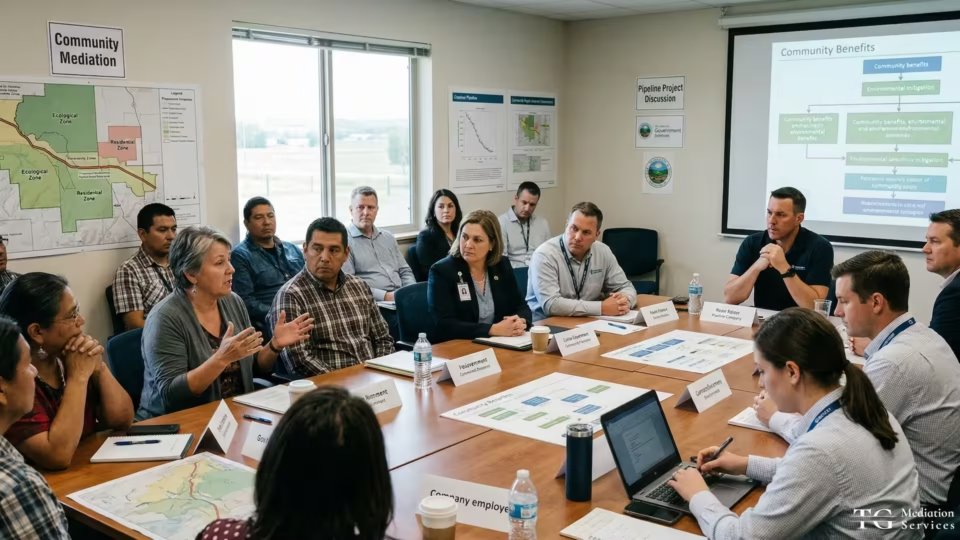
Large infrastructure projects, pipelines, roads, dams, and power transmission lines, reshape landscapes and disrupt lives. They also create unprecedented opportunities for conflict if community concerns are not integrated into project design from the earliest stages. The framework that resolves these tensions, rooted in decades of extractive industry experience, applies directly to infrastructure development. Community mediation principles, initially developed to manage complex relationships between mining operations and affected populations, now offer infrastructure developers a proven pathway to sustainable project outcomes.
This article bridges a critical gap in infrastructure development practice. While mining and oil and gas companies have invested substantially in community relations and mediation expertise, the infrastructure sector, particularly in Africa and Asia, operates with fragmented approaches that vary by project type, geography, and developer. A pipeline company may excel at stakeholder engagement but lack the experience to manage resettlement disputes. A dam developer may have strong technical expertise but limited exposure to indigenous rights frameworks. Road authorities may commit to consultation without understanding how to facilitate genuine deliberation about project routing.
Infrastructure community mediation draws from extractive industry best practice while adapting to the distinct characteristics of pipeline, road, and dam projects. If you are an infrastructure developer, government agency, or mediator responsible for managing community engagement on large projects, this guide provides the sector-specific framework to transform potential conflict into sustainable partnership.
Why Infrastructure Projects Fail at Community Engagement
Infrastructure projects fail not because communities oppose development, but because developers often treat communities as obstacles to overcome rather than stakeholders whose interests must be integrated into planning. The pattern repeats across sectors and geographies. A road is planned through consultation with government and private investors but not with the farming families whose land will be bisected. A dam is designed based on hydrological and economic calculations, with community impact assessments completed after design is finalized. A pipeline route is selected through technical and cost optimization that overlooks sacred sites and subsistence livelihood zones that are critical to community survival.
Community engagement, in these contexts, functions as a compliance exercise rather than a genuine integration of community interests into decision-making. The result is projects that are technically sound but socially fragile. They face delays, legal challenges, construction disruptions, and post-implementation grievances that cost far more than early mediation and genuine inclusion would have cost.
The Infrastructure-Community Engagement Gap
The infrastructure sector differs from extractive industries in several critical ways that shape how mediation must be adapted. First, infrastructure projects are typically shorter in duration than mining operations. A road construction may span two to three years. A dam filling may take months. This compressed timeline creates pressure to accelerate community processes, yet legitimate deliberation cannot be rushed. Second, infrastructure projects are more dispersed geographically, affecting multiple communities across broader areas. A pipeline network may cross dozens of villages. A road corridor may affect hundreds of settlements. Managing mediation across this dispersed impact zone requires approaches that mining companies do not typically face. Third, infrastructure projects are often owned and operated by government entities or public-private partnerships, introducing political dimensions and multiple layers of authority that complicate mediation. When a government, rather than a private company, is the project developer, communities face different power dynamics and different enforcement mechanisms for agreements.
The World Bank’s Environmental and Social Framework (ESF, 2016/2018) addresses these dynamics by requiring infrastructure projects to conduct stakeholder engagement that is proportionate to the risks involved. Yet proportionality is often interpreted as minimal engagement on projects deemed low-risk, and infrastructure developers frequently underestimate the risks that poor community relations create. A road construction that involves resettlement of even a small number of households requires the same sophisticated mediation approach that a mining project does. The difference in project type does not eliminate the need for genuine consent.
Practitioner Insight: Why Pipeline Developers Often Get Community Relations Wrong
Pipeline companies frequently assume community concerns center on immediate construction impacts: noise, dust, traffic disruption. In reality, communities often have deeper concerns about long-term risks: water contamination, land value loss, livelihood disruption from restricted access, or cumulative impacts from the pipeline plus other development pressures. Mediators who focus only on construction-phase impacts miss the sources of genuine conflict.
The same applies to energy transmission projects. Communities worry not about the towers themselves but about health effects, property value implications, and visibility of external control over their landscape. Addressing these underlying concerns requires mediation frameworks that are adaptive to context-specific values and risks.
Mediation Approaches Across Infrastructure Project Types
While all infrastructure projects require community mediation, the specific approach must adapt to the distinct characteristics of pipelines, roads, and dams. The framework that succeeds for a pipeline may not work for a dam, which faces different scope of community displacement and different regulatory requirements. Understanding these distinctions is essential for any mediator or community relations manager working across infrastructure sectors.
Pipeline Projects and Right-of-Way Mediation
Pipeline projects create a unique mediation challenge: they involve a narrow corridor of intensive impact across a wide geographic area. A pipeline may be twenty meters wide but extend for hundreds of kilometers, affecting dozens of communities, each with distinct interests and concerns. Unlike a mining operation that creates a discrete footprint, or a dam that concentrates impacts in one location, a pipeline distributes its impacts thinly across many communities, yet the cumulative effect on landholders along the corridor can be severe.
Pipeline community mediation must address several specific issues. First, land access and right-of-way arrangements. Community members whose land the pipeline crosses need to understand what access rights the pipeline company will have, what land use restrictions apply above and around the pipe, what compensation mechanisms exist if the pipeline ruptures or causes damage, and how long these arrangements will last. Second, livelihood impacts along the corridor. Communities in agricultural areas worry that pipeline installation and maintenance activities will restrict seasonal access to productive land. Pastoralist communities worry about barriers to livestock movement. Urban and peri-urban communities worry about proximity to high-pressure infrastructure and associated safety risks.
The Asian Development Bank’s safeguard framework emphasizes that pipeline projects should identify any involuntary resettlement early, even when resettlement affects small numbers of households. A household directly in the pipeline route may need to relocate entirely. Mediation must address not only compensation but livelihood restoration and community relocation, issues that many pipeline developers underestimate in their social planning.
Mediation approach for pipelines requires establishing clear communication protocols with multiple small communities rather than intensive engagement with one large community. This creates resource challenges: managing dozens of separate deliberation processes takes more time and cost than managing a single community engagement process. Yet this distributed structure also offers opportunities. Communities along a pipeline corridor often share concerns and can benefit from coordinated mediation that builds understanding across communities and reduces the company’s burden of managing separate negotiations.
Road and Transport Projects: Routing and Resettlement Mediation
Road projects present distinct mediation challenges centered on routing decisions and resettlement. Unlike pipelines, where the route is largely determined by technical factors, road routes often involve genuine choices that affect different communities differently. Should a road bypass a town or run through it? Should it follow an existing transport corridor or cut a new path? These routing decisions fundamentally affect which communities bear the costs and which may benefit from improved access. For a deeper exploration of how early dialogue prevents land access disputes from escalating, see “Defusing Land Access Conflicts Through Early Dialogue“.
Mediation in road projects must include stakeholders in routing deliberation early, before final design is locked into engineering drawings and environmental impact assessments. Routing decisions made without community input, then presented for consultation after engineering is complete, typically generate conflict that could have been avoided. Communities that feel excluded from routing decisions often challenge the entire project, leading to delays and legal costs that dwarf the cost of genuine early engagement.
Road projects also involve resettlement and livelihood impacts that require intensive mediation. Households that sit directly on the planned road route face displacement. Communities adjacent to the road face construction impacts and ongoing access changes. Communities not directly affected but whose livelihoods depend on trade along the road corridor face disruption during construction. Mediation must address each of these impact categories with distinct approaches.
The World Bank’s framework emphasizes that resettlement in road projects should include not only compensation for lost land but livelihood restoration support. A farmer whose land is taken for road construction needs not only payment for the land but support to re-establish farming operations on new land, training if crop types change, and ongoing economic support until new livelihood systems are productive. This extended mediation on livelihood restoration is often where road projects fail. They handle land compensation smoothly but fail to support the transition to new livelihoods, leaving affected households impoverished despite technically adequate compensation.
Dam Projects: Submersion and Long-Term Mediation
Dam projects involve the most severe and irreversible community impacts of any infrastructure type. When a valley is flooded to create a reservoir, entire communities, forests, agricultural systems, and spiritual sites are submerged. The communities affected lose land permanently and must relocate far from their original territories. Mediation in dam projects must address not only resettlement and compensation but the grievances that arise for decades as communities adjust to displacement and new livelihoods.
The International Hydropower Association’s Sustainability Guidelines emphasize that dam community engagement must begin before any dam is constructed, when communities still have genuine opportunity to influence project design and location decisions. Yet in practice, dam projects often present communities with routes already selected, locations already chosen, and engineering already finalized. In these circumstances, consultation produces anger rather than genuine consent. Communities perceive they are being told what will happen rather than being asked whether they agree.
Mediation in dam projects requires establishing long-term mechanisms for ongoing dialogue and grievance management that extend well beyond project construction. Dam impacts intensify over years as communities settle into new locations, as promised benefits fail to materialize, or as unexpected negative impacts emerge. Dams that seemed to have achieved community agreement at completion routinely become sources of conflict within five to ten years as the gap between promises and outcomes becomes apparent. Skilled mediators in dam projects establish structures that can address these delayed grievances and adapt agreements as circumstances change.
A Unified Mediation Framework for Infrastructure Projects
Despite the differences between pipelines, roads, and dams, a common mediation structure applies across all three. This framework adapts principles from extractive industry practice while accounting for infrastructure-specific characteristics.
Phase 1: Early Engagement and Impact Identification
Infrastructure mediation must begin before technical decisions are finalized. This is the point at which community input can actually influence project design. If engagement begins after routing is fixed or location is chosen, consultation functions as notification, not mediation. This early engagement is the foundation of social license, a concept I explore in detail in “Mediation as a Strategic Tool for Earning Social License to Operate“.
Early engagement involves identifying affected communities, understanding their governance structures and decision-making processes, and assessing what project impacts they anticipate and fear. This phase answers fundamental questions. Who will be directly displaced? Who will face livelihood disruption? Who holds authority to make decisions about land use? Which groups within communities have distinct interests that must be separately addressed?
In infrastructure projects across Africa, governance mapping is often more complex than developers initially recognize. A road passing through a region may affect both settled farming communities and pastoralist groups practicing transhumance. Both have legitimate interests in routing decisions, but they speak for different constituencies and follow different decision-making processes. Mapping these distinct governance structures early prevents later conflicts that arise when one group feels excluded.
Phase 2: Comprehensive Information Disclosure
Communities cannot consent to infrastructure projects they do not understand. Information disclosure must go beyond technical summaries of project scope and schedule. It must address the specific risks and impacts communities worry about, in language and formats communities can genuinely engage with.
For pipeline projects, information disclosure must address not only pipeline operation and safety systems but maintenance access requirements and the process for accessing land in case of emergency response. For road projects, it must address not only traffic improvements but construction timeline, how long businesses will face disruption, whether residents will be able to remain during construction, and what happens to properties that sit adjacent but not directly on the road. For dam projects, information must address not only the new reservoir but inundation maps showing exactly which lands will be flooded, where resettled communities will relocate, what new livelihood systems they will depend on, and how long it will take new livelihood investments to generate comparable income to what was lost.
Information disclosure in infrastructure projects must occur in multiple formats, multiple times, and through multiple channels. Information sessions should be repeated. Technical information should be translated into local languages and reviewed by native speakers for accuracy. Visual materials, including maps and models, are essential for communities where written literacy is limited. Separate information sessions for distinct community segments, such as women’s groups and youth associations, ensure that all stakeholders can engage without social pressure.
Phase 3: Deliberation with Community Agency
Once communities have received information, they need time and space to deliberate according to their own processes. This is where infrastructure projects most commonly fail. Project timelines are compressed. Financing deadlines are tight. Political leadership wants to see progress. This pressure creates incentives to accelerate community processes in ways that undermine legitimate deliberation.
Skilled infrastructure mediators protect this deliberation phase even when it creates project delays. When communities have adequate time and support for genuine deliberation, the resulting agreements are more durable and project implementation proceeds with fewer disruptions. The cost of allowing sufficient deliberation time is consistently recovered through reduced grievances and disputes during construction and operation. Conversely, compressed deliberation timelines that produce superficial consent routinely generate conflicts whose costs far exceed the time savings the compression was intended to achieve.
Deliberation in infrastructure projects should be structured to surface not only formal community positions but the underlying interests and concerns that drive positions. Why does a community oppose a particular pipeline route? Is it specific routes that are negotiable, or is it opposition to any pipeline in the area? What would need to change for a route to be acceptable? Are there tangible benefits that could offset livelihood impacts? Are there procedural concerns that, if addressed, would improve acceptance of the project itself?
Practitioner Insight: The Compressed Timeline Trap
Infrastructure projects operate under financing deadlines that are rarely flexible. Yet the pressure to meet those deadlines often leads to community processes that fail their core purpose. A road authority that rushes community consultation to meet a funding deadline ends up delivering a road that local authorities then block from construction because community support was never genuine. The project delay that results from inadequate consultation is far longer than any delay from adequate consultation would have been.
Phase 4: Community Benefit Agreements and Resettlement Support
When communities support infrastructure projects, the basis of that support must be documented through agreements that specify what the community will receive in return. In extractive industries, these are community benefit agreements. In infrastructure projects, they take similar forms but address infrastructure-specific benefits. For a detailed framework on structuring enforceable community benefit agreements, see “Community Benefit Agreements: The Complete Negotiation Guide“.
For pipeline projects, benefits might include local employment during construction, preferential hiring for maintenance jobs, access to trained workforce programs, and revenue sharing if the pipeline generates significant transport fees. For road projects, benefits might include support for businesses disrupted by construction, employment in road maintenance, improved access to markets and services for communities along the corridor, and contributions to public infrastructure in affected communities. For dam projects, benefits must address not only monetary compensation but livelihood support for displaced communities, power access at preferential rates, and revenue sharing from hydropower generation.
Resettlement support in infrastructure projects should extend beyond compensation for lost land to include livelihood restoration. This requires assessment of what livelihoods the resettled population depended on, access to alternative productive land or resources for new livelihoods, training and support to develop new economic activities, and economic support for the multi-year period during which new livelihoods are becoming productive. Infrastructure projects that handle land compensation adequately but provide inadequate livelihood support face long-term grievance and instability among affected populations.
Phase 5: Grievance Management and Ongoing Adaptation
Infrastructure projects change in execution. Timelines slip. Impacts differ from what was anticipated. New risks emerge. Promised benefits are delayed or modified. Mediation frameworks must include mechanisms for addressing these changes and resolving grievances without allowing them to accumulate into conflicts that damage community relations. For more on designing grievance systems that incorporate mediation rather than treating complaints as purely administrative matters, see “You Have a Grievance Mechanism, But Do You Have Mediation?“.
Effective grievance mechanisms in infrastructure projects operate at multiple levels. First, a direct channel for community members to lodge complaints about specific impacts or broken commitments. Second, joint committees bringing together company representatives and community leaders to review grievances and negotiate resolutions. Third, independent verification mechanisms that can verify whether the company’s response to a grievance is adequate. Fourth, escalation pathways when direct negotiation reaches an impasse. These mechanisms should be established before construction begins, not after conflicts emerge.
Why Mediation Training Is Essential for Infrastructure Project Teams
The five-phase framework above requires capabilities that most infrastructure project teams lack. Engineers, project managers, and even community liaison officers are rarely trained in structured mediation, interest-based negotiation, or multi-party facilitation. Yet these are precisely the skills that determine whether community engagement produces durable agreements or superficial consent that collapses under implementation pressure.
Infrastructure projects face a particular challenge: they affect multiple communities across broad geographies, each with distinct governance structures, livelihood systems, and concerns. A pipeline crossing 50 communities requires 50 separate engagement processes, each adapted to local context. A dam affecting upstream and downstream communities must manage fundamentally different impact profiles. A road project must navigate routing disputes that pit community interests against each other. Managing this complexity demands mediation skills that go beyond standard stakeholder consultation training.
Building Internal Mediation Capacity
Mediation training for infrastructure project teams equips staff with the ability to identify underlying community interests rather than responding only to stated positions. A community that opposes a pipeline route may not be opposed to the pipeline itself, but to the specific timing of construction during planting season, or to the loss of access to a particular water source. A trained mediator can surface these interests and develop solutions that address them without derailing the project. A community liaison officer without mediation skills is more likely to interpret the opposition as obstruction, escalating rather than resolving the dispute.
The financial case for mediation training in infrastructure projects is compelling. In my experience, a comprehensive training programme for a project’s community engagement team costs between $40,000 and $80,000. A single month of construction delay caused by community conflict can cost several hundred thousand to several million dollars in idle equipment, workforce costs, and financing charges. Research by Davis and Franks (2014) on extractive industry conflict costs, which translates directly to infrastructure contexts, found that conflict costs approximately $20 million per week for major projects. Even a fraction of that exposure justifies substantial investment in mediation capability.
For infrastructure developers, government agencies, and development banks financing large projects, investing in mediation capacity serves multiple purposes. It reduces the probability and severity of community-related delays. It produces more durable community agreements that survive implementation challenges. It builds organizational knowledge about community dynamics that improves future project planning. And it demonstrates a commitment to genuine community partnership that strengthens the developer’s reputation and social license across jurisdictions. As I wrote in my book on mediation in the extractive sector, these same frameworks for conflict analysis, process design, multi-party facilitation, and agreement implementation apply directly to infrastructure contexts as well.
When disputes escalate beyond what internal teams can manage, access to experienced external mediators with sector-specific knowledge becomes critical. A mediator who understands pipeline right-of-way economics, dam resettlement dynamics, or road routing trade-offs can facilitate negotiations that produce agreements both parties can sustain. Building relationships with qualified mediators before conflicts arise, rather than searching for expertise during a crisis, is a risk management practice that the most effective infrastructure developers prioritize.
Five Mediation Failures in Infrastructure Projects
Understanding how infrastructure mediation fails is as important as understanding how to conduct it properly. These five failure patterns appear repeatedly across projects and geographies.
- Treating consultation as a compliance checkbox rather than a mediation process. Many infrastructure projects conduct consultation primarily to document that they have engaged communities, not to integrate community interests into project design. If community input cannot actually influence project routing, design, or implementation approach, consultation produces cynicism rather than consent. Genuine mediation requires willingness to modify the project based on community input.
- Neglecting to identify and separately address distinct community segments. Infrastructure projects affect women differently than men, youth differently than elders, adjacent landholders differently than communities nearby but not directly affected. Mediation processes that treat communities as monolithic miss these distinct interests and produce agreements that lack support from important community segments.
- Compressing deliberation timelines to suit project schedules. Communities need time to discuss infrastructure impacts, consult internal advisors, and formulate decisions through their own processes. Time compression creates the appearance of consultation but fails to produce genuine consent. The project delays that result from inadequate consultation far exceed the delays that adequate consultation would have created.
- Separating information disclosure from the capacity to act on that information. Communities that receive information about infrastructure projects but lack access to independent technical advice cannot genuinely evaluate project implications. Companies funding independent advisory support that is truly independent, not company-influenced, dramatically increase the quality of community decision-making and the durability of resulting agreements.
- Failing to establish adaptive management and ongoing grievance mechanisms. Infrastructure projects always evolve in execution. Impacts differ from predictions. New risks emerge. Communities need mechanisms to address these changes and resolve grievances as they arise. Projects without these mechanisms see initial agreements deteriorate into ongoing conflict.
Ready to Design Infrastructure Mediation That Works?
If your organisation is developing a pipeline, road, dam, or other major infrastructure project and needs community mediation that goes beyond compliance to achieve genuine partnership, our infrastructure mediation services provide the expertise and operational framework to get it right.
Schedule a consultation to discuss your project context, or explore our deeper resource on ‘Community Relations in Mining vs. Oil and Gas: Key Differences’ to understand how extractive industry principles translate to your infrastructure context.
For developers managing resettlement and livelihood impacts, our guide on ‘Resettlement Disputes: Mediating Involuntary Displacement Issues’ provides the framework for supporting affected populations through sustainable transitions.
DOWNLOADABLE RESOURCE
Infrastructure Community Mediation Readiness Checklist. A field-ready tool covering early engagement planning, governance mapping templates, information disclosure strategy worksheets, deliberation process design, benefit agreement negotiation guidance, and grievance mechanism setup. Designed for infrastructure developers, government agencies, and mediators managing pipeline, road, and dam projects.
Sources
1. World Bank (2016/2018). “Environmental and Social Framework (ESF).” The World Bank Group. Approved August 4, 2016; applicable to IPF projects from October 1, 2018. Ten Environmental and Social Standards covering stakeholder engagement, land acquisition, involuntary resettlement, and community health and safety.
2. Asian Development Bank (2009). “Safeguard Policy Statement.” ADB. Consolidates environment, involuntary resettlement, and indigenous peoples safeguards into a single framework. Comprehensive guidance on resettlement planning and livelihood restoration for infrastructure projects, particularly roads and dams. Addresses consultation requirements, livelihood support frameworks, and dispute resolution mechanisms applicable across infrastructure sectors in developing countries.
3. International Hydropower Association. “Hydropower Sustainability Guidelines on Good International Industry Practice (HGIIP).” Defines performance expectations across 26 environmental, social, and governance topics. Developed through a multi-stakeholder process building on the Hydropower Sustainability Assessment Protocol.
4. Davis, R., and Franks, D. M. (2014). “Costs of Company-Community Conflict in the Extractive Sector.” Harvard Kennedy School, Corporate Social Responsibility Initiative. Conflict costs approximately $20 million per week for major projects.