Skip to Main

Mediation Training

When your team needs the skills to prevent conflicts, manage crises, and hold structured dialogue with communities

Thomas Gaultier designs and delivers practitioner-led training for extractive industry professionals who work where corporate operations and community relations meet. Every program is built around real-world dynamics, not textbook theory.

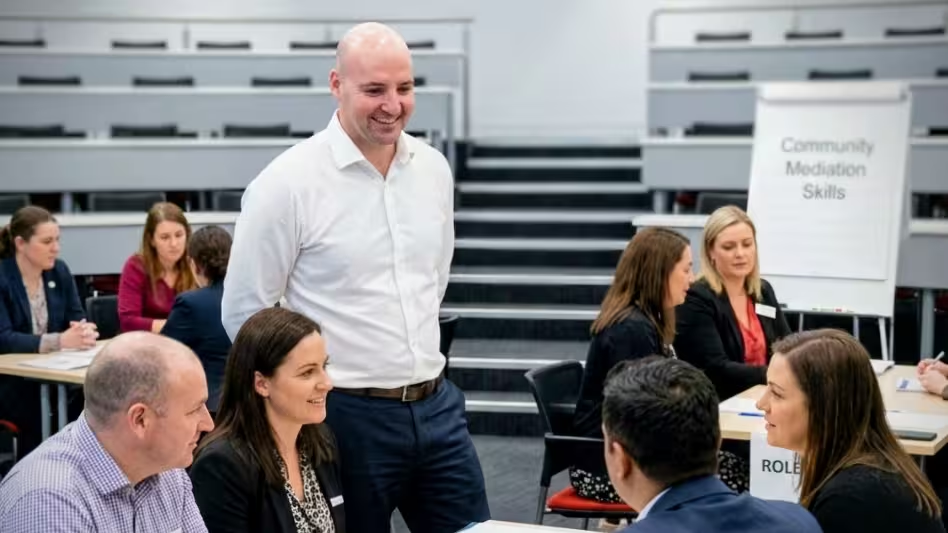
Thomas Gaultier leading a small-group exercise during a community mediation skills workshop, with participants working through a role-play scenario at round tables

Training Programs

What Mediation Training Covers

Effective community engagement requires specific, teachable skills. These training programs equip your teams with field-tested methods for preventing conflict before it escalates, managing disputes when they arise, and building the structured dialogue processes that protect both operations and community relationships.

All programs can be tailored to your company's operating context, the communities you work alongside, and the specific challenges your participants face.

Audiences

Who Benefits from Mediation Training

These programs are designed for professionals who work at the intersection of extractive operations and affected communities. Whether you are building a team's capabilities, investing in your own professional development, or strengthening your organization's community engagement capacity, the training is built around the realities of your work.

Mining, Oil & Gas, and Infrastructure Companies

Your community relations officers, social performance teams, and CSR professionals are on the front lines of stakeholder engagement. When they have the skills to recognize early warning signs, de-escalate tense situations, and manage difficult conversations, minor grievances stay minor.

Training helps your organization:

  • Build internal capacity to prevent and manage community disputes before they require external intervention

  • Equip field teams with structured methods for stakeholder engagement that go beyond relationship-dependent improvisation

  • Reduce operational risk from community conflict, including project delays, permit challenges, and reputational damage

  • Meet IFC Performance Standards and lender requirements for meaningful community engagement

  • Create consistent engagement quality across multiple sites and geographies

Consider training when: Your community engagement depends on individual personalities rather than organizational systems.

Community Leaders and Civil Society Organizations

Your ability to engage effectively with extractive companies and government agencies directly affects outcomes for the communities you represent. Understanding mediation processes, negotiation dynamics, and the operational realities of extractive projects strengthens your position at the table.

Training helps you:

  • Understand the mediation and negotiation processes used in extractive industry disputes

  • Prepare effectively for consultation, negotiation, and mediation sessions

  • Navigate technical complexity with confidence, from environmental impact assessments to benefit-sharing agreements

  • Identify when engagement processes are genuine and when they are performative

  • Build the skills to hold companies and government accountable to their commitments

Consider training when: You want to negotiate from knowledge, not just conviction.

Conflict Resolution and Social Performance Professionals

You work in mediation, dispute resolution, ESG, or social performance, and you want to specialize in the extractive sector. Generalist mediation training does not prepare you for the power asymmetries, technical complexity, and multi-stakeholder dynamics specific to mining, oil and gas, and infrastructure disputes.

Training helps you:

  • Develop sector-specific expertise that differentiates you from generalist practitioners

  • Understand the operational, financial, and regulatory pressures that shape extractive industry behavior

  • Learn frameworks for managing FPIC processes, grievance mechanisms, and multi-party negotiations

  • Build a professional network in the extractive industry community mediation field

  • Apply international frameworks, including IFC Performance Standards, to real engagement scenarios

Consider training when: You have mediation or social performance experience and want to deepen your extractive industry expertise.

Government and Regulatory Agencies

You oversee permitting, environmental review, or community consultation for extractive projects. When disputes between operators and communities end up on your desk, you need the skills to facilitate resolution, not just impose decisions.

Training helps your agency:

  • Build capacity to facilitate constructive dialogue between operators and communities

  • Ensure consultation requirements are met in substance, not just in form

  • Reduce the regulatory burden of managing protracted community disputes

  • Support durable outcomes that survive beyond the permitting phase

  • Strengthen institutional credibility with both communities and industry

Consider training when: Your regulatory tools alone are not producing resolution.

Why Extractive Industry Expertise Matters in Training

Read our Mozambique Study

Generic conflict resolution training teaches useful principles, but it does not prepare participants for the specific dynamics of extractive industry disputes. The power asymmetry between a multinational mining company and a rural community is not a footnote in this work, it is the central challenge. The history of broken agreements, FPIC processes reduced to checkboxes, and grievance mechanisms that function as complaint archives rather than resolution channels create a backdrop that generalist trainers are not equipped to address.

Thomas has worked inside these dynamics across multiple continents, from community mediation mandates in Mozambique and Zambia to embedded community relations roles in European mining operations. He has trained hundreds of mediators through ICFML (Instituto de Certificacao e Formacao de Mediadores Lusofonos), delivered community mediation training for a mining company's CSR and Ombudsman team in Zambia, lectured on mediation and negotiation at leading Portuguese universities, and delivered training for the Turkish Ministry of Justice on topics including risk analysis, advanced questioning techniques, and mediation service agreements. Every training program he designs draws on this field experience, not abstract theory.

I want them psychologically to come to terms with a change,

I want to get them to a point where they get to decide whether they want to be a part of the conversation.

Thomas GaultierMining Journal (March 2024)

Delivery

How Training is Delivered

Every training program is designed around your specific operating context, challenges, and development needs. There is no off-the-shelf curriculum. Thomas works with you to understand your situation, then builds a program that addresses the real dynamics your teams face.

Every program is tailored. Before any training begins, Thomas conducts a needs assessment to understand your operating context, the communities your teams work alongside, and the specific challenges your participants face. This is not a modular curriculum where you pick from a menu. It is a collaborative design process that produces training built specifically for your situation.

Common Questions

Questions Thomas is regularly asked about mediation training for extractive industries.

Common questions about training programs, delivery, customization, and outcomes. If your question is not answered here, please contact me directly.

How do you tailor programs to our specific context?

Every engagement begins with a needs assessment. I interview key stakeholders, review relevant materials about your operations and community context, and identify the specific skill gaps and challenges your team faces.

This assessment shapes the training content, examples, and scenarios so that participants work with situations that reflect their actual operating reality, not generic case studies from unrelated sectors.

The goal is that every exercise and discussion connects directly to the work participants will do after they leave the room.

What is the typical duration for a training program?

Duration depends on scope and depth. Single-topic workshops can run as focused half-day or full-day sessions.

Comprehensive programs covering multiple competency areas typically run two to five days. For organizations building sustained capability, I design phased programs that combine initial intensive training with follow-up sessions, coaching, and refresher workshops over several months.

We determine the right format during the needs assessment based on your objectives, team availability, and budget.

Can training be delivered in languages other than English?

Yes. I deliver training in English, French, and Portuguese, and can work with interpreters for other languages.

For organizations operating in multilingual environments, I design materials and exercises that account for language dynamics, ensuring that participants who are working in their second or third language are not disadvantaged.

What makes this different from generalist mediation or conflict resolution training?

Three things.

First, every program is built specifically for extractive industry contexts, addressing the power dynamics, technical complexity, regulatory environment, and community expectations that are unique to mining, oil and gas, and infrastructure operations.

Second, the training draws on documented field experience across multiple geographies, not textbook case studies.

Third, the programs address the full range of situations extractive industry professionals actually encounter, from routine stakeholder meetings to full-blown community crises.

Generalist training rarely covers any of these adequately.

Who typically attends these training programs?

Participants range from community relations officers and social performance teams to legal counsel, operations managers, and C-suite executives.

I also train government regulators, NGO staff, community leaders, and conflict resolution professionals looking to specialize in the extractive sector.

Group composition matters, and I often recommend mixing roles within a training program so that community relations staff, operations managers, and legal teams develop shared language and aligned approaches.

What outcomes should we expect from training?

Training does not eliminate conflict.

Conflict is inherent in extractive operations that affect communities. What training does is give your teams the skills to manage it effectively: recognizing early warning signs before situations escalate, conducting difficult conversations with competence and confidence, designing engagement processes that produce durable outcomes, and responding to crises without making them worse.

Organizations that invest in these capabilities report fewer escalated disputes, faster resolution when conflicts do arise, and stronger relationships with the communities they work alongside.

Most training programs start with a single conversation.

A brief call is enough to understand your situation, your team's development needs, and whether Thomas can help. No obligation, no generalist pitch.

Discuss Your Training Needs