
Building Trust Through Data Transparency
Most mining conflicts I have worked near run on an information gap before they run on anything else.
From the field
Practical analysis on social license, grievance mechanism design, FPIC and community conflict in the extractive sector. Most of these start with something that went wrong on a mandate.
Most mining conflicts I have worked near run on an information gap before they run on anything else.
A single WhatsApp voice note can shut your access road by morning. I once watched a rumor about contaminated water move through three villages in a day.
Artificial intelligence can make a grievance mechanism faster, more organised, and much harder to ignore, but it cannot resolve a single grievance.
Reply to an article
This is the most insightful article I have read in a long time. So agree with your comment that companies invest heavily in the appearance of process and starve the substance, then they pay for the difference in delay, blockade, and lost production. Early and professional engagement is an investment, not a cost.
The most effective community engagement technology I have watched a mining company deploy was a community liaison office and a set of hand-held...
Reply to an article
Your framing of social performance as a financing, permitting and execution issue, not just a community relations issue, feels exactly right. That shift is becoming visible on lender-driven projects.
The most effective digital engagement tool I have seen in a remote mining area is not a portal or an app.
Reply to an article
Sometimes I find your posts depressing. I thought some of these things were standard practice. Not best practice, or even good practice, just standard. Thank you for highlighting them, since apparently people are still not getting it.
Mine closure is an economic and social event that happens to involve environmental remediation.
When a mining company and a surrounding community fall into open conflict, attention goes to the acute dispute.
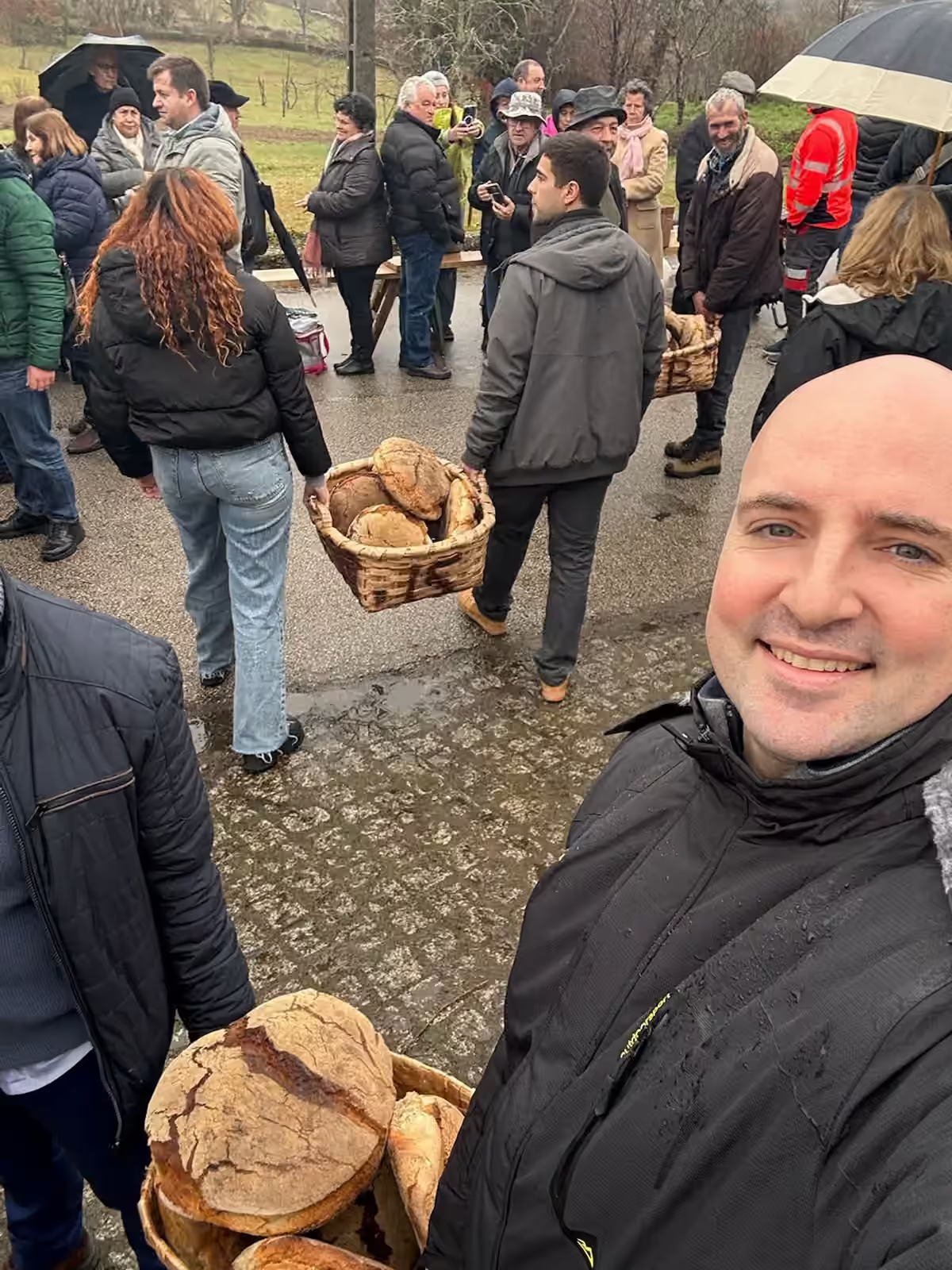
I have stood in northern Portugal, in the Barroso region, and watched opposition to a mining project up close.
The community relations manager carries one of the most demanding roles in mining. You represent the company while you also advocate for the community.
Reply to an article
Excellent article, and it absolutely speaks to trends that have been taking place across the Australian mining sectors for some years.
The community relations skills that matter most in mining are not the ones listed in typical job descriptions.
Most community relations frameworks treat all mining the same way. They should not.
Employment is the most volatile trigger of conflict between mining companies and the communities around them.
Two mining systems often want the same ground. An industrial company holds a legal concession with exclusive mineral rights.
Water disputes are the hardest conflicts a mining project will face, and the reason is structural. You can survey a contested land boundary.
Mining operations sit where corporate interests, government authority, and community land rights collide.
Environmental justice mediation in mining needs shared facts, community capacity and remedies that address harm and dignity.
Design remote mining mediation around travel, neutral venues, local authority, access and time for community decisions.
Choose online, in-person or hybrid mining mediation by weighing trust, cultural protocol, access and power before you convene.
Co-mediation in mining disputes works when roles, authority, language and trust anchors are set before talks begin.
Cross-cultural mining mediation starts with local authority, land, time and agreement norms. Learn how to build a process communities can trust.
Mediating multi-stakeholder mining conflicts requires mapping constraints, testing interests, and building consent that can adapt over time.
Match mining mediation tools to the right moment, from power mapping and fact-finding to monitoring clauses that help agreements hold.
Use reality testing in community mediation to examine alternatives, compare evidence, and adjust expectations without signaling mediator bias.
Caucusing in mining disputes can build trust or deepen power gaps. Learn when private sessions help and how to structure them fairly.
Power imbalances in mining mediation demand safeguards. Learn how to protect informed community participation and fair process.
Resolve cultural heritage disputes in mining through early assessment, design changes, avoidance, mitigation, and co-management.
Design gender-inclusive mining engagement so women can shape decisions through safe forums, local information, and responsive changes.
Work with traditional leaders in mining by verifying authority, mapping decision-makers, honoring protocol, and preventing captured consent.
Build trust with Indigenous communities through rights-based engagement, independent facilitation, shared agreements, and accountability.
Learn what FPIC requires in mining, from governance mapping and independent advice to ongoing consent and durable community agreements.
Community consultation rules vary by country, lender, and EU exposure, so mining projects should plan to the highest enforceable standard.
Stakeholder mapping for mining projects identifies hidden actors, power shifts, relationships, and company constraints before engagement starts.
A stakeholder engagement plan works when it names real groups, funds participation, closes feedback loops, and resolves disputes independently.
Consultation to collaboration explains how mining projects move from informing communities to shared decision authority that can hold.
Meaningful community engagement shows whether affected people shaped mining decisions, not just attended meetings or signed registers.
Early stakeholder engagement lets mining teams surface risks, protect trust, and shape project design while exploration choices remain open.
Post-conflict mining needs conflict-sensitive engagement, honest risk planning, and mediation before board approval in fragile regions.
Critical minerals community relations require consent built for faster timelines, new actors, benefit pressure, and transition-era risk.
Mining community consultation rules differ sharply across Canada, Australia, and Africa. Compare consent, benefit, and lender standards.
ESG community engagement now carries legal and financial exposure. See where mining compliance fails and how to build defensible records.
Community risk due diligence shows how mining investors can price conflict, consent gaps, and mediation capacity before they sign.
Good neighbor agreements help bridge early mining uncertainty by defining commitments, monitoring, dispute paths, and a transition to a CBA.
CBA case studies show why clear benefit formulas, independent monitoring, community control, and dispute paths decide whether agreements hold.
Community benefit agreement renegotiation needs clear triggers, neutral facilitation, shared evidence, and review terms before disputes harden.
CBA dispute resolution clauses work best when they put consultation, mediation, expert review, and arbitration in the right order.
CBA implementation needs governance, monitoring, capacity, and review systems that keep mining agreements working after signature.
CBA legal frameworks determine enforceability. Compare statutory, contractual, regulatory, and reputational enforcement across mining regions.
CBA financial structures shape durable community benefits. Compare five revenue-sharing models, formula choices, governance, and safeguards.
Community participation in CBA negotiations requires inclusive representation, independent advice, capacity building, and accountable processes.
Community benefit agreement pitfalls hide in vague clauses. Learn practical fixes that make CBA commitments measurable and enforceable.
Learn the 10 essential CBA elements that make a community benefit agreement measurable, enforceable and durable through the full mine life.
Estimate mining community conflict costs, from delay and lost output to social-license risk, and compare prevention spend.
Detect mining community conflict early with signal tracking, clear triggers, and mediation before grievances escalate.
Grievance mechanism design for mining: build trust, deliver real remedy, and route hard cases into mediation.
Silence can break stakeholder trust on delayed mining project. A practitioner's guide to communication, mediation, and keeping your social license.
Know when to hire a mining community mediator, when to trust your CR team, and how to avoid costly stakeholder escalation.
This is what social license to operate looks like in 2026. Not a slide in a sustainability deck. Not a number on a regulator's checklist. A daily judgment
A genuine apology is the foundation of durable mining conflict resolution. A practitioner guide for community relations directors and ESG leaders.
Adversarial mining conflicts need relationship transformation, not settlement. A practitioner guide for ESG leaders and community relations teams.
Community mediation for infrastructure projects. Strategies for pipeline, road, and dam projects adapted from extractive industry best practices.
Discover the critical differences between mining and oil & gas community relations. Field-tested strategies for each sector. Get expert guidance.
Critical minerals projects are generating community conflict at scale. A practitioner risk analysis for ESG leaders and social performance teams.
What social performance work in mining does to the people who do it, and a practical framework for building resilience, from fifteen years in the field.
What is changing in mining community relations? 2026 trends analysis with strategic implications and recommendations for extractive industry professionals.
Social performance indicators for mining that measure outcomes, not activities: community trust, commitment delivery, and resilience.
Learn when and how to deploy shuttle diplomacy in mining conflicts. Field-tested protocols for mediators navigating high-tension extractive disputes.
IBAs and CBAs differ in legal foundation and parties. A practitioner comparison for mining executives and community agreement negotiators.
Uncover root causes of mining-community conflicts with a practical framework. Discover prevention strategies for better relations and reduced risks.
Social Accord Architecture is a new professional discipline for designing, building, and maintaining the structured processes through which industrial
When community protests block your mining operation, your first priority is stabilization, not resolution. You cannot negotiate comprehensive agreements while
Complete guide to negotiating CBAs for extracting industries. Get enforceable targets for jobs, procurement, revenue sharing, and penalties.
How to mediate land access disputes in mining: A practitioner's guide to the 6-phase process, power balancing strategies, and durable agreements.
Learn how mediation helps mining companies earn social license to operate (SLO) by shifting from transactional permits to genuine relationship building.
Transform community resistance from an obstacle into a resource. Learn how mediation converts adversarial pushback into collaborative problem-solving.
Resolving human rights conflicts in mining: why traditional methods fail and how trauma-informed, culturally grounded mediation prioritizes accountability.
Learn how early, mediation-driven dialogue prevents land access conflicts in mining. Practical strategies for building trust with host communities.
Discover how professional mediators can help mining companies identify tensions early, facilitate difficult conversations, and prevent community conflicts from escalating into costly project delays.
A breakdown of the seven core qualities that distinguish exceptional practice, and which ones can be trained and developed.
Mining disputes aren’t resolved by data alone. Discover how mediation bridges facts and emotions to build trust, address fears, and restore dialogue.
This article explains why communities resist change, and how mediation can turn opposition into meaningful dialogue, and co-created solutions.
This article explains why integrating mediation into grievance systems builds trust, accountability, and stronger stakeholder relationships.
The quoted replies are unsolicited public comments on articles published here, quoted by role rather than by name. Nobody was asked for them, so the people who wrote them stay unnamed.
One email when I publish something worth your time. Case studies, mediation lessons and engagement strategies from fifteen years in the field.
A 30-minute call is enough for me to understand the situation and tell you honestly whether I can help. Active opposition, a social license problem, an FPIC process that needs an independent facilitator, a negotiation a community has to prepare for, or a conflict that is not public yet but will be. It makes no difference which side of the table you are on. No obligation, no generalist pitch.
Every first conversation is confidential.