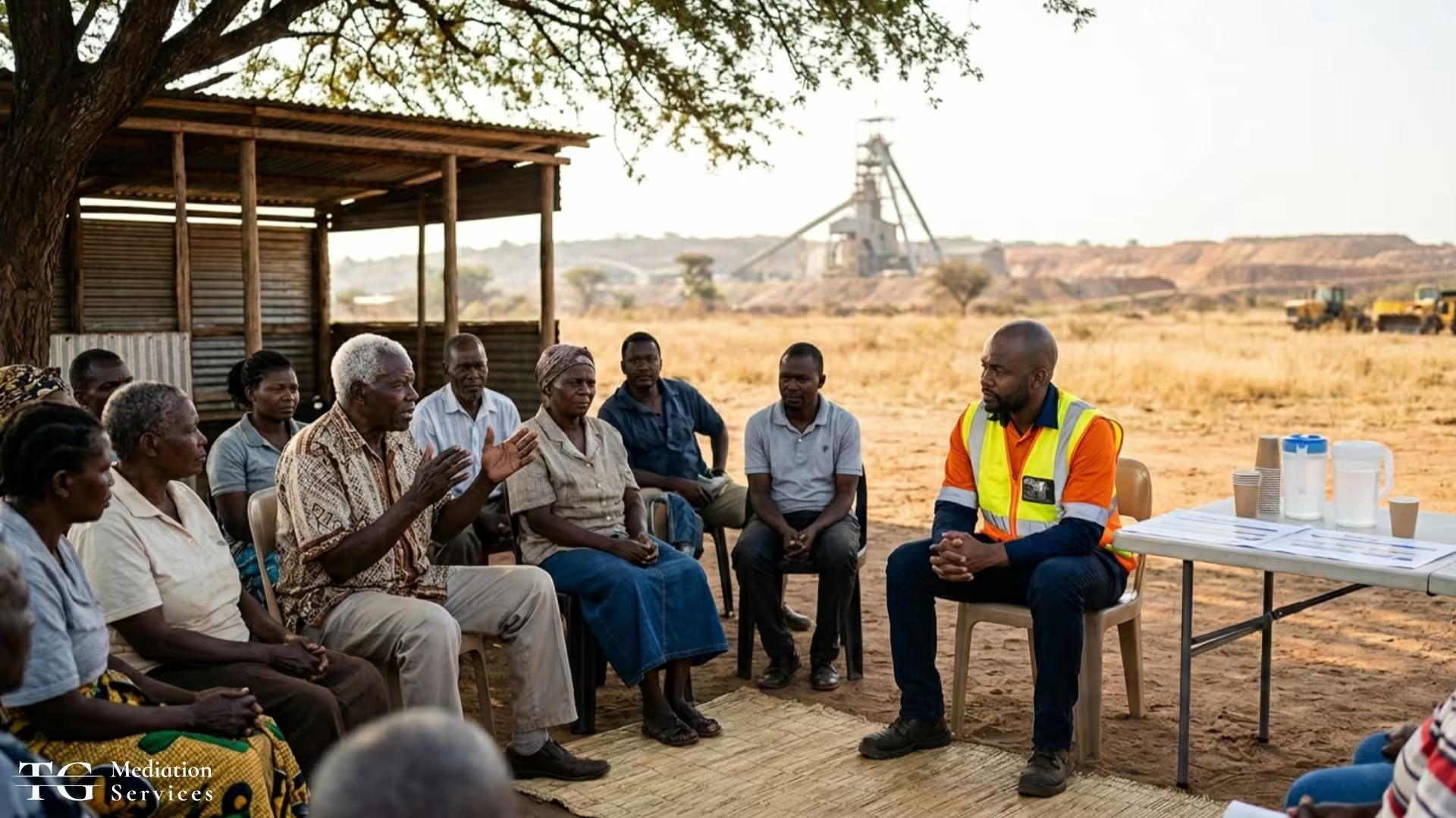
In Mozambique, I spent years inside a grievance mechanism that resolved more than two thousand community claims. The mechanism mattered. What mattered more was what it told us before any claim was ever filed. Long before a complaint reached the logbook, the signs were already there. A village leader who used to arrive early now sent a deputy in his place. Questions at the community forum drifted from “when will the road be repaired” to “who decided this without us.” Field staff came back from site visits quieter than usual. None of that was a grievance yet. All of it was a warning.
Most mining companies wait for the grievance. They treat the formal complaint as the start of the problem, when the complaint is already the second or third act. By the time a tension becomes a claim, and the claim becomes a confrontation, the company has spent the cheapest window it will ever have. An early warning system closes that gap. It reads the signals that come before complaints, while the relationship is still repairable and the cost of fixing it is still small. This is what we built before complaints became confrontations, and it is the most useful piece of social infrastructure a mine can own.
Reaction is the most expensive strategy you can choose
The conventional approach to community conflict is to wait. The company waits for a problem to surface through a formal grievance, a journalist’s call, or a crowd at the gate. By then the conflict has already hardened. A groundwater concern that surfaced six months earlier, left unaddressed, has become the rallying point for a broader community movement. A late payment to local suppliers has become proof that the company never intended to honor anything. A broken hiring promise has settled into a story about corporate deception that circulates until it becomes accepted fact.
The financial case for moving earlier is well documented. Franks and colleagues set this out in the Proceedings of the National Academy of Sciences in 2014. They showed that company-community conflict translates environmental and social risk directly into business costs, through delays, disruptions, and lost productivity. Those costs are real, large, and almost always avoidable at the early stage. They become unavoidable once a conflict is entrenched.
There is also a craft problem here. A grievance mechanism that only logs and resolves complaints is doing useful work, but it is working at the wrong end of the timeline. As I argue in why a grievance mechanism on its own is not enough, the mechanism becomes powerful only when it feeds something larger. It must feed a system that watches for tension before tension becomes a filing. The complaint log is a rich source of early signals. Read as data rather than as a queue of tasks, it tells you which issues are clustering, which language is escalating, and which groups are starting to organize. Reaction treats each complaint as an isolated event. Early warning treats the pattern as the message.
Conflict does not arrive suddenly
Serious conflicts do not appear from nowhere. They move through stages, and each stage leaves a trace. Grievances emerge. They escalate through informal channels. They accumulate when no one resolves them. They shift from an individual problem to a collective identity. They attract wider participation. They activate enforcement, in the form of boycotts, blockades, or occupations. Frameworks like the UNDP’s work on extractive-industry conflict and the Fund for Peace’s Conflict Assessment System Tool map exactly this kind of trajectory, and they make one point clear. Every stage is an exit. Every stage offers a chance to intervene before the next one begins.
The signals are usually quiet. They live in informal conversations, in who attends the community forum and who stops attending, in the structure of the grievances you receive. They show up in shifts in community leadership, in the tone of local radio, in the slow withdrawal of a leader who used to take your calls. Most companies hear these signals and treat them as background noise. An early warning system treats them as the most valuable data the company collects. The understanding of how conflicts build from root causes is something I cover in detail in the anatomy of mining-community conflicts, and the practical lesson is consistent. If you know the sequence, you can read where a relationship sits on it.
The five categories of signal worth tracking
An early warning system needs structure, or it collapses into a pile of anecdotes. Sort what you observe into five categories, and the picture sharpens.
Institutional signals are changes in how the community governs itself. New organizations form around mining issues. Younger or more assertive voices rise into leadership. A previously unified position fractures. In several West African contexts, the first real signal was a women’s committee or a youth association forming specifically to address mine impacts, bypassing traditional authority.
Behavioral signals are changes in how people act toward you. Attendance at forums climbs or drops. The questions shift from specific project matters to questions of justice and identity. Incidents at the project boundary increase in frequency. A boycott of company services begins.
Information signals are changes in the story being told. Local radio moves from neutral to critical. Written grievances circulate. Communities hold information sessions and do not invite you. Photographs and video of impacts are compiled and shared.
Grievance signals come from your own mechanism, and a mechanism built to resolve rather than log produces the cleanest ones. Volumes rise. Complaints cluster around one issue rather than scattering. Language escalates. Submissions arrive from organized groups instead of individuals. Cases sit unresolved past their normal timeframe.
Relational signals are the quietest and the most telling. A key community figure becomes hard to reach. Leaders decline your invitations. They start seeking outside support, from lawyers, civil society, or the press. When the people who used to talk to you go looking for someone else to talk to, the relationship is already moving.
From signal to action: a three-status rule
Signals are worthless if no one is required to act on them. The fix is a simple escalation rule that removes discretion. Use three statuses: green, yellow, and red.
Green is normal. Grievance volumes are stable, leadership is steady, coverage is neutral, and the community engages through your formal channels. The required action is to keep doing what works.
Yellow is emerging tension. Grievances rise and cluster, leadership shifts, an organized group forms, the tone of local coverage turns critical. Yellow must trigger something automatic. That means escalation to senior management, a small task force on the specific issue, and direct conversation with community leaders to understand it properly. It also means an honest review of whether your response to the underlying problem has actually been adequate.
Red is active conflict. Organized opposition escalates quickly, grievances exceed your capacity to resolve them, infrastructure is occupied, the state intervenes, national media arrives, or someone’s safety is at risk. Red must reach the executive level, bring in external mediators or facilitators, and force a strategic review that may include real changes in company practice.
The point of the rule is that it is not optional. When the defined signals appear, the response activates on its own, without waiting for someone senior to decide the situation is serious enough. The same logic of moving at the first sign of strain, rather than the last, sits behind defusing land access conflicts through early dialogue. Early dialogue only happens if something tells you to start it early.
Building the system: networks, readiness, and learning
A warning system rests on three practical foundations. The first is an integrated information network. Your grievance mechanism, your structured meetings with leaders, your community monitors, and your periodic independent surveys should feed one shared view of community sentiment. So should the informal intelligence your field, security, and procurement staff pick up. Most companies keep these channels separate, so HR sees the hiring complaints, community relations sees the falling attendance, and security sees the gate tension, and no one connects them. Integration is what turns scattered observations into a signal.
The second foundation is response readiness, built before you need it. Trained community relations staff with the right language and cultural fit. Standing relationships with respected mediators you can call quickly. Budget authority that lets a manager act without waiting weeks for sign-off. Pre-identified issues, figures, and external actors most likely to feature in a dispute. Readiness does not script the response. It ensures you are not starting from zero when the clock is already running.
The third foundation is learning. After every detected tension, ask what the response actually achieved. Did it prevent escalation, or only suppress the surface symptom while the cause stayed live? Which signals appeared that your framework missed? Which fired often but led nowhere? Feed the answers back into your indicators and thresholds. A system that never updates drifts steadily out of touch with the conflicts you actually face.
To make this concrete, consider a scenario drawn from patterns across mid-sized East African gold operations. A mine runs stable for five years. In year six, the signals begin. Three advisors to a local chief go quiet, forum attendance falls by a third, and grievances cluster around outside hiring for skilled roles. A community survey on water quality starts circulating. No single department sees the whole shape. A company that reads these as one connected signal can act in time. It can adjust hiring, widen consultation to younger leaders and women’s groups, and resolve the issue while it is still small. A company that treats each piece as noise meets the same problem a year later, fully formed.
To put structure around your own assessment, you can work through the audit tool below before you design anything new.
> Download: The Mining Conflict Early Warning Audit, a 16-point self-audit that scores how well you can detect and act on conflict signals across all five system elements.
Where these systems fail
Most early warning systems do not fail because the indicators are wrong. They fail for reasons that have nothing to do with detection. Knowing the common failure modes is the cheapest insurance you can buy, because each one is avoidable before you start.
The first and most damaging failure is building a system without executive commitment. A warning system only works if senior management agrees, in advance, to act on what it reports. If executives wave through yellow status because the project timeline matters more, the system does exactly the wrong thing. It documents a conflict forming while the company keeps doing the thing that forms it. The person who owns the system needs explicit executive authority and a standing line to the people who can change course. Without that, you have built a record of decisions no one was willing to make.
The second failure is listening only to formal grievances. Communities signal long before they file. Leaders change how they behave, conversations shift in tone, attendance drops, the radio turns. A system that watches only the complaint log detects conflicts after they have already grown. Informal intelligence is not a supplement to the system. It is the part that buys you time.
The third failure is standing the system down after the first success. You catch one emerging tension, you manage it well, and the temptation is to declare the problem solved and move on. Community circumstances never stop moving. New leaders rise, project phases change, fresh issues surface. A system left to lapse becomes steadily less relevant to the conflicts you actually face. Treat it as permanent infrastructure, not a project with an end date. The cost of running it is modest. The cost of the conflict it prevents is not.
Start with what you can already see
You do not need a large budget or a new department to begin. You need to stop treating the signals you already collect as separate streams. Take one month. Pull your grievance log, your meeting notes, your survey results, and an honest conversation with your field and security staff into a single weekly brief. Define a baseline for each of the five signal categories, so you know what normal looks like before you try to detect change. Write down, in advance, what moves you from green to yellow and what each status obliges you to do. Name one person who owns the brief and has a direct line to someone who can authorize a response.
That is the whole foundation. The rest is refinement. The mechanism in Mozambique resolved more than two thousand claims. But the real return was the claims it never had to resolve, the confrontations that never formed because we acted on the quiet signals first. Reaction will always cost you more than attention. Detecting a signal early is only half the work. The other half is responding through facilitated dialogue before positions harden, which is where a skilled mediator changes the outcome. The Social Accord Architecture connects the two, pairing early detection with a structured mediation response so tension converts into conversation rather than conflict. If you want help designing or stress-testing an early warning system for a specific operation, reach me via my contact form.