Community conflict is a financial risk. Most boards price it at zero until the invoice arrives, and by then the number is far larger than anything prevention would have cost. This is not a social responsibility argument. It is a balance-sheet argument, and the evidence behind it is now strong enough to belong in every project’s risk register and every investment committee’s due diligence.
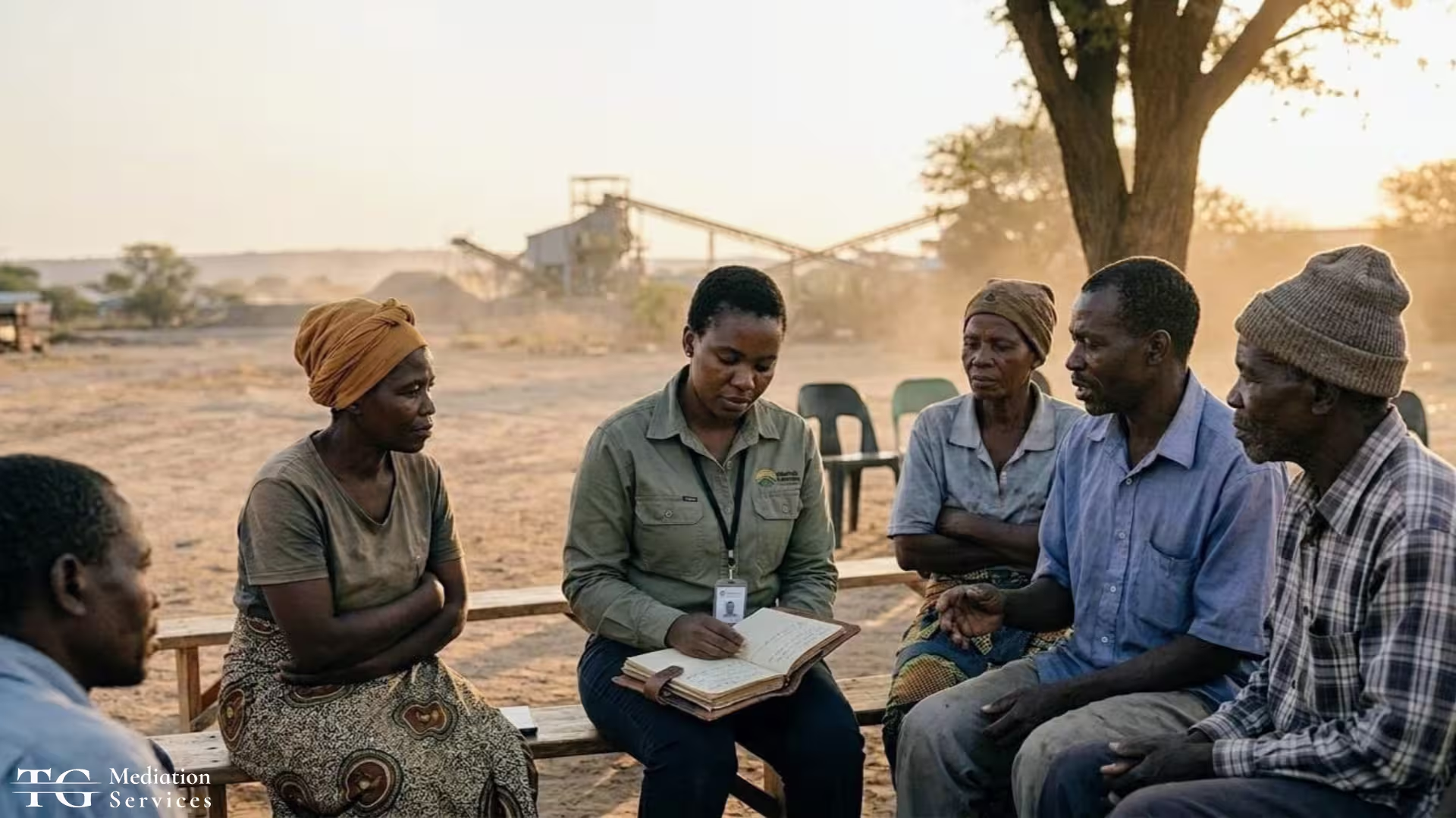
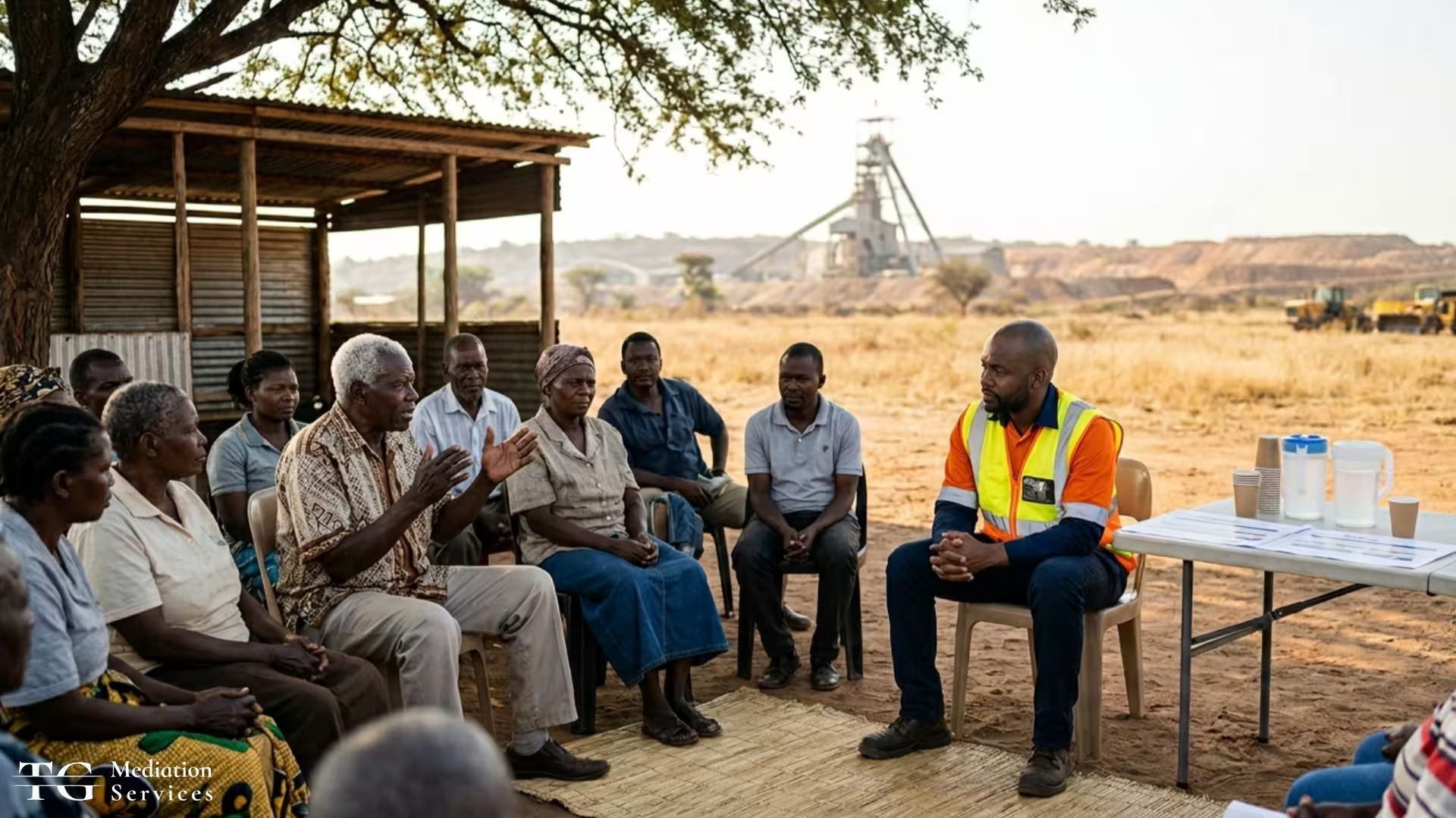
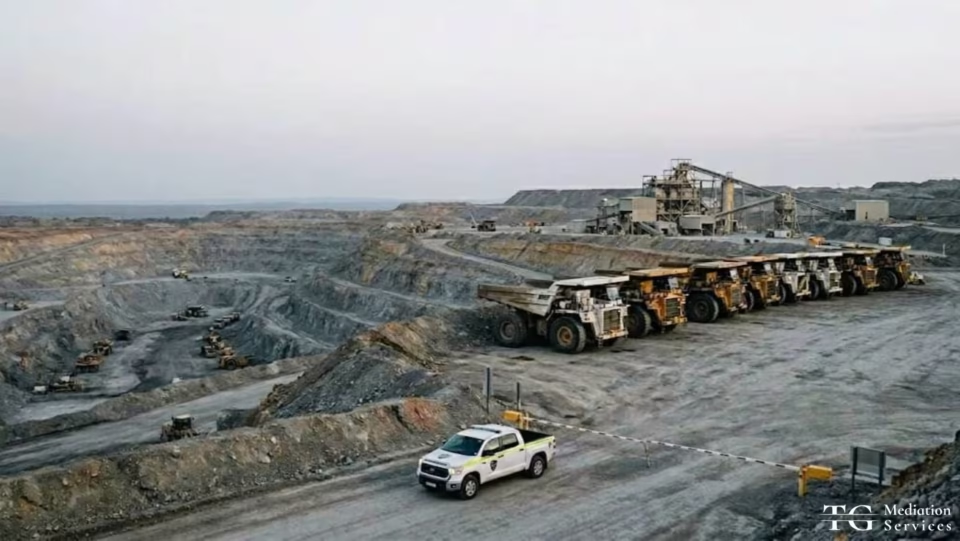
I have stood at a mine gate during a community blockade. The haul trucks were parked. The processing plant ran far below capacity. Contractors stayed on full pay and did nothing, because there was nothing they were allowed to do. That operation was losing tens of thousands of dollars a day, and it was a small site. No one had put that figure in a forecast. The blockade did not appear overnight. It grew over months from grievances the company had logged and left unresolved. The cost was real, it was large, and it was avoidable. That is the pattern this article is about.
The number that never reaches the risk register
Most mining companies do account for conflict costs. They just file them under other names. A blockade becomes an “operational delay.” Extra guards become a “security line item.” Payments to end a standoff become “community relations spend.” Each entry is recorded honestly, and the underlying driver disappears. The board sees a scatter of unrelated costs, never the single cause sitting behind them.
This matters because what you cannot name, you cannot manage. When conflict costs are spread across a dozen budget lines, no one owns the total, and no one builds the business case to prevent it. Franks and colleagues made exactly this point in the Proceedings of the National Academy of Sciences in 2014. Companies that fail to identify and aggregate the full range of conflict costs consistently underinvest in prevention. Their research found that one company’s analysis of its own non-technical risk exposure revealed costs of roughly six billion dollars over two years. The costs were always there. The company simply had not added them up.
The first discipline, then, is accounting. Give conflict cost a single line of sight. Track the delay days, the security uplift, the legal spend, the settlement payments, and the management hours under one heading tied to their real cause. The act of aggregation changes the conversation. A board that sees conflict as a scattering of small operational annoyances treats it as noise. A board that sees one large, recurring, preventable number treats it as risk. The work of tracing each cost back to the grievance that produced it depends on understanding how these conflicts build. That sequence, from first signal to open dispute, is covered in the anatomy of mining-community conflicts.
Cobre Panama: when social risk becomes a balance-sheet event
The clearest recent illustration is Cobre Panama. In November 2023, after weeks of mass protests, Panama’s Supreme Court ruled First Quantum’s mining contract unconstitutional and the mine was ordered to close. Two protesters were killed during the unrest. The operation was not a marginal asset. It produced around 330,000 tonnes of copper a year, roughly 40% of First Quantum’s revenue. It accounted for about 5% of Panama’s GDP and close to 75% of the country’s goods exports.
None of that protected it. The total investment, more than ten billion dollars and the largest in Panama’s history, was stranded almost overnight. The mine has since sat in preservation and safe management, which costs an estimated fifteen to twenty million dollars a month while producing nothing. The company faces arbitration and a collapsed share price that limits its ability to fund projects elsewhere.
The cause was not resource depletion or a price crash. It was social and environmental opposition that had built for years, combined with a contract renegotiated without securing genuine public consent. The lesson for a board is not that Panama is unusually risky. The lesson is that strategic costs from a loss of social acceptance can exceed the entire capital investment in a project. A mine can be technically sound, fully financed, and still be closed by the people who live next to it. That is the exposure that rarely sits on a risk register, and it is the one that can end a project outright.
Three layers of cost, and why the deepest is the one boards miss
Conflict costs sit in three layers, and the visible layer is the smallest. Direct costs are the daily operational losses: suspended production, idle equipment, added security, legal fees, remediation, and settlement payments. These show up in project accounts. They hurt, but they are recoverable, and they are the costs most companies already track.
Indirect costs are larger and slower. A conflict that delays a project does not just cost the delay days. It extends financing, raises capital costs through inflation, pushes commodity exposure past the original hedging horizon, and lets competitors reach market first. Consider an 800 million dollar project with a four-year build. If conflict adds eighteen months, the damage runs through the entire model. In an illustrative analysis, an eighteen-month delay can cut a project’s internal rate of return by 150 to 250 basis points. That swing alone can move a marginal project from viable to dead.
Strategic costs are the deepest layer, the hardest to quantify, and the one boards consistently underweight. They include permanent loss of social acceptance in a jurisdiction, the foreclosure of nearby expansion, distressed asset sales, and lost access to capital when investors reprice the company’s risk. Cobre Panama is the strategic layer made visible. These costs do not appear in a delay calculation because they are not about delay. They are about whether the project, and sometimes the company’s wider pipeline, has a future at all. A board that budgets only for the direct layer is insuring the cheapest part of the loss and leaving the expensive part uncovered.
What conflict costs, line by line
Boards plan better when the exposure is itemized rather than described. Here is what the layers tend to look like for a mid-tier operation. These are practitioner planning ranges, not figures from any single project, so treat them as a way to scope your own model rather than as fixed numbers.
Start with the direct layer. Operational loss during a suspension runs from a few hundred thousand dollars a day on a large operation down to tens of thousands on a small one. The driver is commodity price, throughput, and project stage. Added security and site hardening during a sustained dispute commonly runs several million dollars a year. Legal response to a serious dispute, covering challenges, injunctions, and arbitration, ranges from low single-digit millions into the tens of millions per event. Remediation and compensation, once damage is done and trust has to be rebuilt, can run from a few million into the tens of millions.
Then come the layers that dwarf these. A delay of a year or more adds financing and inflation costs that compound month after month across the whole capital base. The strategic layer is larger still. A lost jurisdiction or a foreclosed expansion can reach into the hundreds of millions, or it can end the project outright, as Panama showed.
The point of itemizing is not the precision of any single figure. It is what happens when you lay the totals side by side. A serious community engagement program for the same operation costs single-digit millions a year. Set that one figure against the stacked exposure above, and the comparison stops being a debate about values. It becomes an obvious allocation decision. The numbers also reveal where contingency planning is thin. Most companies carry reserves against equipment failure and price swings. Few carry an equivalent reserve against the social risk that has closed more mines in the past decade than either.
The prevention math holds up
The case for prevention is not a matter of values. It survives a straight financial comparison. Compare the cost of engagement against the probability-weighted cost of conflict, and the numbers favor engagement in almost every realistic scenario.
Take the same 800 million dollar project. A serious community engagement program, running from exploration through early operations, costs in the range of five to twelve million dollars a year. Assume eight million. Without it, a risk team might put the probability of significant conflict during development at around 50%. With structured engagement from the start, that probability falls materially, to something closer to 15%.
Now weigh the two paths. With no engagement, the expected cost is the probability multiplied by the combined direct, delay, and lost-return exposure, and it runs well into nine figures. With engagement, you pay roughly thirty-two million dollars over four years and cut the probability of the large loss by more than half. In an illustrative model built on these assumptions, engagement returns about two dollars for every dollar spent, and that is before counting the strategic costs it helps you avoid entirely. The exact multiple shifts with project size, commodity, and community profile. The direction does not. The expected cost of conflict without engagement consistently exceeds the cost of engagement plus the residual risk that remains.
The reason companies still underinvest is the accounting failure described earlier. If you never aggregate the cost of conflict, you will always underestimate the return on preventing it. Mediation positioned as a strategic tool for social license is one of the clearest expressions of this logic. The return is not soft. It is measurable, and it compounds across the life of the asset.
Where the highest-return prevention spending goes
Not every engagement dollar produces equal value. A board allocating a social risk budget should concentrate it where it demonstrably lowers conflict probability. Five areas carry most of the return.
Genuine consent processes at project commencement reduce the conflicts that come from communities never having agreed in the first place. Independent grievance mechanisms catch complaints while they are still cheap to resolve, long before they become protests. An early warning system that reads the signals before complaints form is the cheapest catch of all. As I argue in why a grievance mechanism alone is not enough, the mechanism only pays off when it feeds early action rather than a filing cabinet. Community-led monitoring reduces the suspicion and misinformation that drive escalation. Dedicated community relations staffing keeps a steady relationship with leadership so problems surface in a meeting rather than at the gate. And well-built community benefit agreements, with commitments that are specific and actually delivered, convert opposition into a stake in the project’s success.
To put a number on your own exposure before you set that budget, work through the model below. It turns the three cost layers into a single probability-weighted figure you can take to an investment committee.
> Download: The Community Conflict Cost Exposure Model, a fill-in template that helps CFOs and risk teams estimate direct, indirect, and strategic conflict costs against the cost of prevention.
What a board should ask next quarter
You do not need a new framework to start. You need three questions on the agenda at the next risk review. First, what did community conflict actually cost us last year, pulled out from under the line items that hide it and added into one number? Second, what is our probability-weighted exposure on each active project if a serious dispute develops, across all three cost layers, not just the operational one? Third, what are we spending to prevent it, and how does that figure compare to the exposure we just calculated?
Most boards cannot answer the first question, which is why they underprice the third. The companies that manage social risk well are not the ones with the largest community budgets. They are the ones that treat conflict cost as a real, ownable number and fund prevention against it like any other risk. The blockade I watched cost more in a week than a year of decent engagement would have. That trade is available on almost every site, and it is a financial decision before it is anything else. The cheapest way to lower this exposure is to resolve disputes through mediation before they reach the balance sheet as delay and lost production. Independent facilitation settles conflicts at a fraction of the cost of litigation, blockades, or a stalled project. The Social Accord Architecture is the methodology I use to build that mediation capacity into a project from the start, as a financial control rather than an afterthought. If you want help quantifying the exposure on a specific project, reach me via my contact form.