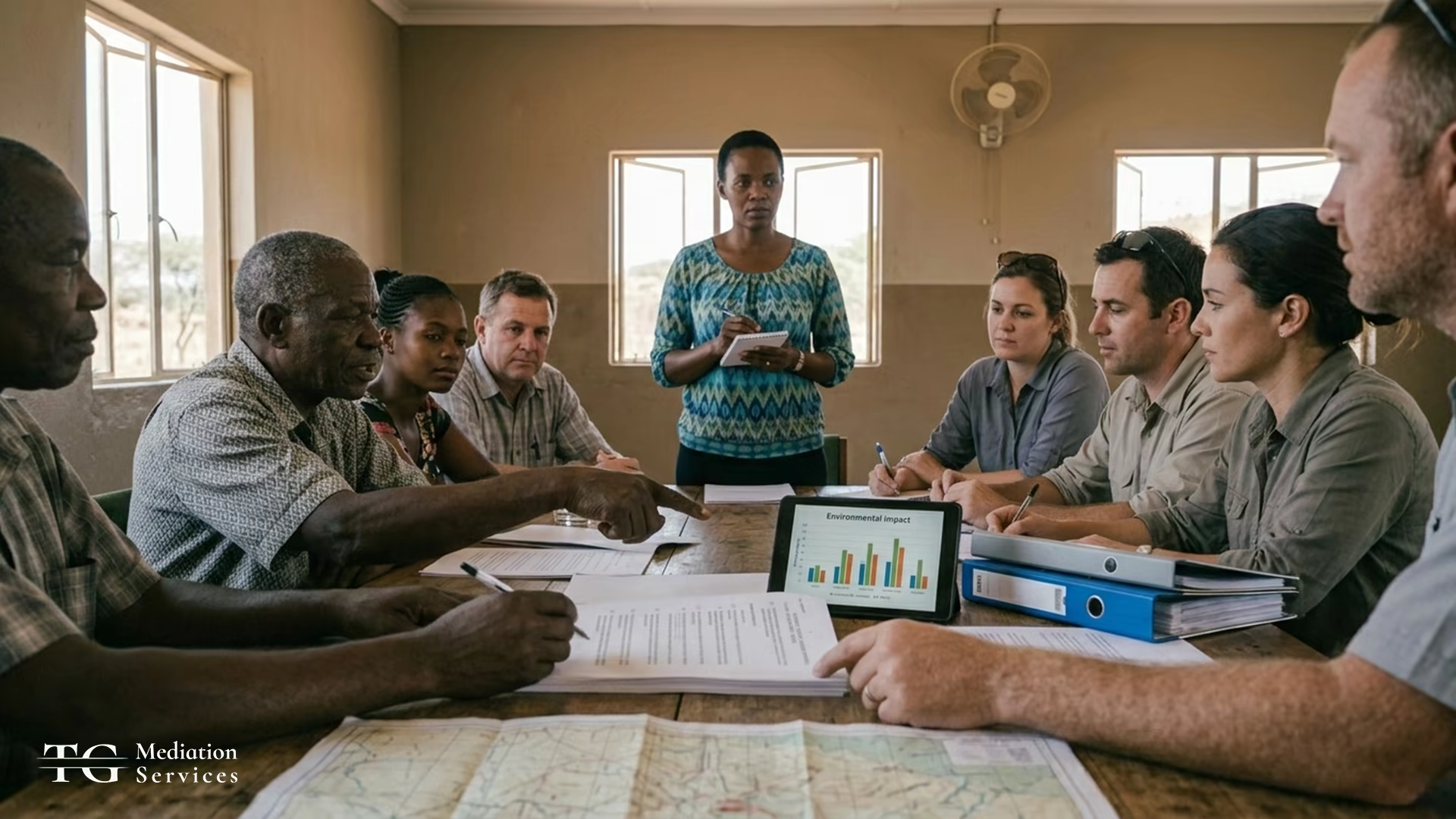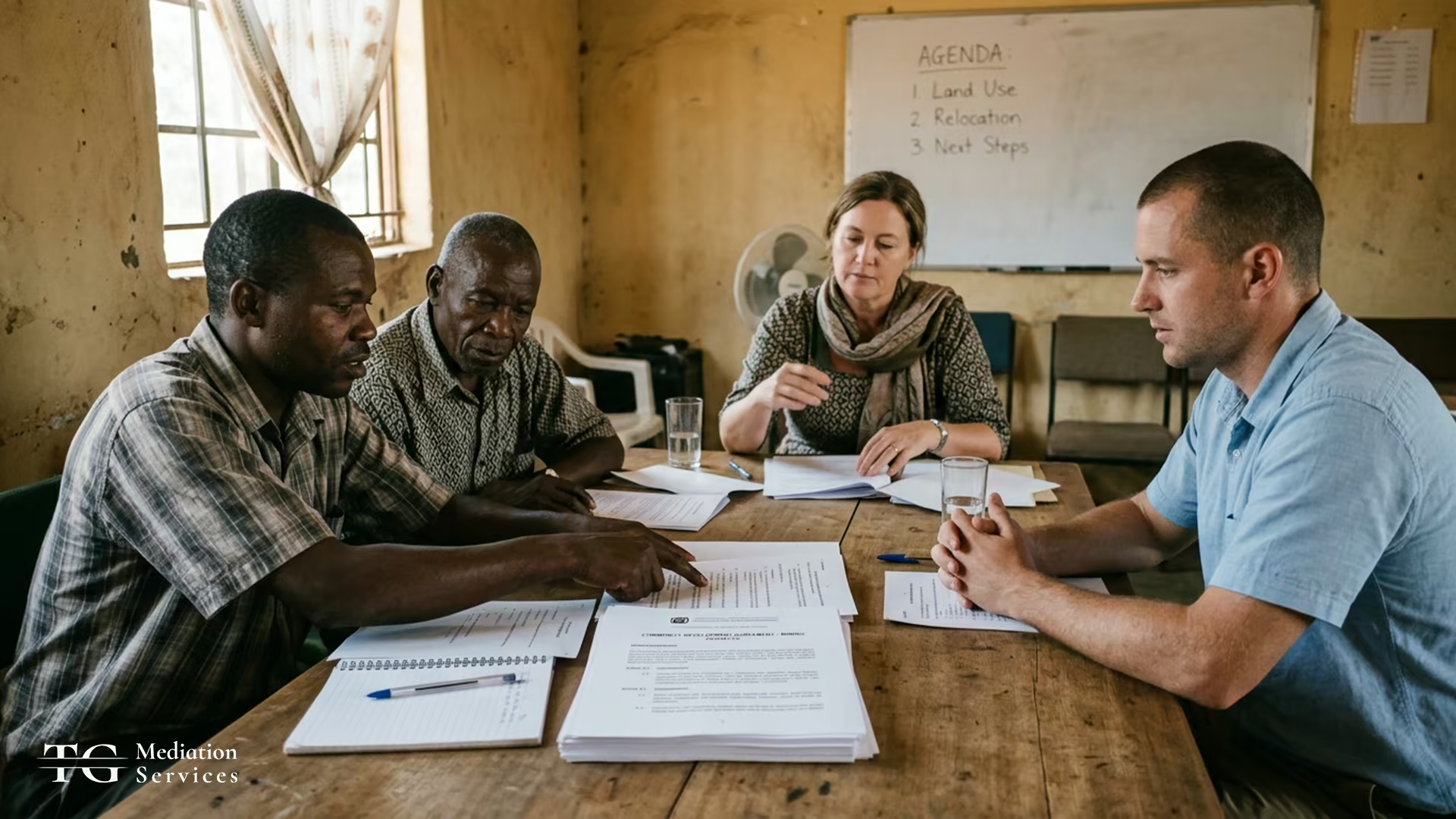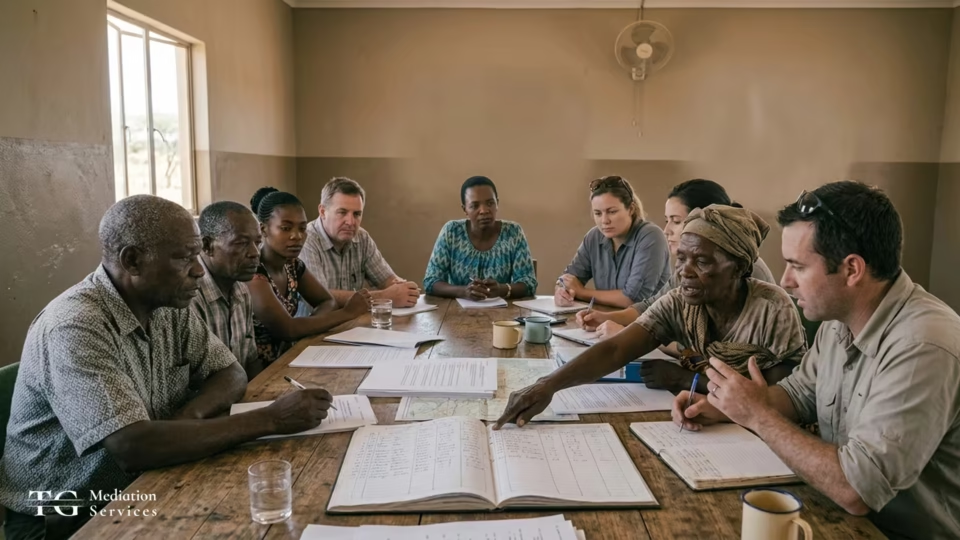
Community benefit agreements do not fail because the legal drafting is weak. They fail because the structure, the money mechanism, and the governance design do not match the real economics and politics of the community the agreement is supposed to serve. The same is true in reverse. The agreements that hold for fifteen or twenty years are not the ones with the most clauses. They are the ones where someone is genuinely accountable for delivery. They are the ones where the benefit formula survives a price crash, and where the community controls enough of the process to trust it. The recurring failure modes behind these patterns are catalogued in common CBA pitfalls and how to avoid them.
This article works through five mining contexts. Two are documented real agreements. Three are scenarios drawn from recurring patterns across the field record, presented as illustrations rather than named cases. For each, you will see what held, what broke, and which lesson transfers. The research base behind this is solid. Franks and colleagues showed in 2014 that company-community conflict translates social and environmental risk directly into business cost, which is why a failed agreement is never only a community problem. If you are negotiating a CBA, leading the community side, or auditing an existing framework, treat these five as diagnostic reference points, not templates to copy.
Case 1: Ahafo, Ghana, where transparency outlasted the money
In 2008, Newmont signed a Social Responsibility Agreement with its Ahafo host communities in Ghana, including Kenyasi. The agreement created the Newmont Ahafo Development Foundation, known as NADeF. The foundation is funded by a fixed contribution of one US dollar per ounce of gold produced, plus one percent of net profit after tax. Ten host communities sit inside the arrangement. A foundation board with community representation directs how the fund is spent.
What held was the predictability. The formula is simple enough that any community member can understand it. Production and profit are reported, the contribution follows, and the money lands in a foundation rather than in discretionary company hands. That transparency is what kept the structure alive across commodity cycles, a company ownership question, and shifting national politics. The agreement has been revisited and revised rather than abandoned, which is itself a sign of durability.
What broke was the gap between the formula and community expectation. One percent of net profit plus a dollar an ounce is real money, but it is a small share of what the mine earns. Communities have publicly pressed Newmont over unmet commitments and infrastructure they consider overdue. The lesson is not that the formula was wrong. It is that a transparent, community-visible mechanism buys you durability even when the absolute number disappoints. People can see exactly what they are owed, and they can argue about it on the record. A discretionary fund gives you neither the trust nor the paper trail. That difference is what keeps an agreement alive through a downturn.
Case 2: Tete, Mozambique, when a strong promise meets no delivery engine
Between 2009 and 2010, Vale resettled roughly 1,365 families in Mozambique’s Tete Province to clear ground for the Moatize coal operation. The families moved to the Cateme and 25 de Setembro sites. The relocation came with commitments around housing, land, water, and livelihoods. On paper the package looked progressive for the region at that time.
The delivery did not follow. Resettled families reported arid, distant land they could not farm, broken access to water, and promises that never arrived at the scale agreed. In January 2012, residents of Cateme blocked the rail line linking the mine to the coast, and the police response turned violent. The dispute had no structured channel, so it escalated straight into protest, blockade, and national scrutiny.
The structural failure matters more than any single broken promise. Each unmet item was real, but the deeper problem sat in the design. There was no independent monitoring that tracked delivery against the commitments. There was no agreed dispute process, so the first real disagreement went to the streets and the political system rather than to a table. And when coal economics softened, the commitments were treated as a soft preference rather than a hard obligation tied to the company’s licence to operate. A detailed promise with no delivery engine behind it is worse than a modest promise that is actually monitored, because it manufactures the specific anger that comes from documented betrayal. Building that delivery engine is the subject of turning a signed CBA into practice. This is the same dynamic I covered in the anatomy of mining-community conflicts, where unmet written commitments are one of the most reliable conflict triggers.
Case 3: An illustrative independent-fund scenario
Consider a scenario drawn from patterns across West African mining, where companies have experimented with structurally independent community funds. Imagine a bauxite operation that agrees to fund a community benefit vehicle governed by a board the company does not sit on. Village leaders, a women’s cooperative, a youth association, and a civil society figure from the capital hold the seats. The company contributes a fixed annual percentage of profit with a guaranteed floor, then reports its results and steps back from spending decisions.
The independence works on legitimacy. Because the community controls the board and an outside chair audits the books, people believe the fund is theirs rather than a gift dispensed at company discretion. The floor lets the community plan multi-year programs instead of guessing each year. Both features are rare and both build trust faster than years of company goodwill ever could.
The weakness shows up in capacity and ceiling. A volunteer community board with no financial management support struggles in its first years, and avoidable mistakes erode the early goodwill. The fixed percentage, set at the minimum the company felt it could defend, reads to the community as compliance rather than fair sharing. And because the fund only ever receives contributions and never invests in anything that generates its own return, it stays permanently dependent on the company. The transferable lesson is concrete. Structural independence is achievable and worth fighting for. It has to come with funded technical support and a contribution level the community accepts as fair. It also needs at least some mechanism for the fund to build assets of its own.
Case 4: Grasberg, Indonesia, where scale outran fairness
PT Freeport Indonesia’s Grasberg operation in Papua is one of the largest mining complexes on earth, and the benefit arrangements around it are real and substantial. Freeport committed one percent of its annual revenue to development for the indigenous Amungme and Kamoro communities. That money is channeled through a Partnership Fund managed by a community foundation known as LPMAK, later reconstituted as YPMAK. Contributions have run past 825 million US dollars since 1996, reaching tens of millions in a single recent year.
What worked is that pressure produced money and recognition. As civil society scrutiny grew, the commitments grew with it, which shows that a CBA can create real incentives for a company to improve. The arrangement also reached beyond cash. Indigenous cultural recognition and community roles in monitoring acknowledged that not every community interest is financial. People wanted a say in the land and the rivers, not only a cheque. An agreement that treats benefit as money alone misses the part of the grievance that money never resolves.
What broke is fairness at scale. When the benefit pool is enormous and many groups compete for it, per-capita distribution becomes contested, and internal community conflict replaces any clean company-community dialogue. Large flows invite elite capture, and accountability systems strain to keep pace. The deeper problem is structural. When a single company dominates the regional economy and politics, no benefit formula can manufacture genuine community independence, because the community’s whole livelihood still runs through one employer. The sobering lesson is that a CBA distributes benefits from mining, but it cannot by itself fix economic dependence on the mine. Where mining is the only game, even a generous agreement leaves the power imbalance intact.
Case 5: An illustrative mine-closure scenario
Imagine a mature copper operation entering its final decade, where the community and the company negotiate an agreement built around the end of mining rather than its continuation. Most CBAs quietly assume the mine runs forever. This one does the opposite. It funds a transition program meant to help the community build economic alternatives before the operation closes. It also gives the community real roles in employment and environmental decisions rather than advisory seats.
The forward-looking design is the strength. Naming the closure out loud and planning for it positions the agreement around long-term community survival instead of short-term extraction. That reframing is rare and valuable, and it tends to align the company with national economic-transformation goals at the same time.
The flaw is that the transition is funded from current profit. When the metal price falls, the transition budget contracts exactly when the community needs it most, and people who were retraining or starting ventures lose support mid-stride. The agreement also addresses only the benefits from mining, never any community stake in the mineral wealth itself, so dependence on a single employer persists right up to closure. The lesson transfers cleanly. Plan for the wind-down, and ringfence transition funding so it does not collapse with the commodity cycle. A closure fund that depends on current margins is a closure fund that disappears in a slump. Ask who benefits as the mine closes, not only who benefits while it runs.
What the five cases share
Read across all five and the patterns repeat. First, the benefit mechanism has to fit the community’s real economics, which means revenue links need floors or hybrids that protect people when prices fall. Ahafo’s predictability held; the unprotected promises in the Tete pattern did not. Second, implementation governance outweighs drafting quality. Someone has to be accountable for delivery, and independent monitoring has to make gaps visible, or the agreement quietly dies the first time company priorities shift.
Third, structural independence from company control buys legitimacy that years of discretionary generosity cannot. Communities trust what they govern. Fourth, a real dispute resolution path is what stops disagreement from becoming existential. Where no structured channel exists, the first serious conflict goes to blockade and politics, as it did at Tete. Fifth, community capacity is not a given. The best-designed fund fails if the people running it have no funded technical support. Sixth, and hardest, no CBA overcomes structural economic dependence on a single employer. Grasberg shows that even large, well-intentioned benefits cannot manufacture independence where the mine is the entire economy.
These six tests are exactly what the Social Accord Architecture approach builds into an agreement from the start, rather than discovering them after the agreement has already broken. For the full negotiation sequence, see the CBA negotiation guide.
> Download: CBA Implementation Health Check, a sectioned worksheet that scores your agreement against the six durability factors these five cases revealed.
Applying this to your own agreement
Whatever continent or commodity you work in, run your current or proposed agreement against the same questions these cases raise. Does the benefit formula survive a price crash, or does it quietly evaporate when margins tighten? Is anyone independently checking that commitments are actually delivered, with the gaps on the record? Does the community control enough of the governance to believe the fund is theirs? Is there a real dispute path before conflict reaches the rail line? Has anyone funded the community’s capacity to hold up its side? And are you honest about what the agreement cannot fix, namely dependence on a single employer?
The strongest agreements are not the longest or the most generous. They are the ones designed around delivery, transparency, and a fair, protected benefit, then backed by a real channel for handling disputes. None of the five cases here failed for lack of words on the page. They failed, or held, on whether those four things were actually built and funded. The agreements that held share a quiet feature: a mediated process behind them, and a structure that channels future disputes to a table rather than the street. That is what separates a durable accord from a signed disappointment. The Social Accord Architecture is the methodology I use to build that mediation discipline into an agreement from the first conversation. If you want a second read on an agreement you are negotiating or reviewing, you can contact me. Bring the structure and the money mechanism. Those two, more than the legal language, decide whether the agreement still stands a decade from now.