Community Relations Managers and ESG Professionals
Working in mining, oil & gas, infrastructure, or energy transition projects where community tensions threaten operations and social license.
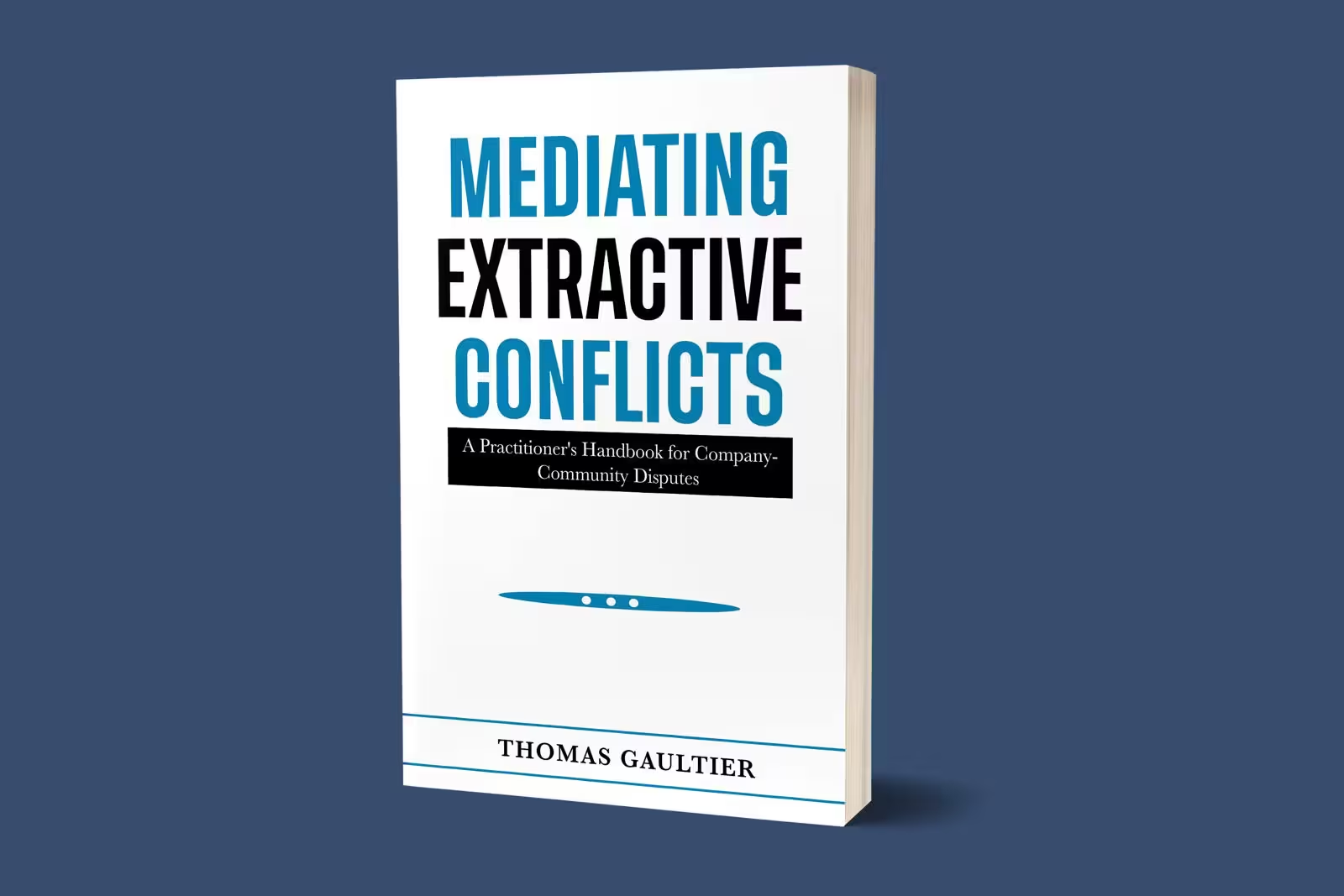
A Practitioner’s Handbook for Company-Community Disputes
Built from 15 years of frontline practice and over 2,000 resolved claims across Africa, Europe, and Latin America. The field-tested handbook for resolving high-stakes disputes between extractive projects and the communities they affect.
Resolving company-community disputes goes well beyond writing consultation plans that satisfy regulators.
This comprehensive practitioner's handbook builds the skills and systems that genuinely prevent conflicts, address power imbalances, respect diverse stakeholder perspectives, and adapt to changing project phases over time.
Working in mining, oil & gas, infrastructure, or energy transition projects where community tensions threaten operations and social license.
Facilitating or preparing to facilitate disputes between companies and affected communities, including contested decisions around land use, environmental impacts, and benefit sharing.
Whose projects operate in or near communities affected by extractive or infrastructure activities, and who need practical frameworks for constructive engagement.
Working on social license to operate, free prior and informed consent (FPIC), community-benefit frameworks, or international performance standards such as the IFC guidelines and UN Guiding Principles.
Advising on grievance mechanisms, dispute resolution clauses, community governance processes, or the legal dimensions of stakeholder engagement in extractive and infrastructure sectors.
For ESG consultants, social performance teams, and engagement practitioners who need transferable, field-tested methods for sustainable stakeholder engagement, not just personal instincts as communicators.
When a mining project, a pipeline, or a wind farm lands on a community's doorstep, the conflicts that follow are never simple. They involve power imbalances, cultural divides, historical grievances, and livelihoods at stake. Generic mediation training does not prepare you for this.
This handbook does. It argues that company-community disputes require a specialized discipline, one that integrates trauma-informed practice, cultural sensitivity, and deliberate power-balancing into every stage of the mediation process. Most resources treat mediation as a universal skill. This book shows why extractive and infrastructure conflicts demand their own frameworks, and provides them.
The handbook walks you step by step through every phase of company-community mediation: pre-mediation assessment, process design, facilitation, agreement drafting, and post-agreement implementation and monitoring.
It also dedicates an entire chapter to when mediation should not proceed, covering situations involving ongoing violence, severe bad faith, or fundamental human rights violations. Knowing when to say no is as important as knowing how to proceed.
In extractive disputes, one side typically has legal teams, technical consultants, and deep pockets.
The other often has neither.
This book treats power asymmetry, trauma, and cultural context not as side topics but as central design challenges. You will learn practical strategies for balancing power, working with traumatized participants without retraumatizing them, and adapting your process to local customs, languages, and decision-making structures.
Every technique in this handbook has been applied in real disputes.
The book includes ready-to-use templates, simulation exercises, ethical frameworks, and detailed case studies that show what worked, what failed, and why.
These are not academic exercises.
They are the actual moves that work when communities and companies are at odds.
When community members sit across from company representatives, they carry the weight of historical grievances, power imbalances, and deep skepticism.
Creating space for genuine dialogue requires demonstrating, through consistent action, that the process itself is trustworthy.
The signing ceremony marks not an ending but a beginning, and the work that follows determines whether the conflict is truly resolved or merely postponed.
In Chapter 1, Thomas Gaultier lays out the handbook’s guiding philosophy, identifies who this book serves, and presents a real case from Guinea where a gold mining company and a displaced community transformed years of hostility into a collaborative partnership through structured mediation.
It gives you a real sense of the book's argument before you commit to the full text.
Join hundreds of executives and community leaders solving real conflicts.
Buy on Amazon