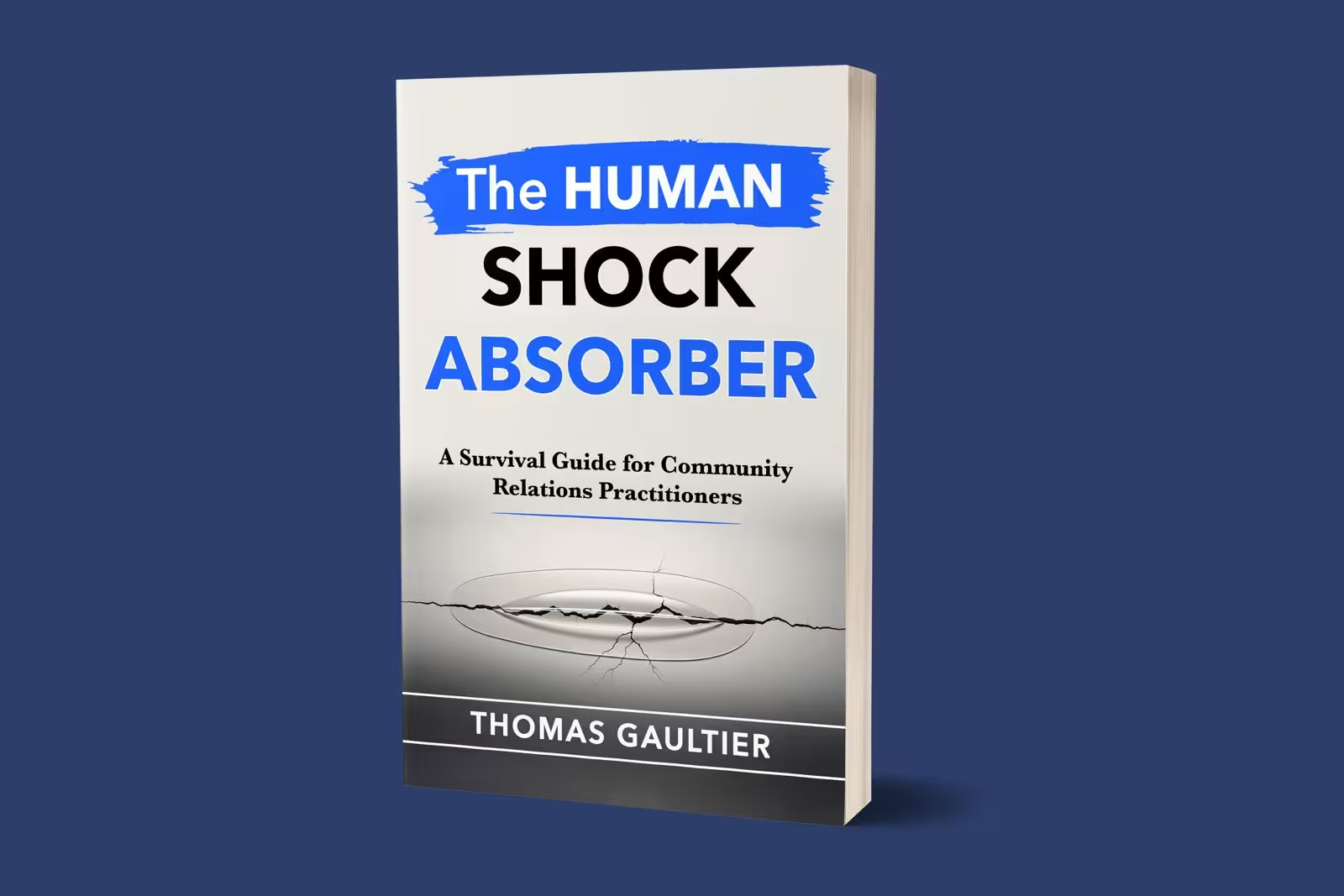
A Survival Guide for Community Relations Practitioners
The first book written for the people who stand between companies and communities, absorbing the conflict so everyone else can keep operating. From the practitioner who mediated 2,000+ extractive sector claims across Sub-Saharan Africa, Europe, and Latin America.
Community relations is not about being friendly. It is about conflict analysis, negotiation under pressure, and the resilience to hold the line between corporate imperatives and community anger, often with no psychological support and no institutional recognition of what that costs.
This book is written for the people who do that work, and for the organizations responsible for protecting them.
Community Relations Officers and Social Performance Practitioners
Working on the frontline of extractive, infrastructure, or energy projects, managing community expectations while delivering corporate objectives in high-pressure, sometimes hostile environments.
HR Directors and People Operations Leaders
Responsible for recruiting, retaining, and supporting field staff in mining, oil & gas, and energy companies, and looking for evidence-based frameworks to reduce turnover, burnout, and occupational stress.
Project Developers and Operations Leaders
Who rely on community relations teams to maintain social license but lack a framework for understanding the occupational risks those teams carry and how organizational systems can mitigate them.
ESG and Sustainability Professionals
Who measure the "S" in ESG through community outputs (schools built, meetings held) but need to understand the human cost of delivering those metrics, and why their best field staff keep quitting.
Occupational Health and Safety Teams
Who have rigorous protocols for physical hazards but no equivalent framework for the psychological risks of working in contested, hostile, or trauma-affected communities.
Trainers and Capacity Building Professionals
Designing resilience, conflict management, or field readiness programs for social performance teams, and seeking a structured, field-tested foundation that addresses the human experience of the work, not just the technical competencies.
What You’ll Learn
There are many books about stakeholder engagement strategy, grievance mechanism design, and community development programming. None of them speaks honestly about what this work does to the people who do it. The Human Shock Absorber fills that gap.
It argues that community relations practitioners face specific occupational hazards, including vicarious trauma, moral injury, chronic isolation, and burnout, that are built into the structure of their role, not symptoms of personal weakness. Until the profession names these realities and builds systems to address them, it will continue to lose its most capable people.
The Invisible Profession: What Community Relations Work Actually Is
If you have ever struggled to explain your job to your family, or felt unseen within your own organization, this book starts by naming the reality.
Community relations officers are human shock absorbers: they sit between corporate power and community vulnerability, translating pain in both directions, carrying knowledge they cannot fully share with either side.
The book maps the role as it actually exists, not as industry brochures describe it, and explains why the lack of professional identity has real consequences for how practitioners are supported, trained, and valued.
The Weight We Carry: Trauma, Burnout, and the Toll of the Middle
The book names what most practitioners experience but few discuss openly: direct trauma from physical threats and hostile encounters, vicarious trauma from absorbing hundreds of stories of displacement and loss, moral injury from representing decisions you disagree with, and the particular loneliness of a role that neither side fully trusts.
Drawing on field experience across mining, oil & gas, and infrastructure projects, these chapters provide a clinical and practical framework for recognizing symptoms, understanding their causes, and breaking the cycle before it ends careers.
Practical Tools for Survival, and a Manifesto for the Profession
The second half of the book delivers what practitioners actually need: field-tested approaches to conflict resolution when the stakes are real, frameworks for the difficult conversations that define this role, resilience strategies that go beyond generic wellness advice, and concrete guidance on protecting your career while protecting yourself.
The book closes with a manifesto for what the profession could become, including specific proposals for companies, industry associations, and practitioners who want to build a community of practice rather than continue working in isolation.
If you have ever driven home from a community meeting and found yourself crying in the car, you are not weak.
You are responding normally to an abnormally difficult situation. If you have ever woken up in the middle of the night thinking about a community member's face, wondering if you did enough, you are not obsessing.
You are carrying the weight of real moral responsibility. If you have ever questioned whether you are part of the problem, you are not being disloyal. You are engaging honestly with the complexity of your position.
The Human Shock AbsorberChapter 1
Not sure Yet? Start with a free chapter
In Chapter 1, Thomas Gaultier introduces the shock absorber metaphor that defines the book: what it means to translate pain in both directions, why neither side sees your position, and what happens when shock absorbers wear out from too much force without maintenance.
It gives you a real sense of the book's argument before you commit to the full text.
About Thomas
Not a generalist. Not an academic. A field practitioner.
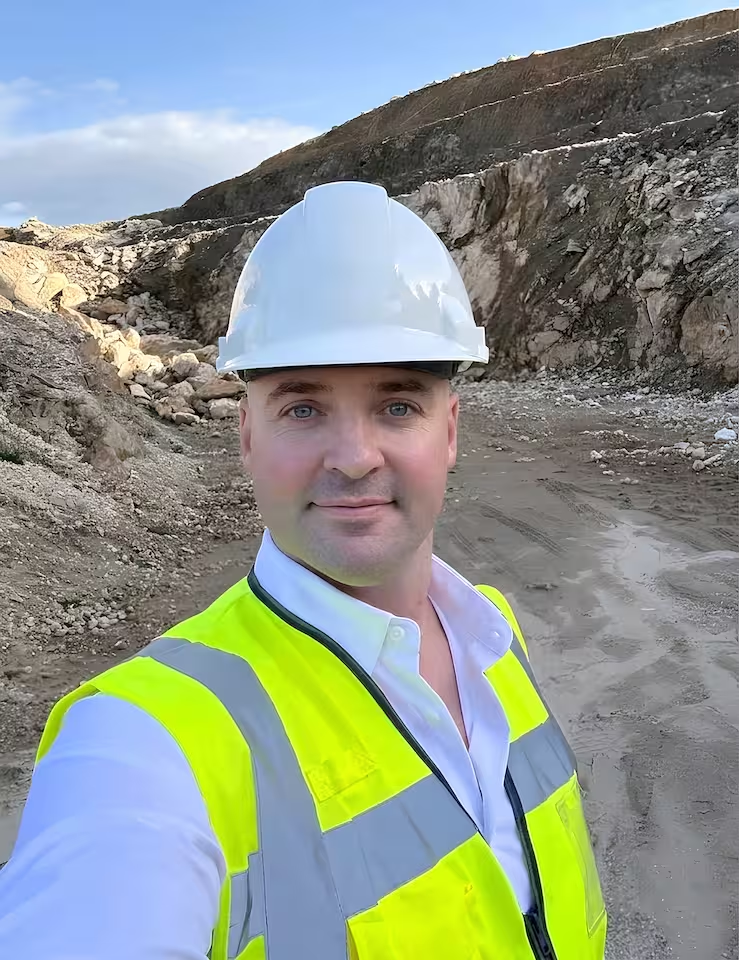
Thomas Gaultier is a mediator, lawyer, and strategic engagement expert who has spent his career navigating the tension between industrial development and community wellbeing. He served as a community and social performance officer for a lithium mining project in Portugal and was appointed as an expert mediator for a ruby mining operation in East Africa. His fieldwork across Sub-Saharan Africa and Europe, including mediating over two thousand grievance claims in Mozambique, has shaped a practice grounded in the realities of frontline community relations.
That body of field experience led Thomas to develop Social Accord Architecture, a professional discipline for designing durable agreements between industrial projects and affected communities. He provides training in conflict prevention, conflict resolution, and community mediation for some of the world's largest mining groups. He is a professional mediator who works with CEDR in London and serves as an expert mediation trainer with the International Mediation Campus at Consensus Group.
Thomas is co-founder and Vice-President of the ICFML (Instituto de Certificação e Formação de Mediadores Lusófonos) and teaches negotiation and mediation at the Universidade Católica Portuguesa. Admitted to the New York Bar, he holds an LL.M. in Alternative Dispute Resolution and an MBA in Mining and Raw Materials. He is fluent in English, French, Portuguese, and Spanish.
Contains information related to marketing campaigns of the user. These are shared with Google AdWords / Google Ads when the Google Ads and Google Analytics accounts are linked together.
90 days
__utma
ID used to identify users and sessions
2 years after last activity
__utmt
Used to monitor number of Google Analytics server requests
10 minutes
__utmb
Used to distinguish new sessions and visits. This cookie is set when the GA.js javascript library is loaded and there is no existing __utmb cookie. The cookie is updated every time data is sent to the Google Analytics server.
30 minutes after last activity
__utmc
Used only with old Urchin versions of Google Analytics and not with GA.js. Was used to distinguish between new sessions and visits at the end of a session.
End of session (browser)
__utmz
Contains information about the traffic source or campaign that directed user to the website. The cookie is set when the GA.js javascript is loaded and updated when data is sent to the Google Anaytics server
6 months after last activity
__utmv
Contains custom information set by the web developer via the _setCustomVar method in Google Analytics. This cookie is updated every time new data is sent to the Google Analytics server.
2 years after last activity
__utmx
Used to determine whether a user is included in an A / B or Multivariate test.
18 months
_ga
ID used to identify users
2 years
_gali
Used by Google Analytics to determine which links on a page are being clicked
30 seconds
_ga_
ID used to identify users
2 years
_gid
ID used to identify users for 24 hours after last activity
24 hours
_gat
Used to monitor number of Google Analytics server requests when using Google Tag Manager