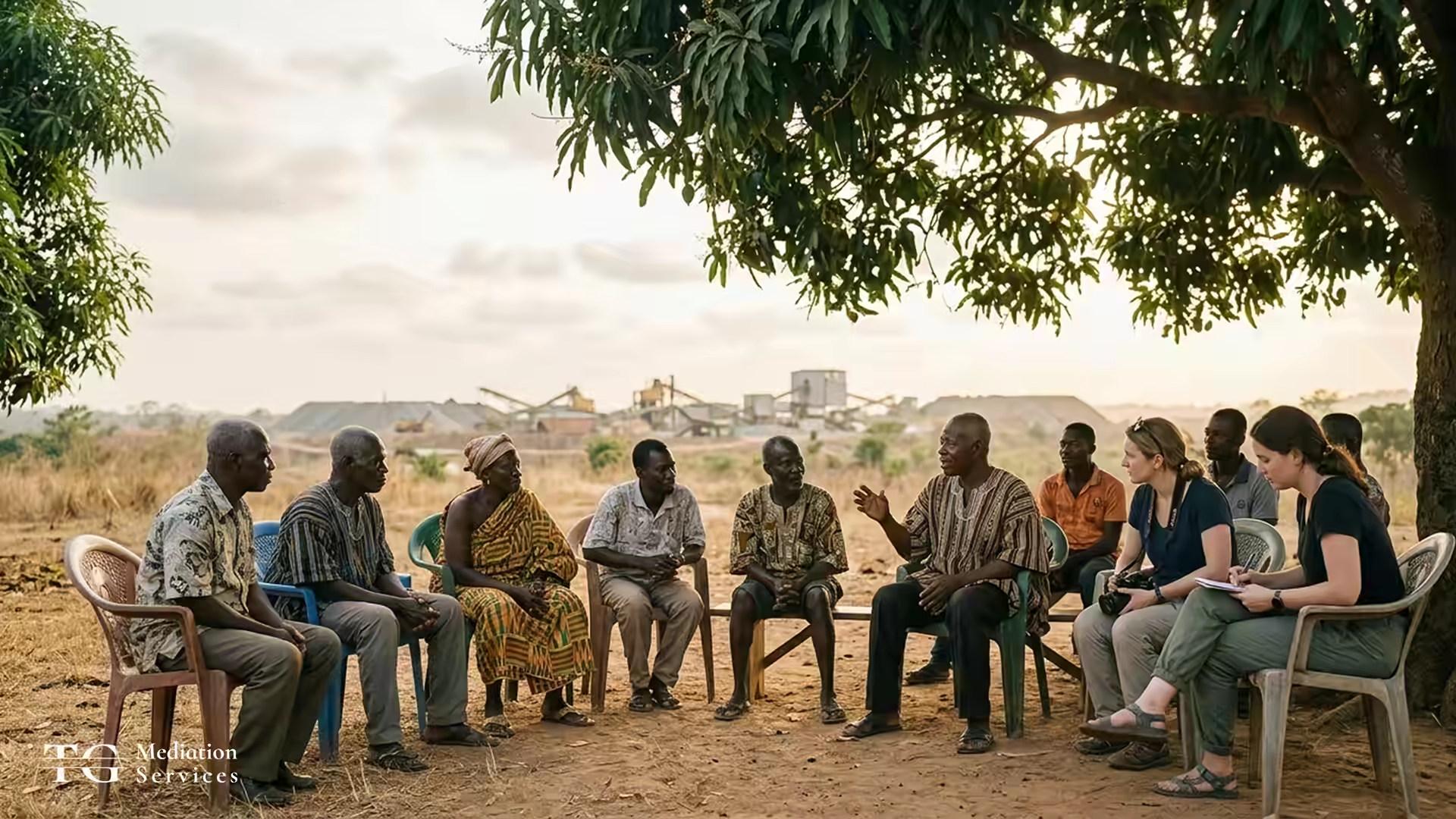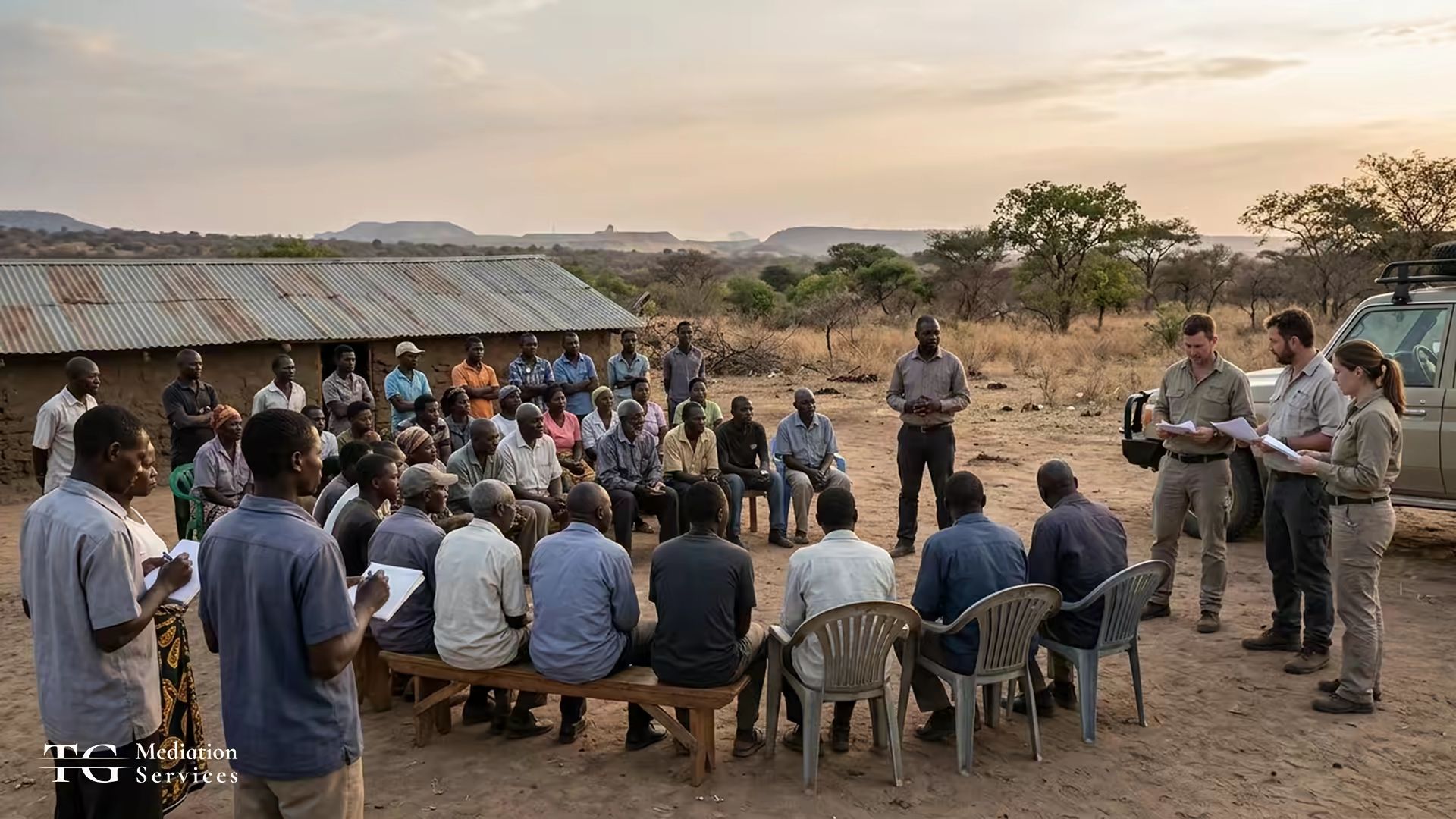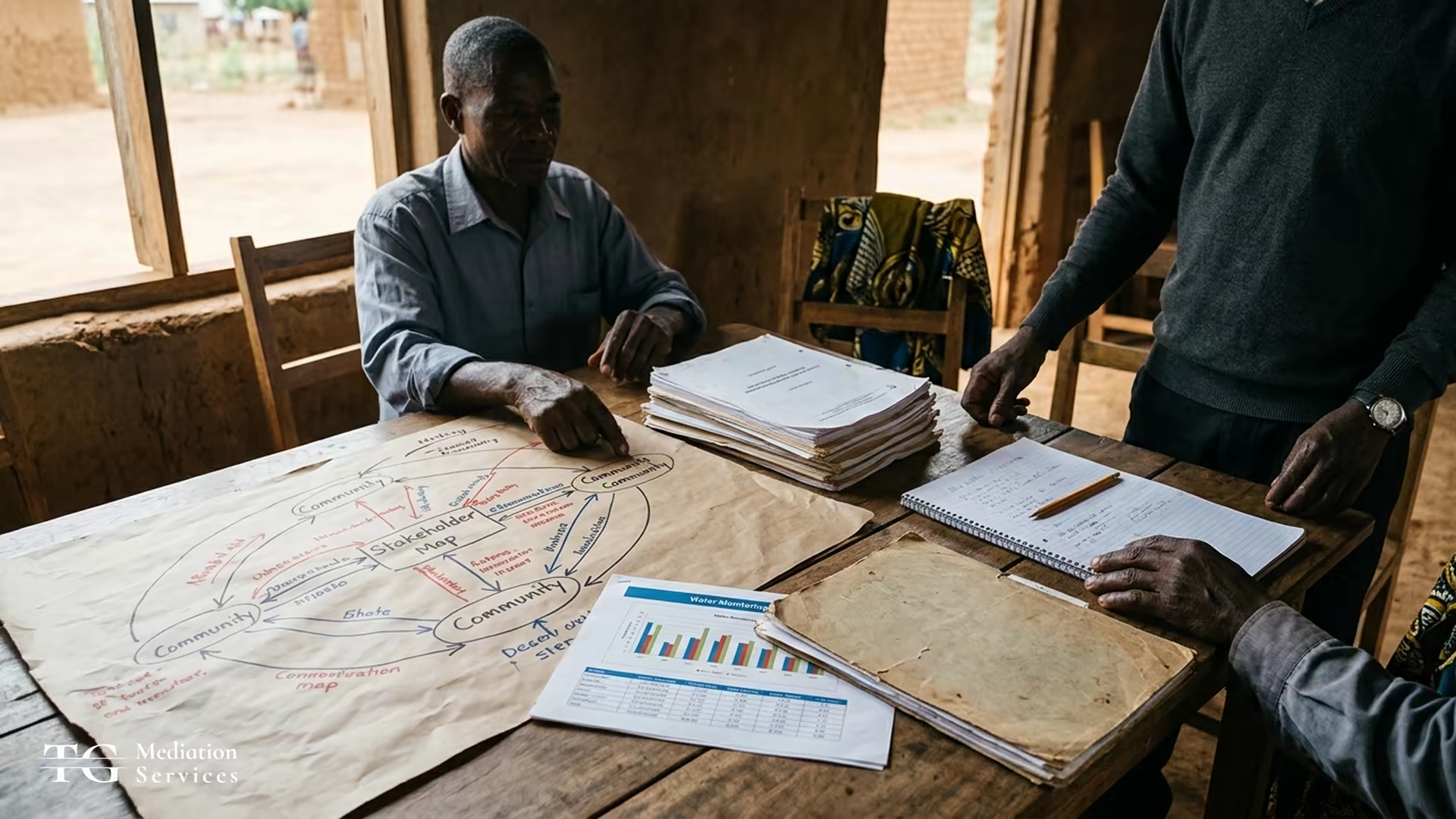
Most serious mining disputes do not fit two parties across one table. A single project can gather a company, several community groups with rival interests, a regulator, an environmental organisation, and competing traditional authorities. Each one holds a claim that deserves a seat. One mediator cannot carry all of them at once. That single facilitator has to manage communication across cultures, hold trust with hostile parties, and follow technical argument about water or tailings, all in the same room. The work outruns one person. This is where co-mediation earns its place. Two professional mediators take distinct but complementary roles, and together they reach outcomes neither could reach alone.
A second mediator can add real value or only add cost, and the difference is decided long before the first session. The test is which conditions justify the pairing, how the two roles are split, how cultural pairing works in a resource dispute, and which protocols keep a partnership from breaking under pressure. Get those wrong and two mediators become a second front of conflict in full view of the parties.
When a second mediator earns its cost
Co-mediation is not automatically better than solo work. It costs more. It demands coordination. A poorly matched pair can become a new source of conflict in front of the parties. So the question is never whether two mediators are always preferable. The question is which specific conditions make the added cost worth paying.
The first condition is genuine multi-party complexity. A dispute qualifies when interests diverge so sharply that one mediator cannot hold credible neutrality with everyone at the same time. Consider a scenario drawn from patterns across copper and gold operations in sub-Saharan Africa. A company seeks to expand. A chief’s council asserts land rights. A women’s cooperative depends on the affected fields. A national environmental group tracks water quality. The provincial government wants tax revenue. Five parties, five value systems. One mediator, however skilled, will struggle to anchor trust with all five while also steering technical talk on monitoring and livelihood transition.
Two mediators with different backgrounds change that. One brings corporate and commercial experience and holds credibility with the company. The other brings deep community relations experience and holds credibility with local stakeholders. Each becomes a trust anchor for a constituency. Together they can run conversations that neither could facilitate alone with the same standing.
The second condition is an extreme trust deficit. Some disputes reach the table after years of broken promises and failed consultation. By then the community treats the company as an adversary to resist, not a partner to negotiate with. Any mediator linked to corporate interests meets an immediate wall. A pairing answers this. The community-rooted mediator shows local parties that their reasoning has a serious advocate at the table. The corporate-experienced mediator shows the company that professional process is in place. Neither is neutral in isolation, yet together they build enough balanced trust for talks to begin. This is closely tied to the work of managing power imbalances and reframing the relationship from adversarial to collaborative.
The third condition is a heavy technical track. Major disputes turn on water chemistry, tailings management, baseline data, and cumulative impact. One mediator cannot run community relations, technical facilitation, and corporate dynamics at full depth at once. Splitting the load lets one mediator hold the relationship while the other manages the specialist discussion, with clear coordination between them.
Structuring the partnership before the first session
The line between co-mediation that works and co-mediation that collapses is usually drawn before anyone enters the room. Most failed partnerships share one cause. The two mediators never agreed, in plain terms, on who does what, how decisions get made, what happens when they disagree, and how they present themselves to the parties.
Three structural models cover most mining cases. The first is a primary mediator plus specialist support. One mediator leads and holds the relationship with the parties. The second brings a specific expertise, often technical or cultural, in a supporting role. Imagine a gold operation where one mediator has built community relationships over years and stays the lead. A hydrogeologist joins only to facilitate the groundwater discussion. The parties understand that the specialist supports the process, not overturns it.
The second model is a co-equal partnership with domain division. Two mediators hold equal status but split responsibility by subject. One runs community and company relations, stakeholder coordination, and process design. The other runs the technical track, specialist talks, and data validation. This fits when both tracks are equally demanding and need full attention throughout. Picture a dispute where one mediator handles the commercial negotiation over tax revenue while the other handles livelihood transition talks with communities. The two tracks carry equal weight, and the mediators stand as peers.
The third model is culturally paired co-mediation. Two mediators are chosen precisely because they bring different cultural operating systems. One is rooted in corporate and technical culture. The other is rooted in community and traditional culture. They operate as equals, selected for their difference. This is the most demanding structure to run and often the most effective across a wide cultural divide. The pairing must be intentional, built into the design rather than left to chance.
Role clarity then turns on decision authority. Co-mediators must settle this before the first session. Do both need to agree on every major process call, or does one hold primary authority? Who decides to postpone a session? Who calls a private meeting? What happens when strategies clash? The cleanest partnerships give one mediator primary process authority while requiring consultation with the other on anything that affects the substantive balance of the mediation. That formula keeps the team decisive and still protects the integrity of the process. The same close calibration of judgment runs through the core qualities that separate strong mediators from weak ones.
Cultural pairing as a working method
Cultural pairing is the deliberate combination of mediators from different cultural backgrounds, with different working languages and decision-making systems. It is one of the strongest applications of co-mediation in African mining disputes. It only works, though, when the pairing is intentional and the mediators use their difference as a tool rather than treating it as background detail.
Effective pairing is not two people who happen to differ. It is two mediators chosen because they bring different frameworks, with explicit agreement on how to use them. Consider a scenario drawn from patterns across West African gold mediations. One mediator is fluent in English, trained in international commercial mediation, and experienced with multinational companies. The other is fluent in the local language and steeped in customary governance and family-based decision-making. In joint sessions, the locally rooted mediator explains to company representatives why an elder council decision carries binding weight, even when its timeline does not match corporate expectations. The internationally trained mediator explains to community representatives why certain financing timelines are fixed. Neither tries to appear culturally neutral. Both are culturally specific, on purpose, and bridging is the core of the role.
Language demands its own plan. The most effective approach runs each session in the dominant language of that party’s strongest negotiators, with professional interpretation when needed. If community representatives are most articulate in a local language, hold those sessions in that language with interpretation into English. If technical talks run in English, hold those in English. Do not default to English throughout. That choice privileges corporate fluency and weakens community parties. The locally fluent mediator leads local-language sessions. The English-fluent mediator leads English-language sessions. Splitting facilitation by language domain beats trying to manage interpretation everywhere at once.
Decision sequence differs across systems too. Corporate mediation tends to move from problem to options to evaluation to choice. Many community processes prioritise long discussion, consultation with authorities, and decisions reached by consensus or elder designation. Skilled paired mediators do not force both into one sequence. They run parallel processes. The community-focused mediator facilitates extended deliberation where members voice concerns without pressure to conclude. The corporate-focused mediator works with the company on its internal negotiation parameters. Then both teams return for joint sessions where formal option evaluation can proceed, each side already aligned internally. This parallel design is close cousin to the structured back-and-forth of shuttle diplomacy in mining conflicts.
A dual-track scenario worth studying
Imagine a mid-tier company seeking to expand a gold operation near pastoralist communities. The expansion would affect grazing land and dry-season water sources. Years of consultation had failed. The company believed it had engaged adequately. The communities felt marginalised and rushed. Both sides had retained lawyers and were drifting toward court.
A co-mediation team is engaged. One mediator carries long experience in multinational corporate mediation and standing with executives and lenders. The other comes from the affected region, with years in community development and respected ties to elders and women’s associations. They design a deliberate dual-track process. For two months they hold no joint sessions. The corporate mediator works with the company and government on what the expansion truly requires and where flexibility exists. The community mediator works with local representatives on which land is non-negotiable, what benefit arrangements might address disruption, and what decision process the community needs. The goal is clarity, not yet agreement.
Once each side’s genuine position is clear, the mediators convene three joint sessions. The first builds shared understanding of core interests. The company explains financing-linked production targets. The community explains that losing specific dry-season water would force permanent out-migration. No one tries to solve it yet. The second session generates options. A modified expansion footprint avoids the critical water sources. A rehabilitation programme restores a degraded water system. The third session stalls on governance. The company wants firm timelines and accountability. The community wants implementation to follow its own seasonal consultation with elders and women’s groups.
This is where the cultural pairing proves essential. The community mediator explains that these governance processes have carried decisions for generations and cannot be set aside for a project. The corporate mediator explains that a company cannot run without accountability to lenders. Neither system is abandoned. The mediators propose a hybrid: a four-year transition with quarterly reviews that explicitly fold in consultation with community structures and adjust on that feedback rather than override it. Agreement follows. It holds because process honoured both logics, not just one.
Settle the split before you agree to pair
The companion tool is the Co-Mediation Readiness Checklist for Mining Disputes, a checklist of roughly 18 checkpoints across six sections. Section A, “Does this case warrant co-mediation?”, tests whether two mediators are justified at all before you spend the second fee, and sections B through E force the four decisions that quietly sink a partnership when they go unspoken: the pairing logic, the role split, decision authority, and language. Score each item In place, Partial, or Absent, and treat any cluster of Partial and Absent answers as the coordination you still owe your co-mediator before the first joint session, not a problem to improvise around at the table. The value of running it is timing: every gap it exposes is cheap to close on paper and expensive to discover in front of five hostile parties. Download the Co-Mediation Readiness Checklist for Mining Disputes.
The practitioner takeaway
Read the four warning signs together. Many parties with opposed values, an extreme trust deficit, two decision-making cultures, and a heavy technical track. When several appear at once, a single mediator is stretched past the point of credibility. That is the moment to pair. The lesson from the field is plain. The pairing must be designed, not improvised, and the role split must be settled before the first session, not discovered during it.
This matters because the adversarial default is expensive. Research by Davis and Franks (2014) showed that conflict with communities converts social risk into hard business cost through delay, lost time, and damaged relationships. Litigation rarely repairs the relationship a mine depends on for decades. Independent, structured facilitation does. A well-built co-mediation team strengthens that path. It holds trust on both sides at the same time and lets two decision-making cultures operate without forcing one to mimic the other. That is the structured method I work through as the Social Accord Architecture, and a co-mediation pairing is one of its most practical tools. The Social Accord Architecture (SAA) treats trust and process design as engineering problems with deliberate answers, not as soft afterthoughts.
Before you commit to a pairing, close every gap in role clarity, decision authority, and language while it still costs nothing but a conversation. That preparation is what lets two mediators hold trust on both sides at once instead of splitting it. To discuss a specific pairing, contact thomas@thomasgaultier.com.