
Deal teams, counsel, closure and remedy practitioners
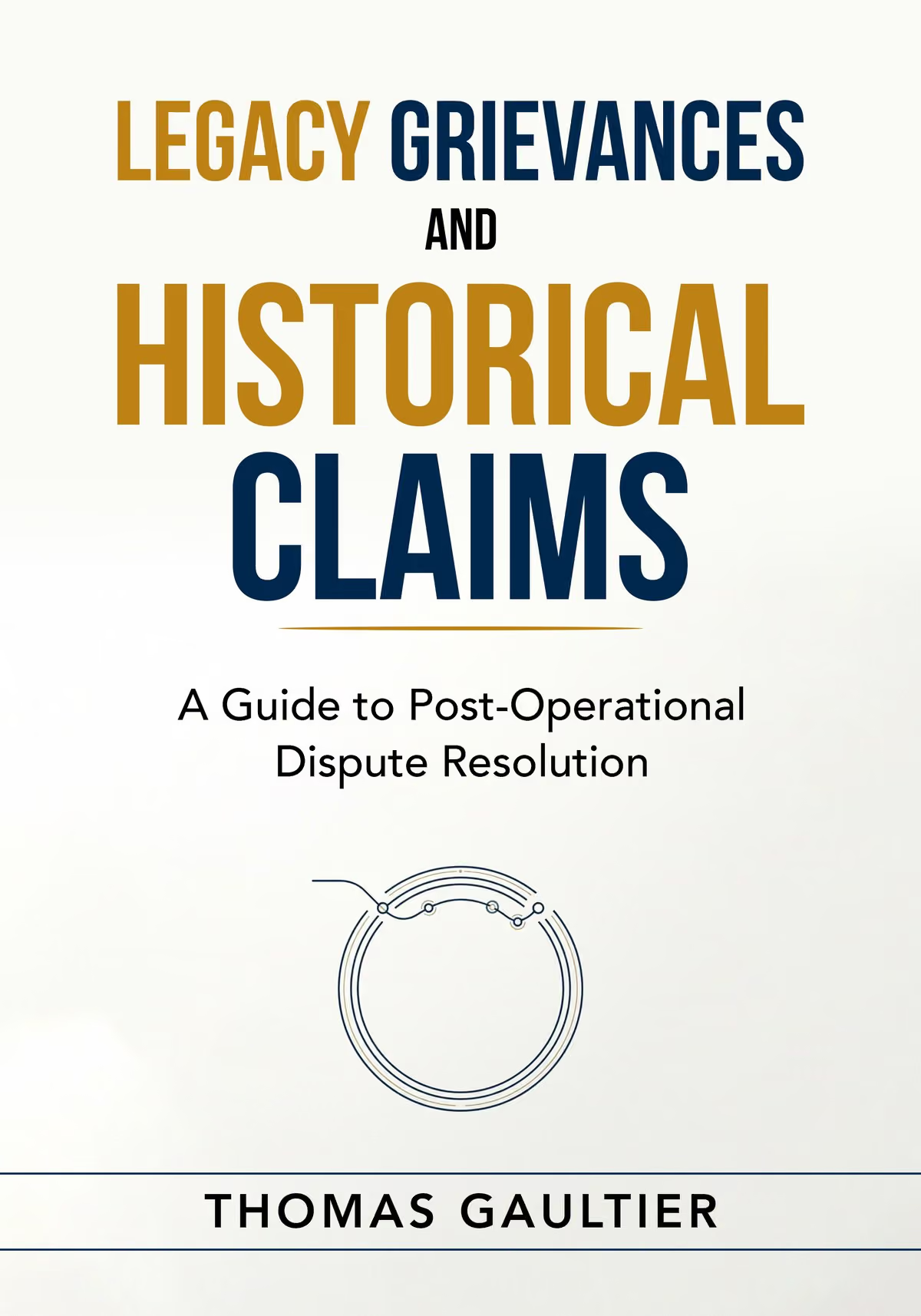
Legacy Grievances and Historical Claims
A Guide to Post-Operational Dispute Resolution
- 238 pages
- 9 chapters in 4 parts
- 5 appendices
- 15 figures
- ISBN 978-989-49072-9-9
A woman walked four hours to a temporary claims office in Mozambique carrying a plastic bag. Inside were a photocopied receipt for a goat, issued as compensation for the destruction of a homestead; a hand-drawn map of her family’s machamba, the subsistence farm that had sustained three generations; and a photograph of a concrete foundation, all that remained of a school promised and never built. She did not ask for money. She asked for someone to look at what had happened and say that it was wrong.
Eighteen months later she had a settlement: formal acknowledgment of the homestead, compensation priced on what the farm produced rather than what a cadastral table said, a public apology from the operator’s country manager, and the school, built, with a plaque naming the community whose land had made the project possible. The word that came back was that the plaque mattered more than the money.
Every company that acquires, inherits or closes an old operation acquires its past with it. Those claims sit on no balance sheet and they do not expire. They wait for a transaction, a closure announcement, a change in law, or a generation that decides to ask again, and by then the mechanism that could have absorbed them has been shut for years.
This book is the method for resolving them. It borrows from transitional justice, the discipline built for exactly this problem in a different arena, and sets out the legal architecture that decides whether an obligation survives a change of ownership. The cases are real and named: the Tshiamiso Trust paying silicosis claims across southern Africa, the Giant Mine and the arsenic that Canada will be managing in perpetuity, the coal closures of Appalachia, and Colombia’s recognition of a territory itself as a victim. So are the failures, which are reported here with the same candour as the settlements.
What is inside
Why the claims are converging now
The after-phase gap, and the forces closing on it at once: the closure wave, investor pressure that now prices legacy exposure as material financial risk, and communities that have learned how to wait and then ask again.
Transitional justice, adapted
Truth-seeking, reparations, acknowledgment and guarantees of non-recurrence, taken out of the post-conflict setting they were built for and applied to corporate disputes, with the test for when a claim needs that treatment rather than standard mediation.
Successor liability and social debt
How historical obligations survive an asset sale, which of them run with the land, and the due diligence and contract design that decide whether a buyer has priced the past or merely inherited it.
The Mozambique Model
The methodology behind more than two thousand resolved historical claims, in operational detail: intake for populations with limited literacy and no experience of formal dispute resolution, verification, mediated settlement across customary and statutory law, and the monitoring that followed.
Obligations in deep time
Perpetual care for sites that will never be walked away from, funding structures meant to outlast the polluter, and governance that has to survive the institutions that created it. Then the transition multiplier: climate pressure accelerating closures faster than remedy capacity is being built.
The pathway, and the apparatus
One four-phase resolution pathway from historical audit and disclosure through engagement, successor obligations and relinquishment, with a readiness scorecard. Five appendices carry the working instruments, including template documents and a plain-language summary written for the communities rather than the company.
Who it is for
- Deal teams and transactional counsel pricing long-tail social exposure
- Closure, remediation and social performance leads on ageing or acquired assets
- Mediators and practitioners sent to resolve claims older than their mandate
- Regulators, community leaders and advisors on the other side of the table
- Directors carrying the liability, who have the one-page brief at the front of the book
Part of the same library
Every volume is built on Social Accord Architecture, written for a different side of the table.
- Social Accord Architecture
The cornerstone of the library
- Mediating Extractive Conflicts
Mediators and social performance practitioners
- The Human Shock Absorber
Community relations and social performance teams
- When the Mine Arrives
Communities, their leaders and their advisors
- Rebuild Grounds
Mediators running extractive disputes
- Social Risk for Boards
Directors and C-suite executives
- Standing in the Middle
The field companion of the library
- Navigating Human Rights Due Diligence
Compliance, legal and sustainability teams
- Grievance Mechanisms That Work
Grievance and social performance teams
The opening chapter
Read it before you buy it
Chapter one, in full, as a PDF. Give me an address and it arrives as a link you can open on any device. I send the chapter and nothing else unless you ask for it on the second box.
If the relationship around a project is under pressure, or heading there, let us talk.
A 30-minute call is enough for me to understand the situation and tell you honestly whether I can help. Active opposition, a social license problem, an FPIC process that needs an independent facilitator, a negotiation a community has to prepare for, or a conflict that is not public yet but will be. It makes no difference which side of the table you are on. No obligation, no generalist pitch.
Every first conversation is confidential.