

What the files said, and what the market knew
I once watched a traditional leader sign every document a company put in front of him. By every measure the head office tracked, the consultation was going well. Meetings were held and minuted. Attendance sheets were filled. The chief reviewed each document with care and signed with a slow, formal hand. The project was months from breaking ground, and as far as the company’s files were concerned, the community had agreed to everything.
Then the compensation lists went up, and the agreement dissolved in a single afternoon. The dispute did not come from the chief, or from any of the men who had sat in the meetings. It came from a retired schoolteacher and the leaders of a women’s savings group, people who had never attended a consultation, reading the lists aloud at the market. The lists were accurate by the company’s records and wrong by the community’s. Fields farmed by widows for twenty years were registered to their dead husbands’ brothers. The chief had signed honestly. He simply did not hold the power the company had assumed he held, and the people who did hold it had never been in the room. The company had mapped the organization chart of the community. The community was not an organization chart.
That gap between what the files record and what the community actually holds is the reason the Trust Audit exists. Companies measure ore grades, water quality, and equipment availability to two decimal places, then describe their most project-critical variable with words like “decent” and “improving.” The most common sentence in a social risk report is some version of “we have a good relationship with the community,” and it is almost never true in the way it is meant, because it treats a web of specific, uneven, contested relationships as a single warm quantity. The Trust Audit replaces the adjective with evidence. It tells you what condition a company-community relationship is actually in, pair by pair, before you design anything on top of it.
Trust is the load path, and it is usually unmeasured
Treat the relationship between a project and its community the way an engineer treats ground before pouring a foundation. Soil is tested, water tables charted, fault lines located, load limits calculated, all before a drawing is approved. The discipline is not decoration. Buildings that skip it fall down. The social ground under an industrial project deserves the same rigor and almost never receives it. Engagement processes get designed in capital cities, from templates, by people who could not name the five most influential actors within ten kilometers of the site.
The cost of skipping the survey shows up later, and it is not abstract. Davis and Franks, in their 2014 study for the Harvard Kennedy School, analyzed fifty projects and documented how conflict with local communities converts environmental and social risk into hard business cost: delay, suspension, cancellation. What their work makes plain is that the relationship is a material variable. A project builds on it the way a bridge builds on its piers, and a pier nobody inspected is a failure waiting for its first heavy load.
The Trust Audit is the inspection. It is the second instrument of the diagnostic phase in Thomas Gaultier’s Social Accord Architecture, the field methodology that treats the capacity for agreement as buildable, measurable infrastructure. Within that framework, Phase 1 (Diagnostic Mapping) runs three instruments in sequence. The Actor Map establishes who actually holds influence, including the people no attendance sheet captures. The Trust Audit measures the present condition of the relationships between those actors and condenses the result into a single load rating. The Impact Baseline records the socio-ecological conditions the accord will be expected to improve. The audit sits in the middle for a reason. It cannot run until the map has told you whose trust to measure, and nothing downstream should be designed until the audit has told you how much weight the relationships can bear.
Regulation already points the same direction. IFC Performance Standard 1 requires that the risks-and-impacts process rest on recent baseline data and identify affected communities before a project proceeds. The audit takes that requirement and applies it to the one variable the compliance file usually leaves blank. That variable is whether the people involved trust each other, and how much weight that trust can carry.
Two warnings belong before the mechanics. First, the audit is fieldwork. It can be faked from a desk, and faked versions circulate widely in the industry, scored from head office off the last consultant’s report. They are worse than nothing, because they manufacture confidence without knowledge. Second, the audit is not neutral observation. The questions you ask, and whom you ask them of, are already interventions. Done well, the audit is the first act of relationship building. Done carelessly, it is the first broken promise.
What the audit measures, and why it measures pairs
The audit examines relationship pairs, not parties. “The community trusts the company” is not a usable finding, because trust is not a single quantity. It is a set of specific expectations running between specific pairs of actors, and each pair is assessed on its own. Five pairs recur on almost every site: community and company, community and state, company and state, the community internally, and company and contractors.
The internal pair surprises newcomers, and it should not. A community divided against itself cannot hold any agreement, however well drafted. When a benefit package lands on a community split by generation or faction, the split does not disappear. It decides how the package is received, and often who gets to reject it on everyone’s behalf. An audit that skips internal cohesion misses the most common point of structural failure. The contractor pair is the second one people fold away by mistake. Contractors cause a large share of early grievances, they are usually the face the community sees most days, and they are bound by community commitments only if someone wrote those commitments into their contracts. Scoring them inside “the company” hides exactly where the relationship tends to crack first.
Within each pair, the audit scores four dimensions. They are not an arbitrary list. Each one isolates a different mechanism by which trust is built or lost.
The first is promise-keeping history: what was committed, by whom, and what actually happened. This dimension carries the most weight, because it is the one the community itself uses to decide whether to believe the next promise. A community keeps its own ledger of every school, borehole, and job it was promised, and that ledger votes in every meeting whether or not anyone at the table can see it.
The second is process credibility: when someone raises a problem through the existing channel, does anything happen. A community can believe a company’s intentions and still know its complaint process is a dead end. The two are separate findings. People who like the company personally will still route their grievances around a mechanism that has never resolved one.
The third is personal relationships: whether individuals on each side know, respect, or can at least call one another. These informal bridges carry traffic the formal structures cannot. A relationship can rest almost entirely on one respected liaison officer, a single human bridge holding the load of an entire institution, which is a strength today and a liability the day that person leaves.
The fourth is information reliability: when one side explains its data, does the other believe it. Whose numbers would actually be accepted as true after a fish kill or a cracked wall. This is the dimension companies most reliably overestimate, because their data is correct and they cannot understand why correctness is not the point. Correctness and belief are different variables, and the audit measures the second one.
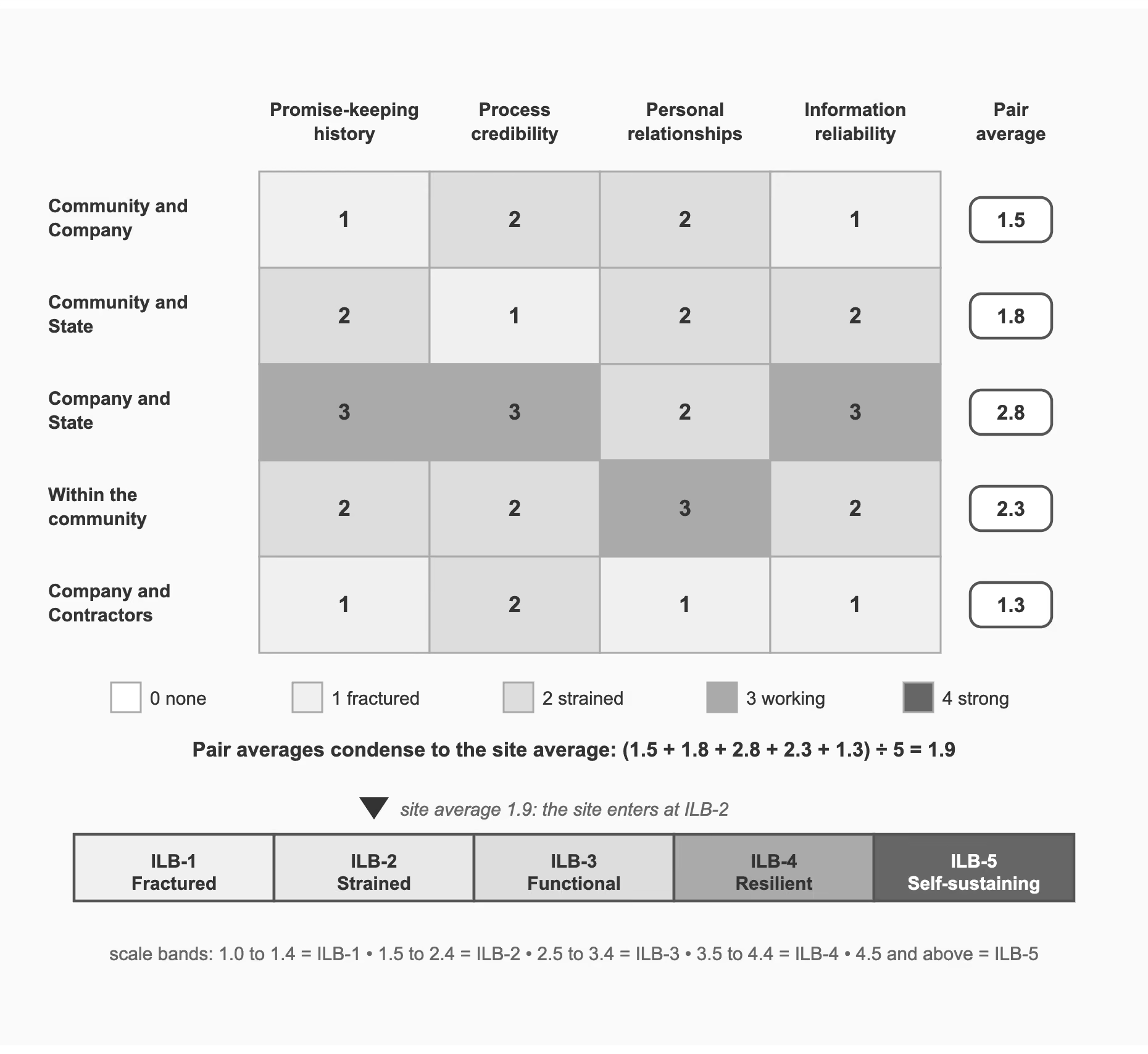
Score each pair on each dimension against documented incidents, not impressions, and use a scale coarse enough to be honest: 0 none, 1 fractured, 2 strained, 3 working, 4 strong. Anchor every number to at least one recorded event, written in a sentence beside the score. The format matters less than the discipline. A score nobody can trace to evidence is an opinion in a costume, and the matrix earns its authority only through those footnotes. Laid out as a grid, pairs down one side and dimensions across the top, the pattern that emerges is the finding. No row runs uniform. The company-to-state row usually outscores everything else. The contractor row usually drags the matrix down. Those differences tell you where the load paths hold and where they crack, and a single blended “trust score” would have erased every one of them.
Why this predicts durable agreement more than any offer
The reason to measure trust this precisely, rather than sweetening the offer and hoping, is that trust is what makes an agreement hold after the signing. The four dimensions map onto the components that the social-licence research of Jijelava and Vanclay identified as what actually builds or loses a community’s acceptance: legitimacy, credibility, and trust. Legitimacy, in their account, is acceptance grounded in fairness, whether the process to approve the project was fair and whether the benefits are shared fairly. That is exactly what promise-keeping history and a working complaint channel test on the ground. Credibility is believability, built by consistently providing true, clear information and delivering on commitments, which is what the audit reads in whether a company’s data survives contact with a cracked wall.
Trust, in their framing, is a strong form of credibility in which the community has confidence that the company will act at least in their mutual interest even when nobody is watching. It has two components worth naming, because they correspond to the top of the load scale. Interactional trust is the perception that the company listens, responds, keeps promises, and treats people with respect, a real but transitional state that can be withdrawn after one bad quarter. Institutionalized trust is the enduring version, where the parties regard each other’s interests as their own and do things with the community rather than for it. A relationship built only on interactional trust behaves like a relationship that can absorb routine friction but not a crisis. A relationship that has reached institutionalized trust behaves like one that survives a bad year and a change of personnel. The audit measures these components pair by pair instead of treating social licence as one number a project either has or lacks, and the payoff is predictive. A generous offer laid on a low-legitimacy, low-credibility relationship is received as a bribe or a trap. The same offer laid on a relationship that has earned credibility is received as a promise, and promises on that ground get kept by both sides. That is why baselining trust has to precede design. The offer is not the variable that determines whether the deal holds. The ground it lands on is.
The reading has to be earned in the field
The audit’s raw material is structured conversation, and it cannot be faked from a desk. Plan for somewhere between twenty and forty interviews on a typical site, sampled deliberately across every ring of the Actor Map. That means both sexes, all age groups, the margins as well as the center, and the corporate and state sides as well as the community. Build the sample as a grid before the first appointment, rings against demographics, and fill its cells consciously. A sample assembled from whoever is available collects the people with time and confidence, who are never the whole story. Include the contractors. Include at least two people who refuse to attend meetings, interviewed wherever they are willing to stand. Stop when saturation arrives, the point at which new interviews only repeat what the grid has already heard, and not before the margins cells are filled.
Conditions matter as much as questions. Interview where the person is comfortable, kitchens and fields over boardrooms, in their own language, with an interpreter they trust rather than one the company supplies. For a women’s savings group, a female interviewer is not a refinement but a precondition for hearing anything true. Open every conversation with clear terms: what will be recorded, who will see it, how the findings come back to the community. An audit that begins by taking words without terms has already scored itself on the first dimension.
Run each interview as a guided conversation through the four dimensions, anchored in incidents rather than opinions. Ask for stories, not ratings. A handful of questions does most of the work:
- Tell me about a promise this company made and kept. Now tell me about one it did not.
- The last time you raised a problem, what happened next? Walk me through it.
- Is there anyone on the other side you would call directly if something went wrong tonight? Who?
- When the company presents its water results, do you believe them? If not, whose results would you believe?
- What happened here before my time that I would never learn from the files?
- If your daughter took a job with this company, what would you tell her on her first day?
Mirror every one of those on the corporate side, because an audit measures relationships, and relationships have two ends. Ask the operations manager which community commitment he is least confident his successor would honor. Ask the contractor’s site agent what the community believes about his firm, and listen for whether he knows. Ask the district officer whose call he returns first. An audit that asks the community about the company but never asks the company about the community is not an audit. It is a complaint file with a methodology section.
Three rules protect the data. Never score in the room; a number assigned mid-conversation changes the conversation, so write the narrative and score it the same evening, while the wording is still exact. Follow every general claim down to a specific event, with the patience of a detective rather than a pollster; “they always lie” becomes usable only when you know which lie, when, and to whom. Close every interview by asking who else you should be speaking to, so the audit and the Actor Map keep feeding each other.
Interviews alone are not enough, because every account is partial and some are strategic. Triangulate each score against two further sources. Documents are the first: grievance logs, meeting minutes, prior agreements and their implementation records, and the gap between what the minutes claim and what the interviews remember. Observation is the second. Sit in the waiting room of the community office and watch whether anyone comes. Attend a public meeting and note who speaks, who whispers, and who has stopped attending. A channel that exists on paper but carries no traffic is itself a finding. When the three sources disagree, the pessimistic reading stands until evidence improves. This is a deliberate bias, because optimistic misreadings of trust are the expensive kind. A relationship reported as stronger than it is will be loaded accordingly, with predictable results. This is the same discipline behind a working early warning system for mining-community conflict: measure the relationship before it breaks, not after.
From a matrix to a load rating
The matrix then condenses into the audit’s headline metric. Impact Load-Bearing is the capacity of a social relationship to carry the weight of large-scale financial, political, or operational investment without fracturing. The construction analogy is exact. Engineers do not describe a bridge as “pretty strong.” They rate the load it can carry and post the rating where everyone can see it. The Impact Load-Bearing scale does the same for the relationship a project proposes to build on, in five levels. Each level has a diagnostic signature, the evidence pattern that places a site there, and a design posture, the loads that may responsibly be attempted from it.
ILB-1, Fractured. The relationship bears no load. The signature is refusal: meetings boycotted, staff barred from villages, every company statement read as provocation. Any initiative, however benign, is received as an attack and converted into fuel. The only permissible designs are safety, acknowledgment, and the smallest conceivable gestures of consistency. Anything larger feeds the fire.
ILB-2, Strained. The relationship is transactional and bears minor loads only. The signature is cooperation without belief: payments collected, attendance thin and wary, individual grievances sometimes settled, but every interaction contested and any shock escalating. Design may attempt single modules with short promise cycles and independently verified facts, nothing comprehensive.
ILB-3, Functional. The relationship carries routine operational loads. The signature is functioning routine: consultations attended, mechanisms processing complaints, ordinary business surviving ordinary friction, but every past shock on the record produced escalation. Design may run a full accord while treating crisis readiness as the binding constraint, because a leadership change or a serious rumor will still break it.
ILB-4, Resilient. The relationship absorbs major loads, including crises, through its structures rather than around them, and survives changes of personnel on both sides. The signature is absorbed shock: the record shows at least one crisis or bad year the structures held without outside rescue. Design may attempt long-horizon commitments and genuine co-governance.
ILB-5, Self-sustaining. The relationship is community-stewarded and bears generational loads without external facilitation. The signature is ownership: the parties run the architecture themselves, and disputes are handled by institutions they now own. The audit finds the practitioner’s absence unremarked.
The rating is not a grade. It is a load limit, and it governs what may responsibly be attempted. Ask the evidence one question: what is the heaviest load this relationship has actually carried without fracturing. Place the site at the highest level the evidence supports, never the level the engagement plan requires. Scores that fall between levels take the lower level, because optimism is not evidence. Scored once at entry and again at the end, the number also converts “the relationship improved” from a claim into a measurement, which is the same logic that makes social performance indicator tracking worth the effort.
A reading assembled end to end
Consider a scenario drawn from patterns across mid-life open-pit operations: an eight-year-old mine, one resettlement behind it, a tailings scare three years ago, and a grievance procedure that exists mostly on paper. The audit runs twenty-six interviews, three document reviews, and two weeks of observation. The sample is built across the map, so the widows farming near the pit, the young men who want haulage work, and the contractor’s crew are all in the grid, alongside the committee that answers the phone.
The matrix comes out uneven, as it always does. Promise-keeping between community and company scores 1, fractured, anchored to the resettlement: twelve of the promised replacement houses stand unfinished four years on, and every household interviewed can name the families still waiting. Process credibility scores 2. Grievances are acknowledged, even politely, but fewer than a third are ever resolved, and people have started routing complaints through a local councilor instead of the company’s own channel. Personal relationships also score 2, resting almost entirely on one respected liaison officer whom everyone names and no structure backs up. Information reliability is the weakest score on the board at 1. After the tailings scare the company published water data nobody believed, while a schoolteacher with a borrowed test kit was treated as the authoritative source. The community’s internal row scores a guarded 2 to 3, split between an older generation that remembers the promises and a younger one that wants the jobs. The contractor row is the lowest of all.
Now apply the load question: what is the heaviest weight this relationship has carried without fracturing. It does not carry routine operational load. A blast-schedule change the previous year produced a road blockade within forty-eight hours, which is the signature of a relationship that cannot absorb even an ordinary surprise. It does transact, though. Compensation payments, when scheduled, are collected without incident. Transactional function with escalation under any shock places the site at ILB-2, Strained, whatever the engagement calendar hoped for. That reading changes the entire design brief. The site cannot carry a comprehensive negotiation, a flagship development program, or an ambitious participatory process, however sincerely those are offered. You do not park a loaded truck on a strained bridge. Design has to begin with loads the bridge can take: small modules, short promise cycles, independently verified information, and visible early repairs, most obviously the twelve unfinished houses, until the rating itself moves.
Not all distrust is the same distrust
The audit’s final analytical step is to name what, exactly, is distrusted, because the design response differs for each and misreading it wastes years. There are three broad diagnoses.
Distrust of the company calls for independence: third-party verification, escrowed commitments, and structures the company cannot unilaterally control. When the finding is that people simply do not believe the operator will keep its word, the answer is to remove the operator’s ability to be the sole judge of its own performance.
Distrust of the process calls for co-design: the channels themselves get rebuilt with the community inside the drafting room, and early cases resolve quickly and visibly. Here the company’s word may be fine, but the grievance mechanism, the consultation format, or the decision rules are the problem, and no amount of goodwill fixes a channel the community had no hand in building.
Distrust of outsiders in general is common where every previous visitor eventually left or took something. It calls for patience and presence: work through institutions the community already trusts, slow the calendar, and let consistency do the work no presentation can. This is the diagnosis companies least want to hear, because it cannot be solved with a program or a payment. It is solved only by showing up, again, after the last outsider did not.
Get this wrong and the remedy insults the wound. The compensation offer that answers company-distrust deepens outsider-distrust, because it looks like one more visitor trying to buy his way out. The shiny new grievance mechanism that answers process-distrust offends the people whose grievance was never about the channel. This is why a generic trust-building program so often fails: it treats one word, trust, as if it named one thing. Understanding the root causes that drive mining community conflict starts here, with a diagnosis specific enough to act on.
The instrument’s deliverable holds all of this together in five parts. It records the scored matrix with its evidence notes; the site’s ILB rating with the load reasoning written out; the damage interpretation distinguishing distrust of company, process, and outsiders; an inventory of assets naming the informal bridges and respected individuals the design should build on; and a repair-cost assessment stating in plain terms what rebuilding would require and how long it plausibly takes. It also states the confidence level of each finding. Where the evidence is thin, it says so, because an honest “we do not yet know” outperforms a confident error every time. The complete instrument, with its scoring templates and worked matrices, lives in the Social Accord Architecture book. What matters here is that the report is written to be acted on, and that its findings become explicit constraints on what gets designed next.
Where the audit goes wrong
The audit fails in recognizable ways, and naming them is part of the method, because most bad audits are not dishonest. They are lazy in a specific direction.
Auditing with the wrong people is the most common failure. Maps built from introductions accumulate allies and omit opponents, and an audit that interviews only the people the company already talks to reads the relationship as far healthier than it is. The retired schoolteacher who dissolved that Mozambican agreement was never on anyone’s interview list. The fix is the sampling grid, filled from the margins first.
Treating one score as the community’s view is the second. A committee chairman’s confident account is one data point, not a verdict. Someone who speaks for the community in public may be precisely the person with the most to lose from an honest reading, and taking his word as the finding buries the internal split the audit exists to surface.
Skipping the outsiders, the contractors and the financiers, hides where the relationship actually breaks. The contractor row is usually the weakest on the matrix, and leaving it off does not make the grievances go away. It just guarantees they arrive unmodeled.
Self-serving interpretation is the subtlest and the worst. The temptation, when a client has paid for the audit, is to soften the ILB-1 finding into diplomatic language. A diagnostic that hides the real rating is not kindness. It sets the accord up to be designed for a site that does not exist. It is also the first failure of the discipline’s core principle, that the method must serve both the community and the project or it serves neither. State the rating plainly, state the confidence level, and let the design deal with the truth.
Score your relationships before you design the process
The companion Trust Audit and Relationship Readiness Diagnostic turns this method into a working instrument. It runs to 17 checkpoints across five sections. The first section, “Relationship pairs and scope,” tests whether you have assessed the community-company, community-state, internal-community, and contractor pairs separately rather than as one blurred whole. The remaining sections cover the four scoring dimensions, the field interview protocol and its sampling grid, triangulation against documents and observation, and the Impact Load-Bearing rating with its damage interpretation. Score each checkpoint In place, Partial, or Absent against documented evidence, never impressions, then read the Absents as your fieldwork list before you write a single line of process design. Run it at entry and again before you claim the relationship has improved, so your progress is a measured number and not a hopeful adjective. Download the Trust Audit and Relationship Readiness Diagnostic.
Why a mediated diagnostic beats a confident assumption
The instinct, under schedule pressure, is to assume the relationship is fine because nobody is currently blockading the road. That assumption is the unexamined load path that fails in the first storm. The alternative is not more optimism. It is an independent, structured reading of the relationship, run by someone the community has no reason to perform for, which is where a mediator earns the assignment. A company’s own team, however skilled, cannot ask “do you believe their numbers” and receive a truthful answer, because the team is the numbers. Neutral facilitation is what makes the fourth dimension measurable at all, and it is why the audit belongs in the hands of a mediator rather than a communications department. Structured, third-party mediation is not the thing you reach for once the road is blocked. It is the discipline that reads the ground honestly first, so the blockade never has to happen.
That is the case for the SAA as a discipline rather than a slogan. It sequences the work: map who holds influence, read the relationship honestly, design only the loads the relationship can bear, and repair the weak pairs before attempting the heavy commitments. The Trust Audit is the first honest number in that sequence. Every later decision inherits it. The Shared Intent Protocol that moves parties toward a shared goal, the GROUNDS mediation pathway that runs the dialogue, and the stewardship that hands governance to the community in the end all build on the ground the audit surveyed. Skip it, and you are negotiating on terrain you have never mapped, hoping the piers will hold.
If you are about to open a major negotiation or benefit agreement, run the audit before you draft the terms, not after the first dispute. To talk through a specific site, reach me at [email protected].