A two-year independent mediation between a mining company and several affected communities in Cabo Delgado, Mozambique. Years of accumulated grievance, a week on site with community-appointed representatives, and an agreement signed in public.
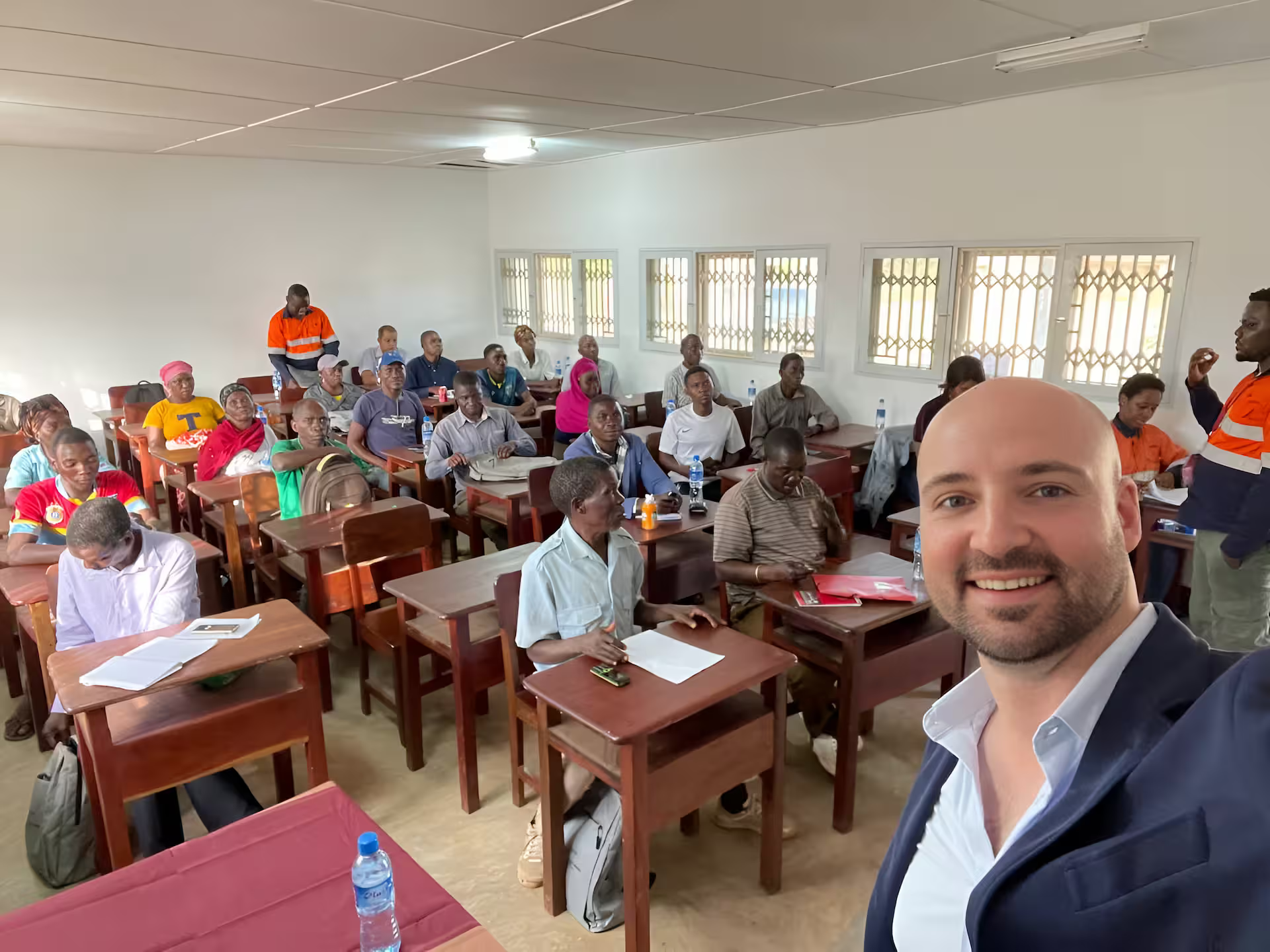
With the community, minutes before the session opens.
The Situation
A mining company operating in Cabo Delgado, in northern Mozambique, was carrying years of accumulated community grievance. The issues were the ones that build up around any large operation in a rural setting: land use, employment expectations the operation was never going to meet, environmental concerns, and a pattern of communication that the neighboring communities experienced as running in one direction only.
Several attempts at informal resolution had been made. None of them held. By the time the company approached me, each side was reading the other’s actions in the worst available light, and the exposure was no longer only to the relationship. Left alone, it was going to reach the operation.
One detail made this harder than a single dispute. This was not one community. Several distinct communities were affected, each with its own leadership, its own history with the operation, and its own view of what a fair outcome would look like. Any process that treated them as a single bloc would have failed, and any process that dealt with them one at a time would have been accused of divide and rule.
The company concluded that no amount of further internal negotiation was going to resolve this, however well intentioned. What it needed was a process that was independent, and visibly so.
The Approach
I was appointed as independent mediator, accountable to the process rather than to either party. The mandate ran for close to two years.
That length is the part people find surprising, so it is worth saying where the time went.
The first phase was diagnostic. Months of confidential meetings, held separately, with company leadership, with community representatives, and with local authorities. The purpose was not to negotiate anything. It was to find out what was actually there: who held authority and who only appeared to, which grievances were live and which were symbols of older ones, and how much weight the relationship could carry before anyone was asked to sit in the same room.
I traveled to northern Mozambique repeatedly across those two years. There is no version of this work that can be done from Lisbon, and the trips were not ceremonial. Each one tested whether what we had designed remotely survived contact with the people it was designed for. Between them, the work continued at distance, building the process alongside other advisers, including specialists in business and human rights, whose reading of the company’s obligations shaped what could credibly be put on the table.
The communities appointed their own representatives. This matters more than the sentence suggests. A representative chosen by the company, or accepted by default because they were easy to reach, produces an agreement that dissolves the moment it meets the people it was supposed to bind. Getting to a mandate the communities themselves recognized took time, and it was time well spent.
The whole engagement followed Social Accord Architecture: diagnostic mapping first, then blueprinting the process itself, deciding who sat at which table, in what order, and what test had to be met before anything advanced, and only then assembly, the building of the agreement. The sequence is deliberate. Projects that skip the first two phases and go straight to the third are the ones where a leader signs in good faith and the agreement collapses the moment it touches reality.
The Outcome
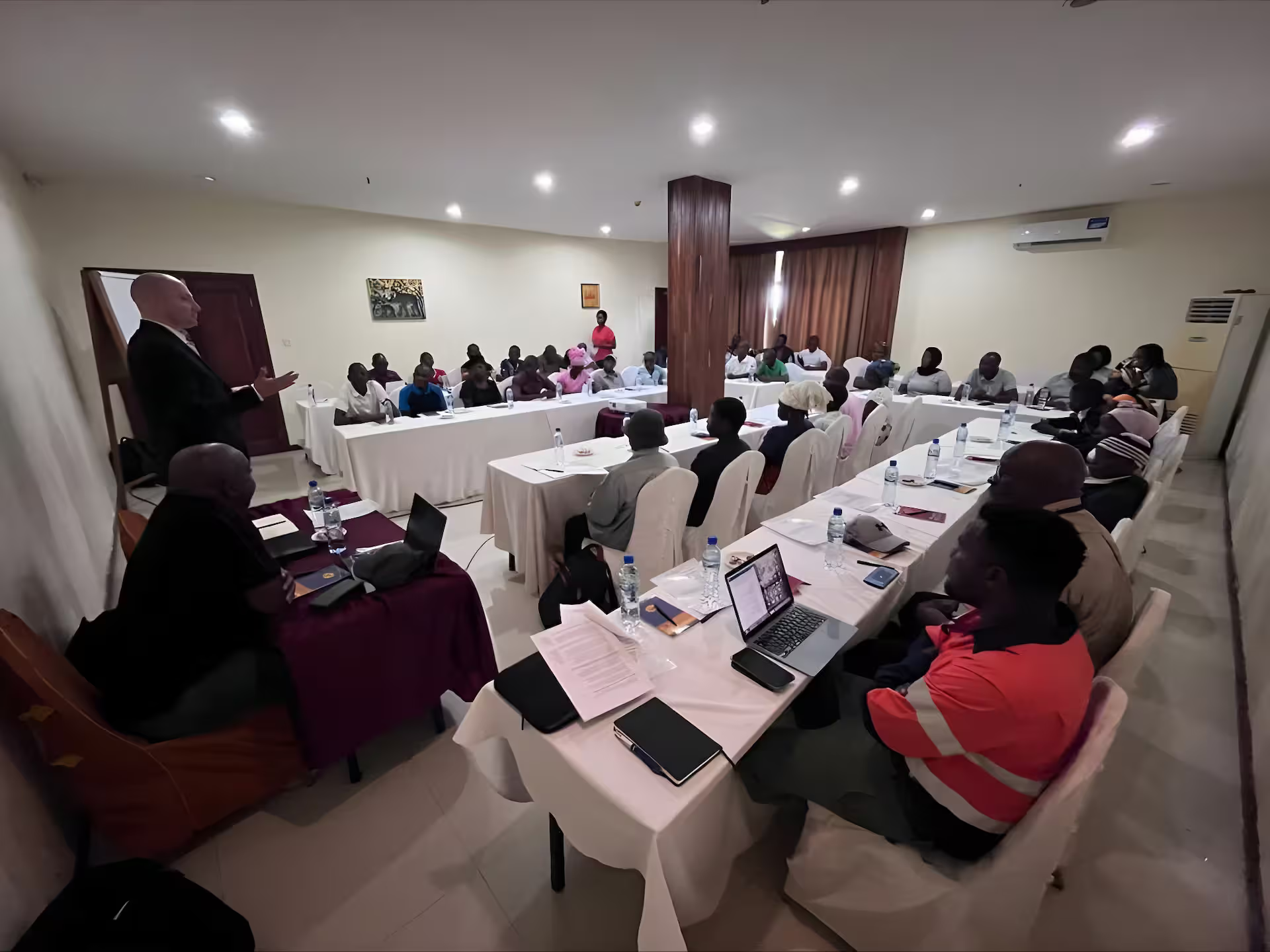
The mandate culminated in a week on site. Five full working days: one to prepare, three with the community-appointed representatives and the company’s management and CSR team in the same room, and a last day with the company alone for the debrief, the lessons and what had to happen next. Each of the three joint days had its own agenda, its own ground rules, and a facilitation structure built so that every party could be heard before any party was asked to agree.
The final day was not a formality. An agreement that nobody maintains fails on the same schedule as any other unmaintained asset, only more quietly, and the company needed to leave that week knowing exactly what it had taken on.
The session closed with an agreement in principle. It was then drafted into a formal agreement and signed publicly, with the communities present.
The public signature is not a detail. An agreement settled quietly between a company and a handful of representatives is a document that can be denied later by anyone it inconveniences. One signed in the open, in front of the people it concerns, is a commitment that both sides can be held to, and it is visible to everyone who was not in the room.
Underneath the document, the process had rebuilt something that had stopped working. People who walked in with visible frustration walked out understanding the constraints the other side was operating under, which is not the same as agreeing with them, and is worth considerably more. The channel that carried the next disagreement was built during this one.
Leaving the site, Cabo Delgado. Most of this work happens a long way from anywhere, which is part of why the mandate ran close to two years before anything was signed.
I left Cabo Delgado with a deep respect for everyone involved: the community leaders who brought courage and candor to the table, the company team who showed a genuine willingness to listen and then to act, and the local professionals who did the work nobody photographs and without whom none of it would have held.
What This Case Illustrates
The part of this engagement anyone would recognize as mediation lasted three days. The mandate lasted two years. That ratio is the lesson. Company-community conflict of this depth is not resolved in a room; it is resolved by the mapping, the process design, the question of who legitimately speaks for whom, and the patience to let a mandate form properly, all of which happen before the room.
It also shows what independence is worth. I was paid by one party and accountable to neither, and that distinction is the only reason the other side stayed at the table. Neutrality that exists only in the mediator’s own head is worthless, because nobody can inspect a mediator’s head. It has to be built into the design of the process, where it can be seen.
For a company weighing whether to commission this kind of work, the arithmetic has not changed in fifteen years. Accumulated community tension does not stay still. It compounds, and it eventually presents itself as a road closure, a permit problem, a lender question, or a headline, at which point the cost is no longer measured in mediation fees.
Key services demonstrated:
Community mediation, stakeholder engagement, structured dialogue facilitation, grievance resolution, extractive industry dispute resolution
Details have been generalized where confidentiality requires it. Client
names appear only where the client has agreed to be named.
How a facilitated multi-stakeholder workshop reformed an operational grievance mechanism for a mining company in Mozambique, resolving procedural bottlenecks and establishing objective standards for assessing community claims.
How an embedded community relations function helped a lithium mining company in Portugal navigate land acquisition, community opposition, stakeholder engagement, and social license challenges in Europe’s critical minerals sector.
If the relationship around a project is under pressure, or heading there, let us talk.
A 30-minute call is enough for me to understand the situation and tell you honestly whether I can help. Active opposition, a social license problem, an FPIC process that needs an independent facilitator, a negotiation a community has to prepare for, or a conflict that is not public yet but will be. It makes no difference which side of the table you are on. No obligation, no generalist pitch.