

The argument was never really about the money
Two years into a stalled land-access negotiation, the offer per hectare had been raised three times, and each increase made the deadlock worse. The money had become the way each family measured its standing against its neighbors, so a higher number widened the split instead of closing it. The turn, when it came, had nothing to do with rent. An older farmer, silent for most of two sessions, asked the project director how old he would be in twenty years. His own grandchildren were gone to the city, he said. So tell me what this place is in twenty years, with your machines or without them. For two years both sides had been arguing about price while both were privately grieving the same thing: a district emptying of its young. Nobody had said it out loud.
That is the gap the Shared Intent Protocol closes. Parties locked on positions are not short of goodwill. They are short of a structure that lets them stop defending demands long enough to discover what they are actually defending. Building that structure is the first design move in the whole methodology, and it is the one that decides whether everything after it has any foundation to stand on. The two reflexive alternatives both fail: raising the number teaches the community that pressure moves money, and reaching for “win-win partnership” language produces a sentence so weightless that nobody can be held to it. The protocol is slower than an auction and harder than a slogan, and it is the only one of the three that leaves a document the parties will still honor when the goodwill wears off.
Why positions are where negotiations start and where they get stuck
A position is what a party says it wants: the demand, concrete and usually mutually exclusive with the other side’s demand. An interest is why it wants it: the need, fear, or hope underneath. Positions are single and opposed. Interests are multiple and frequently overlapping, and the overlap is where agreements live. This distinction is not new. Fisher and Ury built the modern negotiation field on it in 1981, with the instruction to focus on interests, not positions. What the Shared Intent Protocol adds is a disciplined sequence for doing that at the scale of a company and a community, where the “parties” are really coalitions, the interests run in several languages, and the fears are decades old.
Consider the community that demands no turbine within two kilometers of the village. Underneath that single position may sit sleep, property values, a sacred hilltop, or simply the principle that nobody asked them first. Each of those interests opens a different solution space. The position closes all of them. A negotiation that only trades on the two-kilometer number is an auction, and auctions in this sector tend to end at a blockade rather than a deal. Moving from adversarial to collaborative conflict dynamics almost always runs through this exact shift, from stated demand to underlying need.
The Shared Intent Protocol is the first instrument of the design phase in Thomas Gaultier’s Social Accord Architecture, the field methodology that treats the capacity for agreement as buildable infrastructure. Its job is to move parties from positional demands to a single North Star Goal: the one objective all sides agree is larger than their individual interests. The Manifesto puts the mechanism plainly, that the protocol transforms positional bargaining into interest-based collaboration. Get the sequence right and a two-year argument can close in months. Skip the early steps to reach the drafting faster, which is the most common way facilitators ruin it, and you produce a slogan that binds no one.
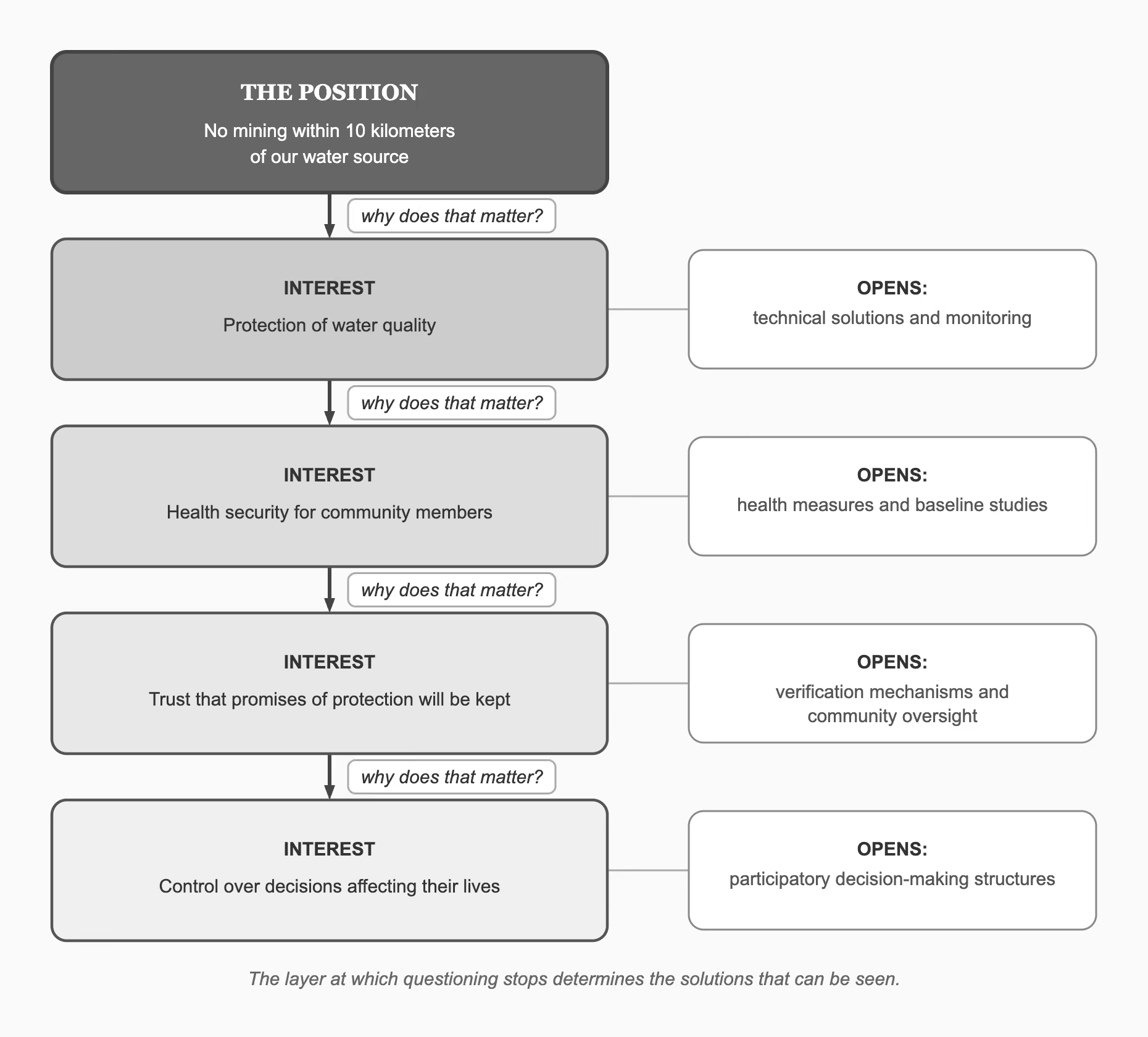
Why intent has to be agreed before anyone bargains
Treating this step as soft, a warm-up before the real negotiation over numbers, gets the sequence backward. Alignment on intent is the precondition that makes bargaining converge instead of escalate, and you can watch it change the physics of the room. Before a North Star exists, every concession is a loss, because any movement toward the other side looks like retreat in front of one’s own constituency, and the natural motion is apart. After a shared goal is adopted, the reference point changes. A proposal is no longer measured against my opening demand but against the sentence both of us signed, and the useful question shifts from “who gives ground” to “which option serves the goal we already agreed on.” That single change reassigns the burden of proof: the party resisting a sensible option now has to explain why it does not serve the shared objective, which is a much harder speech to give than “no.”
This is also the honest difference between the Shared Intent Protocol and conventional interest-based negotiation. Fisher and Ury taught negotiators to look past positions to interests, and that instruction holds. The gap they left is what happens after the interests surface. In a two-party commercial deal, the principals can trade interests directly across the table. In a company-community conflict, the interests belong to coalitions whose members are not all present and whose trust in each other is often near zero, and loose interest-trading there produces a deal the delegates like and the constituencies reject. The protocol adds the missing structure: interests elicited apart, mapped honestly, converted into a single written goal, and ratified by the people who were never in the room. It is interest-based negotiation engineered for asymmetry, multiple parties, and long memory. Trust here is built by sequence, not declaration, so the protocol’s pace is the relationship’s pace, and rushing it is the most common way the whole design cracks.
The five facilitation movements, in order
Run the protocol in five movements. The order is deliberate, and the discipline is refusing to jump ahead. Each movement exists to prevent a specific, predictable failure.
The first movement is to elicit interests separately. Meet each party in caucus before any joint goal work, and walk them down the ladder from position to interest with a small battery of questions worth carrying verbatim, because parties volunteer none of them. Help me understand what makes that important to you. If you got exactly what you are asking for, what would be different the following year? What are you most afraid this project does to this place? What would you need to see to believe a promise from the other side? The reason this happens apart is protective. A community that voices its real fear in front of the company, before any trust exists, has handed the other side its pressure points, so in a joint room it will not voice the fear at all. Listen for interests embedded in stories, because parties rarely announce their interests. They narrate them. A farmer describing how his grandfather walled the upper pasture is telling you about legacy, not stones.
The last two questions matter most. Fears and proof requirements are the load-bearing interests, and they are the ones a negotiator will hide behind a position for as long as the room lets them. The proof question is the more useful of the pair, because its answer is a design specification handed to you by the other side. When a community tells you what it would have to see to trust a commitment, it has just told you what verification the eventual accord must contain, which becomes the monitoring design later.
The second movement is to consolidate the interest inventory. Sort everything you heard into three columns: shared interests, compatible interests that differ but do not oppose, and genuinely conflicting interests. Parties systematically misjudge the size of their disagreement, and seeing the first two columns on paper is itself a change in the temperature. Reflect the inventory back to each side separately and let them correct it before anyone sees it jointly, so that no party can later claim the facilitator put words in its mouth.
The third movement is the future-focus session. Bring the parties together around a question deliberately displaced in time. Ask them to describe the valley, the district, the coastline in fifteen years if everything goes as well as it realistically could. Time displacement is not a trick. It lowers defenses because the distant future is not something either side has to concede today, so it can be discussed without anyone losing face in front of their people. People who cannot agree on this year’s compensation can often agree on what a good twenty-fifth year looks like, and the agreement travels backward from there. This is usually the session where the buried fear finally surfaces, because a question about the future is really a question about what each side is afraid it will take.
The fourth movement is to draft the North Star. Form a small joint drafting group, never the facilitator alone, and always including community drafters with real standing. The composition of that group is doctrine, not courtesy: a sentence written by the company and presented for the community’s approval is a term of service, honored the way terms of service are honored, unread and abandoned at the first inconvenience. Build the statement from the shared column and the future-focus material, and expect three to six drafts. The arguments over wording are not obstacles to the work. They are the work, because every contested word is an interest negotiating its place in the text.
The fifth movement is to test and adopt. Subject the draft to the six wording standards below, then have each party take it home, in its own language, to the constituencies who will have to honor it. This movement exists to catch the failure that kills the most agreements: the gap between a delegate’s signature and a community’s acceptance. A goal ratified only at the table is a goal the table will defend alone when the pressure comes.
What the inventory actually reveals
The point of the separate-then-joint sequence is that it shrinks the conflict to its honest size. Deep in a positional fight, both sides believe almost everything is contested. The inventory routinely shows the opposite: a long shared column, a compatible column full of the pairs that quietly fund agreements, and a conflicting column that, after everything, holds two or three entries, every one of them negotiable.
That reduction is the protocol’s product. It does not manufacture agreement out of nothing. It clears away the false conflict so the real one becomes small enough to solve, and the North Star is the receipt that proves the clearing happened. This is also why a mediated benefit negotiation works so differently from a positional one. The community benefit agreement negotiation guide sets out how the substance gets built once shared intent is established.
The six standards for a North Star that can hold weight
Most North Star statements fail in the drafting, and they fail in the same direction, toward comfortable abstraction. A useful statement meets six tests, each one there to keep the sentence honest, and each easiest to understand through a good example set against a weak one.
It is concrete. It names places, numbers, dates, and institutions, not values. Nouns over adjectives. An abstraction cannot be checked, and a goal nobody can check is a goal nobody has to keep. Weak: “a prosperous and harmonious future for the region.” Strong: “by a fixed year, thirty operating jobs are held by local residents and rents are paid on schedule into named family accounts.” The first describes a mood. The second describes a state of the world you could stand in the village and verify.
It can fail. A goal that cannot observably fail is not a goal. It is a slogan, and if no future state of the place could contradict the sentence, the sentence binds no one. Weak: “a lasting partnership built on mutual respect,” which no event could ever falsify. Strong: “the school is open with at least forty children,” which fails visibly the year the school is empty. A statement that can fail is a statement someone has agreed to be measured against.
It binds both parties. Each side must be able to point to the part it has to deliver and the part it has to risk. A North Star that only obligates one party is a demand wearing a halo. Weak: “the company will invest in community development,” which asks nothing of the community and so commits nobody to a shared fate. Strong: a sentence in which the developer funds and builds while the community adopts, enforces, and governs, so that each side has skin in the same outcome. Mutual obligation converts a goal from a gift, which can be withdrawn, into a partnership, which has to be maintained.
It survives translation. The statement has to cross into the working languages without losing its teeth, because corporate abstractions do not travel. “Win-win partnership” arrives as noise in every language, including English. Draft in the language of the place where possible, then translate outward, and treat any phrase that comes back mangled as a diagnosis rather than a translation problem. What survives is always the same short list: nouns, numbers, institutions, and dates.
It can be recited. If an ordinary community member cannot say it from memory at the market, it is too long, and a goal nobody can repeat is a goal nobody carries. A North Star works by living in the heads of the constituencies who ratified it, so that when a rumor or a bad quarter arrives, people measure the event against a sentence they actually remember. A three-paragraph goal fails this test by existing.
It addresses each party’s deepest mapped fear. Check it against the diagnostic. If the statement does not speak to the specific fear each side named in caucus, one party is signing someone else’s dream, and it will withdraw the first time the process gets hard. This is the standard that ties the North Star back to the Trust Audit before it: the fears the diagnostic surfaced are the fears the goal must answer, by name.
The difference shows immediately at the extremes. “A sustainable, mutually beneficial partnership delivering shared prosperity for all stakeholders” fails every test at once. Nothing concrete, nothing that can fail, nothing translatable, nothing anyone fears or loves. Worse than empty is “zero conflict by 2030,” which sounds rigorous and is poison, because it converts every future grievance into a violation and so teaches people to hide grievances, which is the single most dangerous thing a system can train its members to do. A workable North Star instead reads like a photograph of a specific good year, the kind the worked example below arrives at, where every clause can fail, both parties can be held to each, and an ordinary member can recite it.
The translation test deserves a closing note, because it catches what the others miss. One negotiation first promised “a thriving community,” and the phrase died in translation twice. Rendered into the local language it came back as “a fat village,” which made the elders laugh. Rendered formally it came back as bureaucratic mist. The drafters replaced it with “a living village” and then defined living in clauses: the school open, the jobs held, the rents arriving. What does not translate is the abstraction a head office finds reassuring precisely because it commits the company to nothing. Run every draft through every working language and back, and whatever returns intact is what you can build on.
When the protocol stalls, and the move for each stall
The protocol stalls in recognizable ways, and each stall has a response. Naming them in advance is what keeps a facilitator from mistaking a diagnostic signal for a dead end.
One party refuses joint goal work entirely, treating any shared sentence as a concession. The cause is almost always upstream. A relationship with very low trust, the kind the Trust Audit would have rated at its bottom levels, is being asked to carry a load it cannot yet bear. The move is not to push harder on the goal. It is to retreat to smaller trust repairs, deliver something real and reciprocal, and return to the shared sentence once the relationship can hold it.
The future-focus session produces two futures with no overlap, one side wanting the project gone and the other wanting it expanded. The move is to check whether you are hearing positions again rather than interests. “Gone” usually decodes into safety, control, or disbelief that benefits will ever arrive, and all three are designable. Take the two futures back into caucus, run the fear question underneath each, and the overlap usually appears.
Someone at the table keeps reopening language everyone else has already adopted. That is not drafting, it is actor management. The person may be a spoiler whose interests are served by no agreement, or a delegate without the mandate to close, and the two require different responses, but neither is solved by redrafting the sentence a seventh time. Diagnose the actor, not the wording.
The parties reach for a premature North Star, adopting in week two what should have taken six. Distrust the speed. A statement adopted before the fears have been spoken is a statement nobody has tested against their fears, and it will not survive contact with the first hard module. Slow down deliberately, run the caucus fear questions you skipped, and let the goal be re-drafted once the real interests are on the table. Fast adoption is usually avoidance wearing the costume of momentum.
A worked example, from opposed positions to a ratified sentence
Consider a scenario drawn from patterns across upland renewable-energy conflicts, where a developer needs land access across many small parcels and several villages, and two years of talks have hardened into a single fight over euros per hectare. This is illustrative, not a real named project, but every move in it is standard.
The opening positions are flat opposites. The villages want the offer raised again and several turbines moved off the ridgeline entirely. The developer wants the current table accepted so financing can close on schedule. Two council sessions produce nothing but the two positions restated, louder.
Caucus changes what is visible. Asked what they are most afraid the project does to the place, the village drafters do not talk about turbines. They talk about a district losing its young, a school that may not fill next year, and a suspicion, earned over decades, that the outsiders will build, profit, and leave. Asked what they would need to see to trust a promise, they name money that arrives without being chased, jobs that go to their own people, and a say in how any community fund is spent. The developer, asked the same, names its own fears: a project that dies in appeals after years of sunk cost, roads destroyed by transports with no one funding repair, and a reputation that follows the company to its next site.
Consolidation shrinks the war. The shared column, read back to both sides, holds more than either expected: keep the district inhabited, build with local firms, get the project built rather than litigated to death, protect the roads, and keep this out of court. The compatible column pairs rent certainty for families with capital-cost predictability for the developer, solved by a fixed indexed rent neither side had proposed. The conflicting column, after everything, holds two entries: the siting of two specific turbines, and how rents split between landowners and the wider community. Both negotiable.
The future-focus session gives the North Star its shape. Asked to describe the valley in fifteen good years, the oldest drafter describes a place where the machines turned and the village stayed alive, and the room, for the first time, is describing the same picture. The joint drafting group takes four passes. The first, “a thriving, sustainable community,” fails the recital and translation tests on sight. By the fourth pass the sentence reads as a photograph of a specific good year: a working wind farm and a living village, rents paid on schedule into named family accounts, a school open with at least forty children, thirty operating jobs held by valley residents, and a benefit fund governed by the parish councils and audited in public. It passes all six standards, it goes home in each language to the constituencies, and it comes back ratified. The two remaining conflicts are now the whole agenda, small enough to solve because everything false has been cleared from around them.
Common failure modes, and how to avoid them
Three failures account for most of the wreckage, and each is avoidable with a specific discipline.
The North Star that is really a position in disguise. A community drafting alone will produce “the mine operates at half its planned footprint,” and a company drafting alone will produce “the community supports the project’s full development.” Both are positions wearing a goal’s clothing, and both fail the binds-both-parties test the moment you apply it. The guard is the joint drafting group plus the six standards used honestly. A sentence that cannot pass the both-parties test is one side’s demand with better lighting.
Eliciting interests jointly, too early. The pressure to save time by running one big room instead of separate caucuses is constant, and it is a false economy, because in a joint room before trust exists the real fears stay hidden. What you get is a polite exchange of positions and a goal built on top of nothing. The guard is non-negotiable: caucus first, always, and do not convene the future-focus session until the load-bearing interests are already on paper.
Skipping ratification. A goal adopted by delegates and never carried home feels finished and is not, and the first hard week produces a constituency that repudiates a sentence it never agreed to. The guard is to treat the fifth movement as mandatory: every North Star goes home, in every working language, to the people who will live under it, and it is not adopted until they endorse it.
Where this sits in the Social Accord Architecture
The Shared Intent Protocol does not stand alone. It is Instrument 2.1 of the Accord Architecture Framework, the operational core of the SAA, and it sits at a precise point in a four-phase sequence that gives it its inputs and its purpose.
It follows the diagnostic. Phase 1 produces the Actor Map, which tells you who must be in the drafting group and whose absence would void the result, and the Trust Audit, which rates the relationship’s load-bearing capacity and names the fears each side carries. The protocol depends on both. You cannot elicit interests from parties you have not mapped, and you cannot write a North Star that addresses each party’s deepest fear if the diagnostic never found the fears. A Shared Intent Protocol run without the diagnostic underneath it is guesswork with a drafting group attached.
It sets up everything that follows. The North Star becomes the foundation the rest of the design rests on: when a later module negotiation deadlocks, the way out is almost always downward, back to the foundation, asking which option serves the sentence both parties already adopted. The two remaining instruments of the design phase build on it. Mechanism Design writes the rules of the relationship, how the parties communicate, resolve internal disputes, share data, and make decisions, all calibrated to serve the shared goal. Modular Agreements then decompose the conflict into buildable units, each tested against a single question: does this module move the parties toward the North Star. And when a dispute inside the accord escalates past what design can absorb, the mediation pathways, GROUNDS for standard disputes and REBUILD for cases carrying genuine trauma, deploy underneath the same shared goal. The North Star is the fixed point the entire structure is squared against.
One warning belongs at the end, because the protocol’s success creates its own trap. Adopting a real North Star produces a season of goodwill that tempts everyone to skip ahead to signing ceremonies. Goodwill is weather. The rest of the design work exists to convert it into climate. The sentence is a foundation, not a roof.
Map positions to interests before you convene
The companion Positions-to-Shared-Intent Facilitation Planner turns this method into something you can prepare against. It is a fill-in template with 15 prompts across five sections. It opens with “Position and interest mapping,” where you write each party’s stated demand beside the fear or need you believe sits under it, and mark what you still need to test in caucus. The later sections cover the caucus elicitation questions, the three-column interest inventory of shared, compatible, and conflicting interests, the future-focus session design, and a North Star drafting worksheet that runs your candidate sentence against all six wording standards. Fill the planner in before the first joint session, not after. You then convene already knowing where the real overlap probably sits and which two or three conflicts are the ones that actually need solving, instead of discovering both in front of the parties. Download the Positions-to-Shared-Intent Facilitation Planner.
Why the mediated route beats splitting the difference
The reflexive alternative to this work is to keep raising the offer and hope the number eventually lands. Davis and Franks showed in 2014, across fifty projects, how that reflex converts an unresolved dispute into delay, suspension, and cancellation. The stalled land negotiation is that finding in miniature: three price increases, a wider split each time, and no movement until someone named the fear underneath. Splitting the difference on a position leaves both sides short of what they actually needed, because the position was never the need.
This is where a mediated, structured approach earns its place. An independent facilitator can hold the caucuses where the real fears surface, protect the future-focus session from the reflex to bargain, and draft a North Star that binds both sides rather than one. Neither party can do that for itself while it is still defending its own demand, because the parties cannot referee their own interests. That is the honest answer to when to call in a mediator versus trusting your own team: once positions have hardened and the money is only making the split worse, an independent hand running this sequence is what unlocks it. The Social Accord Architecture gives that facilitation a method rather than an improvisation. As the Manifesto puts it, we do not stumble into agreements, we design them, and the Shared Intent Protocol is where the designing starts. If you are heading into a negotiation where positions have already hardened, run this sequence before you touch the numbers again. To work through a specific situation, reach me at [email protected].