
Skip to Main

When The Mine Arrives

An Insider’s Guide for Communities Negotiating with Extractive Industries

A practical guide written for the people on the other side of the table, the villages, farmers, and communities who wake up one morning to find strangers with equipment on their land and their lives about to change.

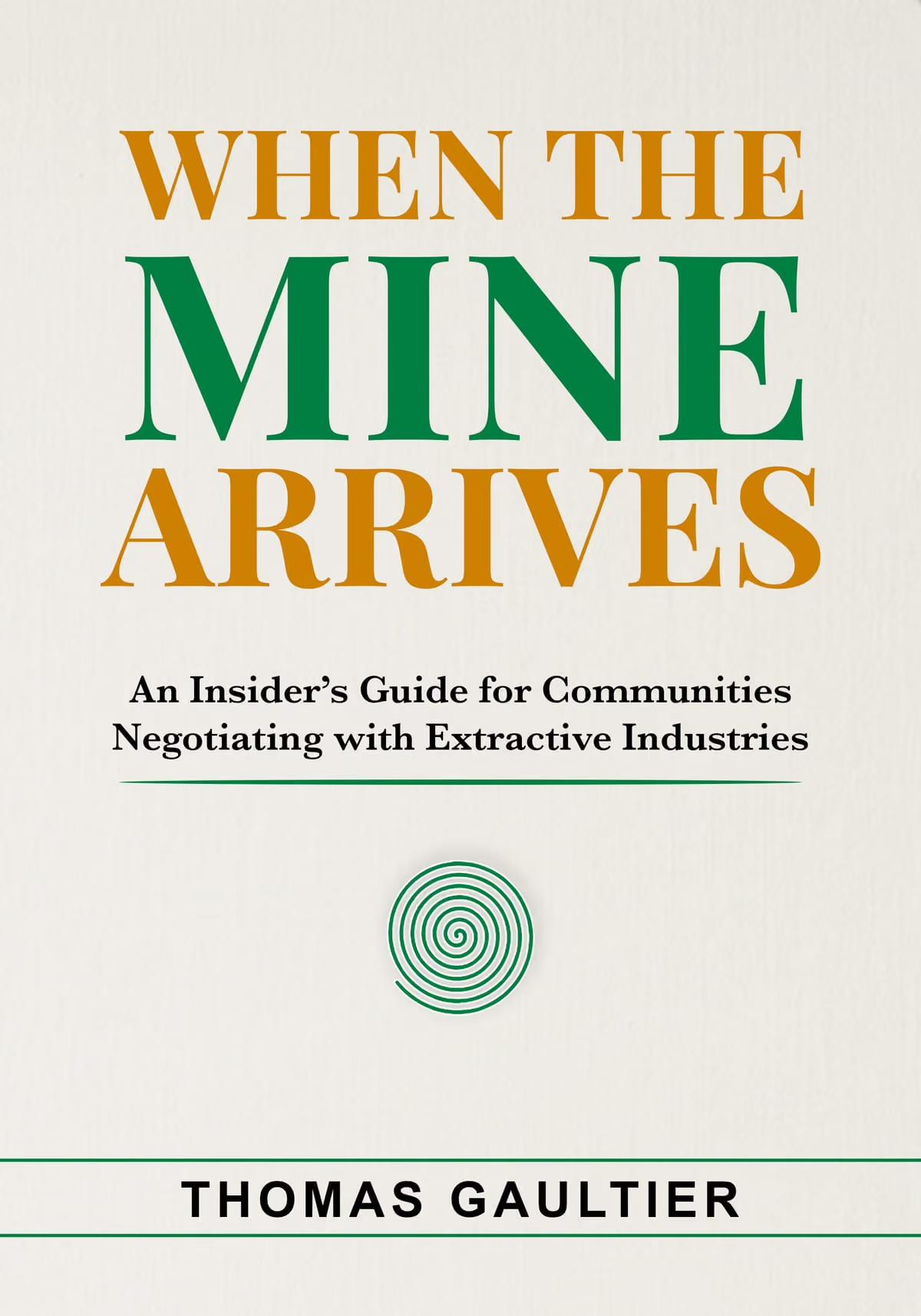
Book cover for When The Mine Arrives

Who Is This Written For?

Mining companies arrive with lawyers, engineers, financial analysts, and communications teams. The communities on the other side of the table usually have none of these things. They have deep knowledge of their land and a moral claim to be heard, but not the technical, legal, or organizational resources to engage on equal terms.

This book exists to close that gap. It is written for the people who must negotiate their future with an industry far better resourced than they are, and for the organizations that stand alongside them.

What You’ll Learn

There are technical manuals for engineers, financial analyses for investors, and legal treatises for lawyers. There is almost nothing that speaks directly to the communities most affected by mining, in language they can understand, about the things they most need to know. When the Mine Arrives fills that gap.

Drawing on fifteen years of community relations and dispute resolution, and two years spent inside a mining company's social performance team, it gives communities the preparation the author wishes every community had before the mine arrives: how projects work, what rights communities hold, how companies think, how to organize, how to negotiate, and how to hold a company to its word for decades.

Understanding the Landscape: How a Mining Project Actually Works

Before you can negotiate, you have to understand what you are facing.

These chapters map the anatomy of a mining project from the first strangers on your land through construction, operation, and closure, explain the rights you hold on paper and in practice across local law, international standards, and lender requirements, and reveal what the company actually wants and what it is afraid of.

Your power is highest at the very beginning. This section shows you why, and how to use it.

Getting Organized: Speaking With One Voice

A divided community is easy to manage and easy to defeat.

These chapters cover who legitimately speaks for the community, how to build a negotiating team and avoid being co-opted or split, and how to gather and protect the information that becomes your strongest evidence.

Document everything before the trucks arrive, because without proof of what was here before, you cannot prove what was lost.

The Negotiation: Reaching an Agreement You Can Live With

This is the heart of the book: how to prepare before you sit down, the negotiation strategies that actually work against a better-resourced counterpart, what a strong Community Benefit Agreement looks like, and how to secure real environmental and health protections rather than vague promises.

The difference between a good agreement and a bad one is rarely luck. It is preparation.

After the Agreement: Holding Them to It

Signing is the beginning, not the end.

These chapters show you how to monitor compliance and enforce commitments, what to do when things go wrong, and how to keep an agreement working over the twenty, thirty, or fifty years a mine operates, when owners change, prices change, and the leaders who first negotiated are gone.

Special Situations and Practical Tools

The hardest cases get their own treatment: when government is not on your side, the distinct rights of Indigenous and traditional peoples, what to do when the answer is no, the gendered impacts of mining, and where industrial and artisanal mining collide.

These chapters show you how to monitor compliance and enforce commitments, what to do when things go wrong, and how to keep an agreement working over the twenty, thirty, or fifty years a mine operates, when owners change, prices change, and the leaders who first negotiated are gone.

We did not know what to ask. We did not know whom to ask. We did not know what we were entitled to, or what we stood to lose.

By the time we understood, the surveyors had already pegged out the open pit on the hillside above our village, and the company was buying our neighbours' land.

This book is the preparation I wish every community had before the mine arrives.

When The Mine ArrivesChapter 1

Not sure Yet? Start with a free chapter

In Chapter 1, “What Just Happened? The Anatomy of a Mining Project,” Thomas Gaultier walks through how a mining project really unfolds, from the first geologists on your land to the day the mine closes, and explains the single most important fact a community can know: your power is highest at the very beginning, before billions are spent and the holes are dug.

It gives you a real sense of the book's argument before you commit to the full text.

About Thomas

Not a generalist. Not an academic. A field practitioner.

Thomas Gaultier is a mediator, lawyer, and strategic engagement expert who has spent his career navigating the tension between industrial development and community wellbeing. He served as a community and social performance officer for a lithium mining project in Portugal and was appointed as an expert mediator for a ruby mining operation in East Africa. His fieldwork across Sub-Saharan Africa and Europe, including mediating over two thousand grievance claims in Mozambique, has shaped a practice grounded in the realities of frontline community relations.

That body of field experience led Thomas to develop Social Accord Architecture, a professional discipline for designing durable agreements between industrial projects and affected communities. He provides training in conflict prevention, conflict resolution, and community mediation for some of the world's largest mining groups. He is a professional mediator who works with CEDR in London and serves as an expert mediation trainer with the International Mediation Campus at Consensus Group.

Thomas is co-founder and Vice-President of the ICFML (Instituto de Certificação e Formação de Mediadores Lusófonos) and teaches negotiation and mediation at the Universidade Católica Portuguesa. Admitted to the New York Bar, he holds an LL.M. in Alternative Dispute Resolution and an MBA in Mining and Raw Materials. He is fluent in English, French, Portuguese, and Spanish.

About Thomas
Thomas Gaultier, community mediation specialist for extractive industries, in the field

Get Your Copy Today!

Join the communities, leaders, and advocates who refuse to face the mining industry unprepared.

Buy on Amazon