
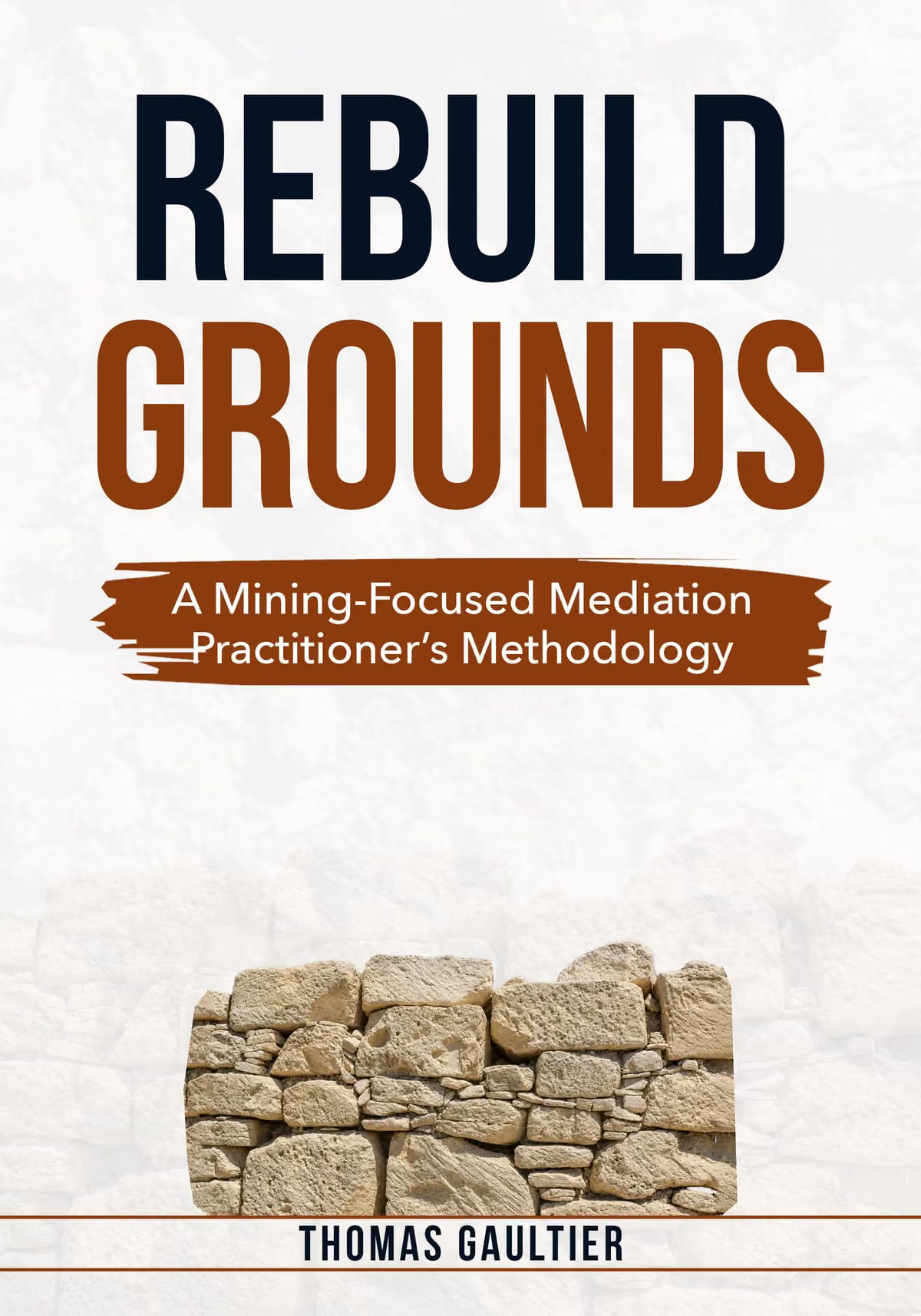
A Mining-Focused Mediation Practitioner’s Methodology
A working method for the room where a mine and a community have stopped trusting each other, written for the mediators, grievance officers, and advisors who have to decide, before anyone sits at the table, which process the dispute in front of them actually needs, and then run it phase by phase.
Most mediation training assumes one process fits every dispute. In mine-community conflict it does not. A quarrel over dust, blasting hours, and a haul road, and a dispute that began when a waste slope failed and people did not come home, look almost the same on an intake form and need almost opposite handling.
Rebuild Grounds is built for the practitioners who carry that judgment call and need a method they can prepare with next week, not a theory. It gives two complete, phase-by-phase frameworks, a scored instrument for choosing between them, and the scripts, checklists, and case examples to run either one in the field.
Mediators and Conflict-Resolution Professionals
The practitioners who sit between company and community and need a repeatable, phase-by-phase method, plus a structured way to decide which process a dispute requires before the first session rather than after the wrong one has already done damage.
Grievance and Social-Performance Practitioners
The officers who run grievance mechanisms and engagement inside an operation, who want field-ready structure for the disputes that reach their desk and a defensible way to handle the ones that carry serious harm.
Community Advisors, Lawyers, and Facilitators
Those who stand with communities through conflict and need to recognize when a standard bargaining track will heal and when it will wound, and how to protect people who are still processing harm before any negotiation begins.
Company Community-Relations and Negotiation Leads
The CR managers and company negotiators who carry the operation's side at the table and need a shared method with the mediator, not a separate playbook that collides with the process halfway through.
ESG, Sustainability, and Social Risk Leaders
The leaders who commission mediation and answer for social license, who need to know what a credible process looks like and how to tell engineered engagement from improvised firefighting.
Trainers, Academics, and Peacebuilding Practitioners
Teachers and researchers in mediation, conflict studies, and transitional justice, who will recognize the REBUILD track's roots in trauma-informed and restorative practice and can use the frameworks to teach.
What You’ll Learn
There are texts on mediation theory, manuals on stakeholder engagement, and academic work on transitional justice. There is almost nothing that hands a working practitioner two complete frameworks for mine-community disputes and tells them, dispute by dispute, which one to use.
Rebuild Grounds does. Drawing on more than fifteen years of frontline practice in extractive conflict, it delivers the method and the judgment together: how to read a dispute, how to run a standard facilitation end to end, how to work when serious harm sits in the room, and how to carry the whole thing with ready-made scripts and checklists.
Foundations: Why Two Frameworks, and How to Choose
Before you run any process, you have to pick the right one.
The opening part explains why a single method cannot serve both a benefit-sharing disagreement and a dispute shaped by death or displacement, introduces the dual-framework system, and gives you a scored selection instrument, together with the core principles that hold across both tracks.
GROUNDS: Structured Facilitation, Phase by Phase
For disputes where the relationship is intact and both sides can engage, GROUNDS carries the process through seven phases, from Groundwork to Secure
Each phase comes with its guiding question, its key activities, and the test that must be met before the process can advance, so you always know where you are and what has to be true to move on.
REBUILD: Mediating at the Pace of Harm
When a community is carrying serious harm, bargaining first does damage.
REBUILD moves through its own seven phases, from Ready to Deliver, putting screening, safety, truth-telling, and acknowledgment before any negotiation, with explicit permission to pause built into the method.
Putting It to Work: Transitions, Dialogues, and Hard Cases
Real disputes do not hold still.
This part shows you how to switch tracks mid-process when the room changes under you, works through sample dialogues and scenarios, and lays out the common challenges that derail mediations before they reach agreement, with ways to recover.
The Practitioner's Toolkit
The book closes with the apparatus you carry into the field: a framework selection checklist, phase-by-phase checklists, a quick-start guide, ready-to-use sample language and scripts, and a working glossary.
Twenty-five case examples and fifteen figures run throughout, showing the frameworks succeed, fail, and recover.
Two disputes arrive from the same district. One is a quarrel over dust, blasting hours, and a haul road. The other began when a waste slope failed and three people did not come home. Run both through the same process and you will settle the first and deepen the harm of the second.
The most consequential decision in mine-community mediation comes before anyone sits at the table: which process does this dispute need?
Rebuild GroundsChapter 1
Not sure Yet? Start with a free chapter
In the Introduction and opening chapter, Thomas Gaultier explains why he wrote the guide he needed and could not find, and why the most consequential decision in mine-community mediation is made before anyone sits at the table. He shows why the structured facilitation that settles a benefit-sharing dispute becomes harmful when applied to a community still processing trauma, and why one process cannot serve both.
It gives you a real sense of the book's argument before you commit to the full text.
About Thomas
Not a generalist. Not an academic. A field practitioner.
Thomas Gaultier is a mediator, lawyer, and strategic engagement expert who has spent his career navigating the tension between industrial development and community wellbeing. He has resolved thousands of community claims across Sub-Saharan Africa and Europe, including mediating over two thousand grievance claims in Mozambique, served for several years as a community and social performance officer for a lithium mining project in Portugal, and was appointed as an expert mediator for a ruby mining operation in East Africa. That fieldwork, and the years he spent reviewing the polished reports that reach headquarters against the very different reality waiting in the field, shaped a practice grounded in the realities of frontline community relations.
That body of experience led Thomas to develop Social Accord Architecture, a professional discipline for designing, building, and maintaining the structured processes through which industrial projects and affected communities reach durable agreement. Social Risk for Boards is the executive-tier volume of the Social Accord Architecture reference library.
Thomas has provided training in conflict prevention, conflict resolution, and community mediation for some of the world's largest mining groups. He is a professional mediator who works with the Centre for Effective Dispute Resolution (CEDR) in London and serves as an expert mediation trainer with the International Mediation Campus at Consensus Group. He is co-founder and Vice-President of the ICFML (Instituto de Certificacao e Formacao de Mediadores Lusofonos) and teaches negotiation and mediation at the Universidade Catolica Portuguesa in Porto. Admitted to the New York Bar, he holds an LL.M. in Alternative Dispute Resolution and an MBA in Mining and Raw Materials. He is fluent in English, French, Portuguese, and Spanish, and is the author of Mediating Extractive Conflicts, The Human Shock Absorber, When the Mine Arrives and Social Risk for Boards.
Contains information related to marketing campaigns of the user. These are shared with Google AdWords / Google Ads when the Google Ads and Google Analytics accounts are linked together.
90 days
__utma
ID used to identify users and sessions
2 years after last activity
__utmt
Used to monitor number of Google Analytics server requests
10 minutes
__utmb
Used to distinguish new sessions and visits. This cookie is set when the GA.js javascript library is loaded and there is no existing __utmb cookie. The cookie is updated every time data is sent to the Google Analytics server.
30 minutes after last activity
__utmc
Used only with old Urchin versions of Google Analytics and not with GA.js. Was used to distinguish between new sessions and visits at the end of a session.
End of session (browser)
__utmz
Contains information about the traffic source or campaign that directed user to the website. The cookie is set when the GA.js javascript is loaded and updated when data is sent to the Google Anaytics server
6 months after last activity
__utmv
Contains custom information set by the web developer via the _setCustomVar method in Google Analytics. This cookie is updated every time new data is sent to the Google Analytics server.
2 years after last activity
__utmx
Used to determine whether a user is included in an A / B or Multivariate test.
18 months
_ga
ID used to identify users
2 years
_gali
Used by Google Analytics to determine which links on a page are being clicked
30 seconds
_ga_
ID used to identify users
2 years
_gid
ID used to identify users for 24 hours after last activity
24 hours
_gat
Used to monitor number of Google Analytics server requests when using Google Tag Manager